

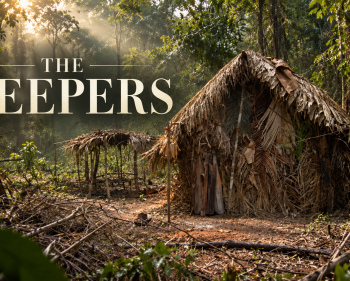
THE KEEPERS
(For the SoundCloud audio, scroll down)
On August 24th, 2022, an official of Brazil’s indigenous affairs agency, FUNAI, walked into a straw hut deep in the Amazon rainforest in the state of Rondônia. He found a man lying dead in a hammock, adorned with macaw feathers, “as if waiting for death.”
He was about sixty years old. No one knew his name and no one knew what language he spoke, or what his people had called themselves. The Brazilians called him the Man of the Hole, and he was believed to be the last of his tribe.
The Man of the Hole’s backstory is tragic, and fascinating. Most of his people were killed by settlers and ranchers in the 1970s. In 1995 illegal miners attacked the few who were left, and he was the only one to survive. When FUNAI found the remains of the village, it had been bulldozed.
For the rest of his life, more than a quarter of a century, the Man of the Hole lived entirely alone. He hunted, gathered honey, grew maize and cassava, and moved constantly. Over the years FUNAI found more than fifty huts he had built and abandoned. Inside every one of them was a hole, narrow and more than six feet deep – hence his name.
Nobody ever discovered what the holes were for. Perhaps they were traps, or hiding places. Perhaps they meant something only he could have explained, and now he was dead, he would never reveal their secret. What was clear is that he did not want to be found. When FUNAI left tools and seeds out for him, he generally ignored them.
But there is one part of the story that is the most fascinating detail of all. A small group of officials spent twenty-six years watching over a man who ignored them and wanted nothing to do with them. That group, who were determined to help him despite his indifference, persuaded the Brazilian government to set aside 8,000 hectares of forest as a protected territory for this single person.
They kept the ranchers out, and they kept their distance. Sometimes, when they came too close, the Man of the Hole signaled to them to avoid the pits he had dug. It was the nearest thing to a conversation they ever had.
In Parshat Bereishit, Cain kills his brother Abel in a field. God asks him where his brother is, and Cain gives the most famous evasion ever recorded (Gen. 4:9): הֲשֹׁמֵר אָחִי אָנֹכִי – “Am I my brother’s keeper?” God does not answer the question directly. Instead, He says this: “The voice of your brother’s blood cries out to Me from the ground.”
The Mishnah in Sanhedrin (4:5) notices something odd about the grammar. The verse does not say “your brother’s blood” in the singular, dam achicha. It says d’mei achicha, the plural – “your brother’s bloods.” The Mishnah explains: “his blood, and the blood of his descendants.”
Cain did not just kill Abel. He killed every person who would ever have descended from Abel. Every child, every grandchild, and every generation that would now never be born.
The Mishnah draws a dramatic conclusion: this was why Adam was created alone. To teach us that whoever destroys a single life is regarded as if he destroyed an entire world, and whoever saves a single life is regarded as if he saved an entire world.
It is a touching and beautiful idea, and for most of us slightly remote and otherworldly. But the Man of the Hole makes it literal. When the settlers and miners massacred his people, they were not only killing the people in front of them. They were killing a language, a way of life, a unique cultural milieu, a set of songs, and an explanation for why a man digs a six-foot deep hole in the floor of his house.
Which meant that when the Man of the Hole lay down in his hammock in 2022, an entire world ended with him, in exactly the way the Mishnah describes.
There is another detail in Bereishit that also comes into focus in light of this story, with a twist. Cain’s punishment was that he was destined to become “a restless wanderer on the earth,” never staying in one place, forced to wander from one location to another for the rest of his life.
The Man of the Hole lived with that same terrible fate for more than a quarter of a century, moving from hut to hut, and never staying anywhere for very long. Except that he was not Cain the killer – he was Abel, the brother. How is it that history has a nasty habit of handing Cain’s punishment to Abel?
Cain asks whether he is his brother’s keeper, and he clearly expects the answer to be no. He did not raise Abel, and on the face of it he was not responsible for him, nor did he sign up to watch over him. But the Torah’s reply, and the Mishnah’s explanation of it, is that every human being is a world, and the person standing nearest to that world is responsible for it – whether you chose the job or not.
The FUNAI teams did not know the man they were protecting. They could not speak to him, and he made it very clear he did not want them around. He never thanked them, and by any normal measure there was nothing in it for them, and no reason for them to watch out for him.
One of them, Bruno Pereira, who for a time headed FUNAI’s unit for isolated peoples, said somewhat whimsically that he believed the gifts they left for the Man of the Hole had “engendered a certain level of trust.”
Pereira never saw how the story ended. In June 2022, just two months before they found the Man of the Hole dead in his hut, while working with indigenous communities in another part of the Amazon, Pereira was murdered together with the British journalist Dom Phillips.
For more than a quarter of a century, a handful of strangers gave Cain’s question the answer the Torah wanted to hear. They were their brother’s keeper – literally.
Most of us will never be asked to guard a random man in a rainforest. But the same question pops up for us all the time, usually in smaller forms. The elderly neighbor no one has heard from in a while. The relative who has stopped answering calls. The person in shul who sits in the same seat every week and leaves without speaking to anyone.
They might not want our help, or even expect it – and if we give it to them they might not thank us for it, or acknowledge it. But that was never the point. Cain asked whether he was his brother’s keeper. In a forest in Brazil, a few strangers spent twenty-six years answering yes. And in our own lives, we must do the same, whenever we can.

(For the SoundCloud audio, scroll down) On August 24th, 2022, an official of Brazil’s indigenous affairs agency, FUNAI, walked into a straw hut deep in the Amazon rainforest in the... Read More