

There are some forms of ancient pagan worship described by classical rabbinic sources that are so bizarre you could be forgiven for assuming they were invented for comic effect.
The Talmud describes the worship of the Moabite god Baal Peor in particularly revolting terms. Its devotees relieved themselves in front of the idol. In one extraordinary story, a gentile woman who had recovered from a serious illness vowed to worship every idol in the world. But when she finally reached Peor and its priests explained what was expected of her, she exclaimed that she would rather become ill again than participate.
Another idol, referred to by Chazal as Markulis and identified with the Roman god Mercury, was worshipped by throwing stones at it. The Gemara goes further: even someone who threw a stone specifically intending to demean the idol had nevertheless performed its prescribed act of worship. The contempt itself became the ritual.
The conceptual point in Chazal is unmistakable: there were forms of worship in which something that looked like desecration was, perversely, the very act by which devotion was expressed.
These strange practices were at the forefront of my mind as I watched the United Nations General Assembly unfold in New York last week. The United Nations was created after the catastrophe of the Second World War with an almost breathtaking set of aspirations: international cooperation, the peaceful resolution of disputes, respect for sovereign nations, human rights, and the replacement of brute force by international law.
But measured against those lofty aspirations, the UN has repeatedly and conspicuously fallen short — and this year’s General Assembly theme effectively acknowledged that the institution has lost its shine: “Restoring Trust, Managing Transformation: A United Nations That Delivers for All.”
The problem is that there are moments when watching the United Nations feels uncannily like watching one of those ancient cults described by Chazal. Everyone insists the institution is sacred, but the accepted rituals seem increasingly designed to degrade it.
Argentina’s President Javier Milei provided perhaps the clearest Markulis moment of the week. Standing at the UN’s own podium, he declared that its “sacred covenant” had been broken. He called the organization “useless,” accused it of sustaining a caste of “fatally arrogant parasites” masquerading as well-intentioned bureaucrats, and argued that it had failed at precisely the responsibilities for which it was created.
One may agree or disagree with Milei’s broader politics, and certainly with his characteristically volcanic choice of language, but there was something almost surreal about the scene. Here was the president of a member state, participating in the institution’s grandest annual ritual, using its most prestigious platform to explain why the institution itself had forfeited its authority.
In other words, he was doing something remarkably similar to the worshippers of Markulis: throwing stones at the idol while taking part in its worship.
Then came António Guterres, delivering his final General Assembly address after almost a decade as Secretary-General, and providing a very different illustration of the same problem. Gaza is unquestionably a humanitarian catastrophe, but Guterres went much further, declaring that it represented “a scale of killing and destruction unlike anything I have witnessed in all my years as Secretary-General.”
Really? During Guterres’s tenure, Sudan has descended into what the United Nations itself calls the world’s largest humanitarian crisis, with nearly 34 million people requiring humanitarian assistance, millions displaced across borders, famine, systematic sexual violence, and credible allegations of the gravest international crimes. Ukraine has suffered years of invasion, bombardment, deadly violence, mass displacement and destruction. Other wars and atrocities have devastated populations on an enormous scale.
None of that minimizes what has happened in Gaza. But it does make an unqualified declaration of unprecedented destruction a strikingly subjective judgment from the man occupying an office whose authority depends on objectivity, consistency and proportion.
To my mind, this begins to resemble the second pagan ritual described by Chazal — Peor worship. The degradation of the institution is no longer being inflicted by a critic standing outside the temple and pelting it with stones. When the person who is supposed to embody universal moral authority appears to deploy that authority selectively, the desecration, so to speak, is defecation taking place at the altar itself.
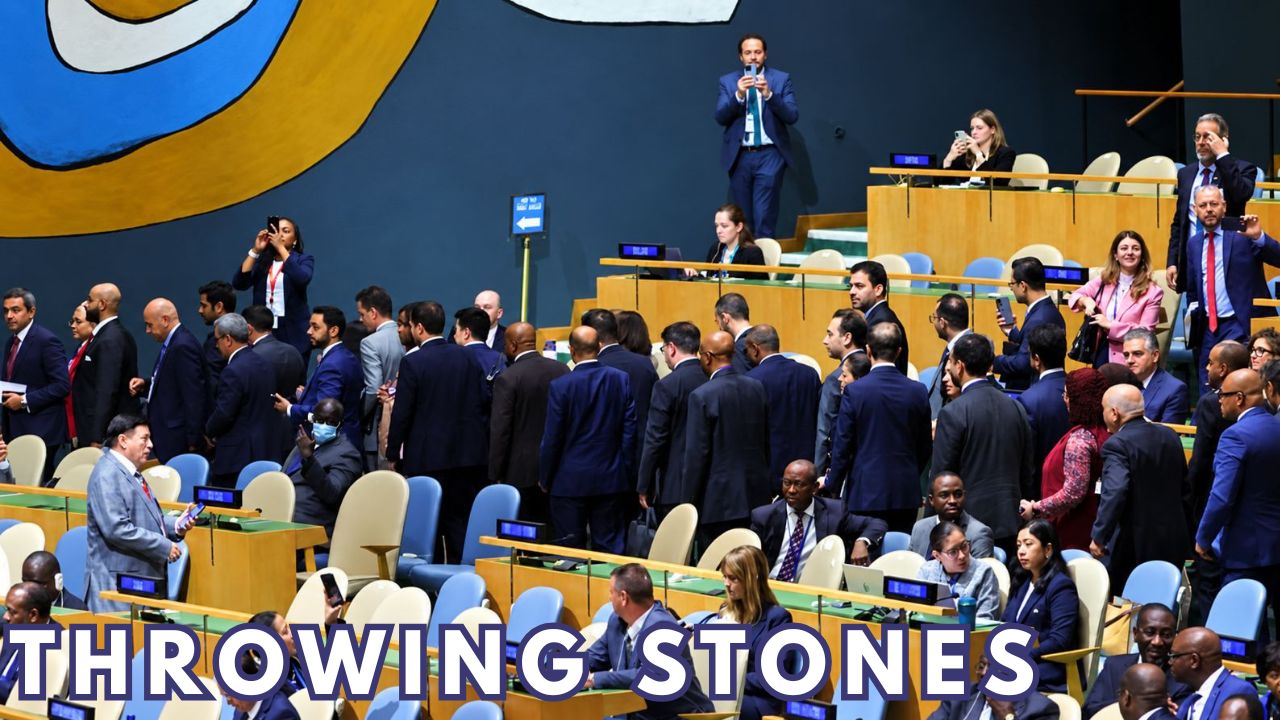
And then, Israeli Prime Minister Benjamin Netanyahu walked to the podium, and dozens of delegates stood up and streamed out of the chamber. Whatever one thinks of Netanyahu, his government, or Israel in general, the spectacle was an utter disgrace. Representatives of sovereign nations had assembled inside an institution whose foundational purpose is to provide a forum for dialogue, and yet they chose to express themselves by ceremonially refusing to listen.
The point is not that governments pursue their own interests at the United Nations. Of course they do. Nations have interests, alliances, enemies, domestic pressures and strategic objectives. The deeper problem begins when all of this is dressed up in sacred language.
Governments invoke the UN’s lofty ideals when it suits them, and disregard them when it does not. They appeal to the authority of resolutions they favor, and dismiss others as meaningless. They praise dialogue while walking out, extol institutional authority while denouncing the institution from its own podium, and invoke universal morality for causes that happen to dovetail with their own interests. It is a peculiar form of worship.
Meanwhile, Judaism has its own vision of the nations gathering together — and it appears precisely at this time of year, on Sukkot.
Over the seven days of Sukkot, the Torah prescribes a sequence of seventy bulls as festival offerings. The Gemara asks what they represent and gives an astonishing answer: they correspond to the seventy nations of the world.
Rashi goes further, explaining that these offerings were connected to the hope that rain would fall throughout the world, so that no nation would suffer from famine. At the very heart of the most joyous Temple season of the year, the Jewish nation made room for humanity beyond itself.
That is a very different kind of universalism. It does not require nations to pretend that they have no interests, and it certainly does not require peoples to abandon their identity. It begins with something much more honest: beneath all our power, rhetoric, weaponry and diplomacy, human beings remain dependent creatures living in the same world.
And perhaps that is why Sukkot ends as it does. After the seventy bulls comes Shemini Atzeret and a single bull, which Chazal understand as corresponding to Israel alone. The Gemara compares it to a king who holds a great banquet for everyone and then asks his closest friend to remain behind for a small private meal. Universal concern does not dissolve a particular identity. And perhaps that is the contrast worth contemplating this Sukkot.
The United Nations sits beneath an enormous emblem of the globe surrounded by olive branches. Its members solemnly invoke universal values – and then, with depressing regularity, use the institution as an arena for national grievance and political theatre, degrading it until it becomes an object of contempt.
Our earliest sages understood this very well: an institution can become so corrupted that throwing stones at it becomes part of the ritual, and repulsive degradation itself can masquerade as devotion.
But Sukkot proposes something better. Gather the nations. Remember what every human being needs. Be honest about who you are. And understand that universal values only mean something when they bind people together despite any individual interests.
Otherwise, you are not honoring the institution. You are simply throwing stones at the idol.