

YOUR DEPARTURE IS HARD FOR ME
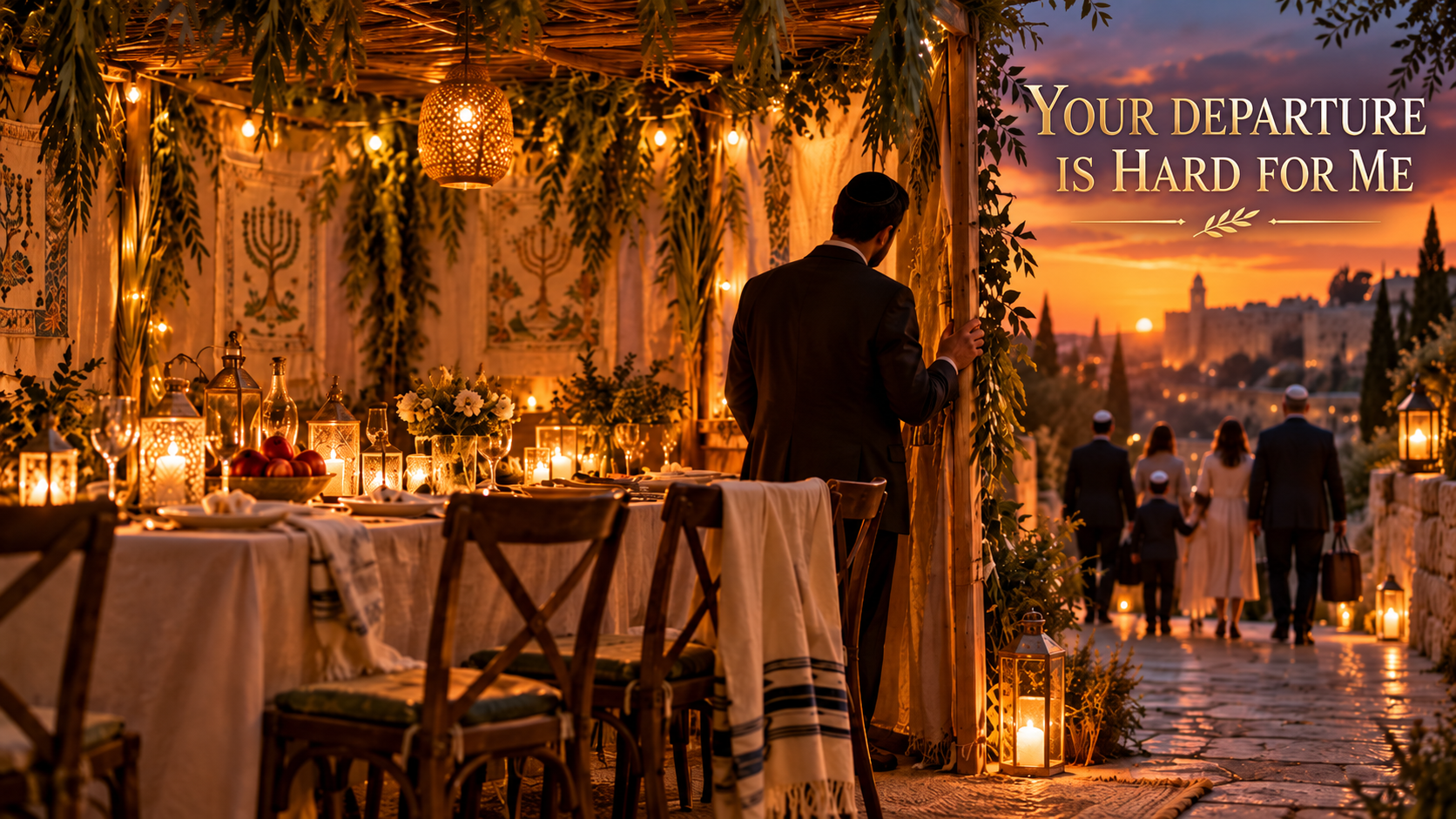
I want to start with a confession. Every year, by the time we get to Shmini Atzeret, I begin to feel a bit like a houseguest who’s overstayed his welcome.
We’ve had Rosh Hashanah, we’ve had Yom Kippur, we’ve had seven days of Sukkos, we’ve shaken the lulav until our wrists have given out, and we’ve eaten enough meals in the sukkah to feed a small army. By the time Hoshana Rabbah comes round, most of us are ready to go back to normal life.
And then the Torah says (Num. 29:35) not yet – ביום השמיני עצרת תהיה לכם. There is an eighth day, and it has no lulav, no sukkah, no shofar and no special activities. Nothing to do, really. You just have to turn up.
Rashi, quoting the Midrash, explains why. A king made a feast for his children that went on for several days. When the time came for them to leave, he said to them, “My children, I beg you, stay with me one more day, kasheh alai preidatchem – your departure is hard for me.”
Rashi even reads the word “atzeret” in that light, from the root “atzar,” to hold back: atzurim atem etzli, I am keeping you here with me.
There is something wonderful about this. We usually think of the relationship between God and the Jewish people as one in which we do all the asking. We ask for life, for health, for parnassah, for a good year, and we spent the whole of Yom Kippur doing nothing else.
But on Shmini Atzeret the roles are reversed. Hashem is the one asking, and what He asks for is very modest. He doesn’t want another korban or another mitzvah. He just wants another day with us.
The Midrash adds a lovely detail. All through Sukkot, seventy bulls were offered in the Beit Hamikdash on behalf of the seventy nations of the world. Sukkot is an international festival, a grand state banquet with the whole world invited.
On Shmini Atzeret there is just one bull, and God says, in effect, “Now that the guests have gone home, make Me a small meal, just you and Me.”
Anyone who has hosted a large celebration knows the feeling. The best part of the wedding is often the hour afterwards, when the guests have gone, the band has packed up, the caterers are stacking chairs, and the family sits round one table just chatting. That hour is Shmini Atzeret.
On Shmini Atzeret we also have Yizkor. And Yizkor is the same idea, with a twist.
The people we remember at Yizkor have left the party, but they haven’t left our lives or our consciousness. We’re not ready to let them go, and so, four times a year, we do what the King does. We say to them: stay with us a little longer. Kasheh alai preidaschem. Your parting is hard for me.
We stand in shul, we close our eyes, and for a few minutes we spend time with them. No speeches, no crowds, just a few moments with a parent, a spouse, a child, a friend.
God holds on to us on Shmini Atzeret because He loves us, and we hold on to our departed loved ones at Yizkor for exactly the same reason.
But after October 7 2023, Shmini Atzeret has a second meaning that none of us can ignore, or ever forget.
In Eretz Yisrael, Shmini Atzeret and Simchat Torah fall on the same day. Three years ago, on 22 Tishrei, the very day the King says “stay with Me one more day”, our people suffered one of the worst pogroms in our bloodstained history. Twelve hundred souls were murdered and 251 were dragged into Gaza.
They were murdered at a music festival, in their beds in Kfar Aza and Be’eri, in safe rooms that turned out not to be safe, and on the streets of towns close to the Gaza border.
So when we say Yizkor today, we are saying it on the actual Hebrew yahrzeit of October 7th. The real yahrzeit is today, and there is something unbearable, and also somehow very fitting, about that.
The day built around the words kasheh alai preidatchem has become, for Jews in Israel and across the world, the day of the parting they will never get over.
I’ve noticed over the past three years during my many visits to Israel that people there don’t talk about October 7th as something that happened in the past. They say “the seventh of October” the way you’d talk about a relative who has moved in and refuses to leave.
It took more than two years of fighting, negotiating, and praying before the hostages came home. There are parents who have learned to live with an empty chair at the table, and young widows who now know far more about military cemeteries than anyone should ever know.
For them, Yizkor isn’t four times a year. It happens every morning when they wake up, and every night when they go to bed.
So today we hold them close as well. We hold the victims of the seventh, the hostages who did not come home alive, the soldiers who fell in Gaza and Lebanon and everywhere else in the years since, and the families in Israel who, a few hours ago, said the same words we are about to say.
Kasheh alai preidatchem. We are not letting go. We are never letting go.
And then, just to make sure we didn’t arrive at this yomtov with any illusions, Wednesday happened.
I imagine everyone knows the story by now. Flydubai flight 1073 left Dubai for Tel Aviv on Wednesday morning, Chol Hamoed Sukkos, with about 170 passengers on board, almost all of them Israelis. Many were families coming home for the end of Yom Tov.
A little more than an hour from Ben Gurion, the co-pilot, an Omani national who had been working for the airline for only eight months and who, as it turns out, had undergone radical Islamist indoctrination, attacked the captain in the cockpit, stabbing him repeatedly, and tried to bring the plane down.
The aircraft dropped more than seventeen thousand feet in under two minutes.
Now listen to how disaster was averted.
A mother, Tali Manes, took her six-year-old daughter to the toilet at the front of the plane. Any parent will tell you that six-year-olds have an unfailing instinct for needing the toilet at the least convenient moment, especially when you’re on a plane. This time it was the most convenient moment in the history of aviation.
Standing by the cockpit, Tali heard shouting and the sounds of a struggle, and she alerted a flight attendant. That’s the first link in the chain.
The captain, Smit Machchhar, a young man from Mumbai, had been stabbed and was losing a lot of blood. Somehow, before he collapsed, he managed to reach the cockpit door and open it.
Since 9/11 airlines have spent billions making cockpit doors impossible to open from the outside. The only person on earth who could open that door was a pilot bleeding badly on the floor of the cockpit, and he did it.
Afterwards he said, “I was not going to let others die.” That’s the second link.
Through the door came a group of Israeli passengers. One of them, Tzvika Manes, is the husband of the woman at the toilet and the head of an investment bank. Another, Yaniv Hayoun, is a plumber.
Yaniv put the attacker in a chokehold, dragged him out of the cockpit, and then, with the plane still falling, took hold of the controls and pulled back.
When the Prime Minister asked him how on earth he knew what to do, he said, “I watch Air Crash Investigation, Mr Prime Minister. Really.”
I have spent thirty years telling my children that TV rots the brain. I now have to admit, in public and on Yom Tov, that I may have overstated my case. Watching mind-rot on TV was one of the reasons 170 people are alive today. Go figure.
They tied the hijacker up with cables from the in-flight headphones, which I believe is the first time anyone has found a use for those headphones. A dentist on board, Dr Shota Musaev, kept the captain alive with oxygen and blankets.
And sitting in row six were two more pilots, travelling as passengers, who took over the controls and landed the plane safely. Where did they land it? In Tabuk, in Saudi Arabia.
If you had told the passengers at take-off that by lunchtime they would be grateful to be on the ground in Saudi Arabia, I think they might have thought you’d lost your mind.
A plumber, a banker and a dentist walk into a cockpit. It sounds like the start of a joke, but in fact it’s the start of Hallel.
Every one of those links had to hold. If the little girl hadn’t needed the toilet, if the captain had blacked out a minute earlier, if the plumber had spent his evenings watching football instead of Air Crash Investigation, if those two pilots had taken the next flight – then this morning there would be 170 more names for Yizkor.
One analyst on CNN called it “nothing short of a miracle.” He meant it as a figure of speech. We don’t.
Some of you will remember Entebbe in 1976. To rescue the hostages from that Air France plane, Israel sent a hundred elite commandos on a 2,500-mile flight into the heart of Africa, and it cost us Yoni Netanyahu.
This week the rescue force was a mother, a six-year-old, a plumber, a dentist, a banker and a wounded Indian captain who refused to give up. Chazal have a wonderful line in the Midrash on Shir Hashirim. God says to the Jewish people, פתחו לי פתח כחודו של מחט ואני אפתח לכם פתחו של אולם – “open for Me an opening no bigger than the eye of a needle, and I will open for you an opening wide enough for wagons and carriages to drive through.”
On Wednesday a bleeding man opened a door just a crack, and through that tiny crack came the hand of God.
So what does any of this have to do with Shmini Atzeret and Yizkor?
Three years ago, on this very day, our enemies tried to bring about the greatest possible parting, and in too many homes they succeeded.
On Wednesday, three days before the yahrzeit, they tried again, and this time, through a chain of small miracles, the King said: no. Kasheh alai preidatchem. I am not ready to part with these children. Not these 170. Not today. They will be home for Yom Tov.
The Ribbono shel Olam holds on to us. That’s the message of Shmini Atzeret. He held on to 170 Jews in the skies this week, and He has been holding on to the Jewish people since the days of Pharaoh and Haman, through the Crusades and the Spanish expulsion and Chmielnitzki, through Auschwitz and through October 7th.
He doesn’t always prevent the parting. We know that, and the people we remember at Yizkor are the proof. But He never lets go of us entirely, and He is always asking us for one more day.
Which is precisely what we are about to do for the people we love.
In a moment the shul will go quiet, and each of us will be together with our loved ones, just for a few moments. Your mother might be there, or your father, or a husband or wife. For some, God help them, it will be a child.
Some of us will also make room for a young man from the Nova festival, or a grandmother from Nir Oz, or a soldier who never came home – people we never met and whose names we only learned because of how they died.
Don’t hurry them out. Don’t simply read the words on the page and sit down. Tell them about your year: who got married, who was born, what worried you, what you got wrong and what you got right.
Tell them that every one of the hostages has come home – some to their families, and some to be buried in the land they loved. Tell them that on Wednesday a plane full of Jews was falling out of the sky, and a plumber saved them.
And then, as the King said to His children, say to them: kasheh alai preidatchem. It’s hard for me to let you go. Stay with me just a little longer.


(For the SoundCloud audio, scroll down) There are some forms of ancient pagan worship described by classical rabbinic sources that are so bizarre you could be forgiven for assuming they... Read More