

THE HORSE THAT KNEW TOO MUCH
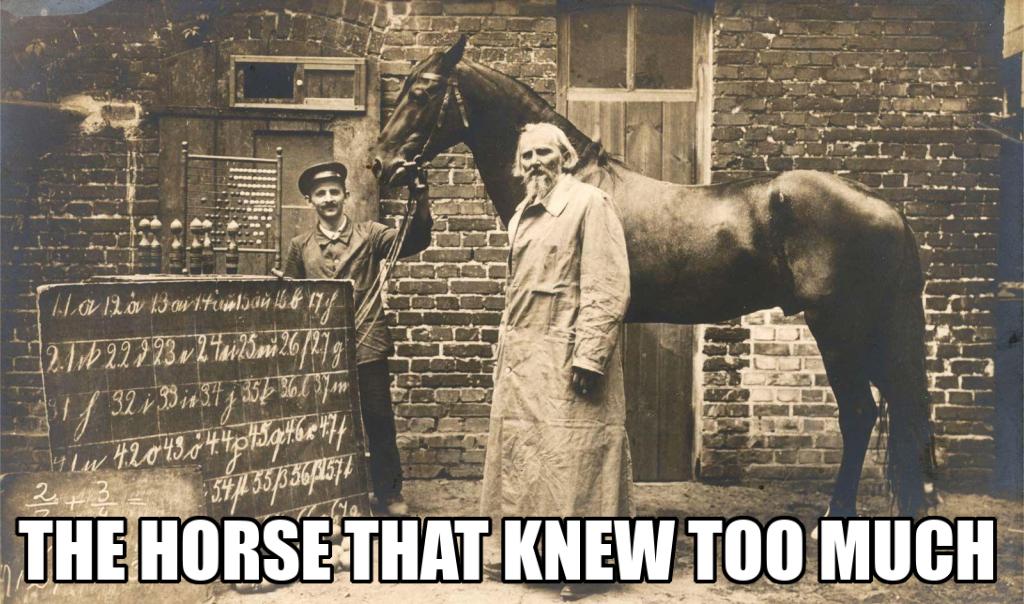
At the beginning of the twentieth century, Germany had a celebrity unlike any other.
His name was Hans. He could add and subtract. He understood fractions. He could tell you the day of the week corresponding to a particular date. He could recognize musical notes, distinguish colors, spell words, and answer questions about German history.
There was only one slight problem. Hans was a horse.
Hans’ owner, Wilhelm von Osten, was a retired mathematics teacher from Berlin. At some point, he became convinced that animals were considerably more intelligent than human beings gave them credit for. So he set out to educate his horse using roughly the same methods he had used to teach children in the classroom.
And apparently, it worked. If you asked Hans what three plus four was, he would tap his hoof seven times. Ask him to divide twelve by three, and four taps followed. Letters could be converted into numbers, allowing him to spell. He could even answer questions asked by complete strangers.
The people of Germany were enthralled. Crowds gathered to see the extraordinary animal, who inevitably became known as “Clever Hans.”
And the really impressive part was that von Osten did not charge any money for people to see Hans. There appeared to be no financial scam. Nor, as far as anyone could tell, was he secretly signaling the answers. Hans seemed to be exactly what von Osten said he was: a clever, educated horse.
In 1904, an official commission was convened to investigate. It included academics, teachers, a vet, a horse trainer, and even a circus manager—presumably on the sensible assumption that if anyone could spot a trick involving a horse, it would be someone from the circus.
Oddly, they found no fraud. Then a young psychologist named Oskar Pfungst began looking more carefully. And he soon noticed something peculiar. Hans was remarkably good at answering questions when the person asking the question knew the answer. But when the questioner did not know the answer, Hans suddenly became rather less impressive.
Even more suspiciously, if Hans could not see the questioner, his mathematical abilities collapsed almost completely.
In Pfungst’s experiments, Hans was correct almost 90 percent of the time when he could see someone who knew the answer, but only around 6 percent when the questioner did not know it.
Eventually, Pfungst worked out what was happening. Hans would begin tapping. One. Two. Three. As he approached the correct answer, the person watching him would unconsciously tense up. A slight movement of the head. An imperceptible change in posture. Raised eyebrows. Perhaps a fractional intake of breath.
Then, at exactly the right number, all the tension disappeared. It was at that point that Hans stopped tapping.
The extraordinary mathematical horse was not doing mathematics at all. He was reading the room. Which, in a way, may actually have been even cleverer—but we will leave that discussion for another time.
In any event, the phenomenon became famous as the “Clever Hans effect”: human beings communicate far more through unconscious movements and expressions than they realize, and a sufficiently observant person—or horse—can learn to pick up the signals.
And guess what: that is how mentalists do what they do.
I have always loved watching a good mentalist. Someone stands on a stage and tells a complete stranger the name of their childhood best friend, the city they are thinking about, or the number they have written inside an envelope. And everybody gasps.
“How could he possibly know that?”
Well, I am about to reveal one of the great secrets of mentalism. Are you ready? The mentalist probably doesn’t know it. At least, not in the way you think he knows it.
There is no single method. Mentalists use an arsenal of techniques: observation, suggestion, misdirection, information gathered beforehand, carefully constructed choices, and an extraordinary sensitivity to tiny reactions.
Some techniques involve what is called “cold reading”—making educated observations and then narrowing them according to the reaction they produce. Others use “muscle reading,” detecting tiny involuntary movements in someone’s body.
Psychologists sometimes describe this as an ideomotor response: thoughts and expectations produce minute muscular movements without our consciously intending them.
You can actually experience this at home. I’ll give you some homework.
Take a ring and suspend it from a piece of thread. Hold the thread between your fingers, with the ring hanging absolutely still. Now stare at the ring and vividly imagine it moving from side to side.
Do not deliberately move your hand. Just imagine it. After a little while, there is a good chance the ring will begin to swing.
Now focus on the ring and think about it moving in a circle. Very often, it will begin doing that too.
Nothing supernatural has happened. Your hand has made movements so tiny that you were unaware of making them, while the suspended ring amplified them into something visible.
Now imagine that instead of staring at a ring, you have spent years training yourself to notice microscopic movements in somebody else. Suddenly, mentalism does not look quite so impossible.
You may be wondering, why does any of this matter? Simple: because human beings are astonishingly vulnerable to spectacle. If you show us something we cannot immediately explain, our critical faculties begin to soften. We assume that if someone knows something they could not possibly know, then whatever else they say must also deserve our attention.
Parshat Re’eh warns us against this very instinct. The Torah describes a prophet or dreamer who appears and announces that he can produce an אוֹת אוֹ מוֹפֵת—a sign or wonder (Deut. 13:2).
And then the Torah says something quite remarkable: וּבָא הָאוֹת וְהַמּוֹפֵת אֲשֶׁר דִּבֶּר אֵלֶיךָ – The sign happens.
The prediction comes true!
This is not some ridiculous charlatan whose prophecy fails. They tell you something will happen, and then it happens.
And nevertheless, the Torah tells us that if the person uses this dazzling performance to lead the Jewish people away from God and from Torah: לֹא תִשְׁמַע אֶל דִּבְרֵי הַנָּבִיא הַהוּא – Do not listen to them.
Why is the Torah telling us this? What’s the message?
Truthfully, this is one of the most powerful lessons we could ever learn, because it is a message contained within a message.
Think about how counterintuitive this instruction is. We instinctively believe that if someone predicts something and it happens, the result validates the person who produced it.
But the Torah says: absolutely not. A prediction can come true—and the prophet can still be false. A guru can identify your problem accurately—and offer you a disastrous solution. A charismatic leader can say something astonishingly perceptive—and still be leading you over a cliff.
The Rambam makes this point with breathtaking force. He says that the Jewish people did not believe in Moses because Moses performed miracles. Miracles are inherently ambiguous. They can dazzle, and at the same time they can confuse and deceive.
The foundation of Moses’ authority was Mount Sinai—the national encounter in which the Jewish people themselves experienced revelation. Consequently, there is no room for someone to arrive later with an impressive wonder and use it to overturn what was established at Sinai.
The Torah’s first message is simple: we are not only vulnerable to people who play tricks with our minds—we are even more vulnerable to people who play tricks with our souls.
Every generation produces religious personalities who announce that the old way is no longer enough. They have discovered something deeper. Something more spiritual. Something more authentic. Something that nobody quite understood until they arrived.
And usually there is great excitement attached to it. A new language. Dramatic claims. Dynamism that is invigorating. A sense that ordinary religious life is somehow pedestrian, while this new approach offers access to something electrifying.
Which brings us to the second message that is contained in the first, and here it is: Being a good Jew is a bit unglamorous. Because, do you know what God wants us to do? Keep the mitzvot. That’s it.
Observe Shabbat. Eat kosher food. Give charity. Pray. Study Torah. Be honest in business. Treat people decently. Honor your parents. Build a Jewish home.
It is, in one sense, terribly boring. There are no horses doing arithmetic. No dashing mentalist guessing the name of your childhood best friend. No prophet performing miracles and then unveiling the secret spiritual system that will change everything.
Just mitzvah after mitzvah, day after day.
And yet, in another sense—and this is the message—there is something exhilarating about a Judaism that does not need constant reinvention.
Because Judaism’s claim is that holiness does not depend upon constantly manufacturing moments of astonishment. Holiness emerges from transforming ordinary life, consistently and patiently, according to God’s will.
We do not need to reinvent the wheel.
That does not mean Judaism should become stale. Every generation needs translation. Every generation needs new teachers, new language, new melodies, new books and new ways to communicate eternal ideas.
Packaging matters. Rebranding sometimes matters. If young Jews no longer understand the language we are using, then we need to find another language.
But there is an enormous difference between repackaging the product and replacing it. The Torah can be presented differently. It cannot become something different.
Clever Hans gave the right answers without understanding the questions. Mentalists can create the overwhelming impression that they know things they do not know. And a false prophet can even produce a sign that seems to give them supernatural powers.
Parshas Re’eh tells us not to be dazzled by any of it.
We do not measure truth by how impressed we are. We measure it against the covenant we already possess.
And we always need to remember that something can come true – and still not be the truth. That is the real message of the Navi Sheker, and it is a message we all need to hear.


(For the SoundCloud audio, scroll down) On August 24th, 2022, an official of Brazil’s indigenous affairs agency, FUNAI, walked into a straw hut deep in the Amazon rainforest in the... Read More