

DON’T GO OVERBOARD
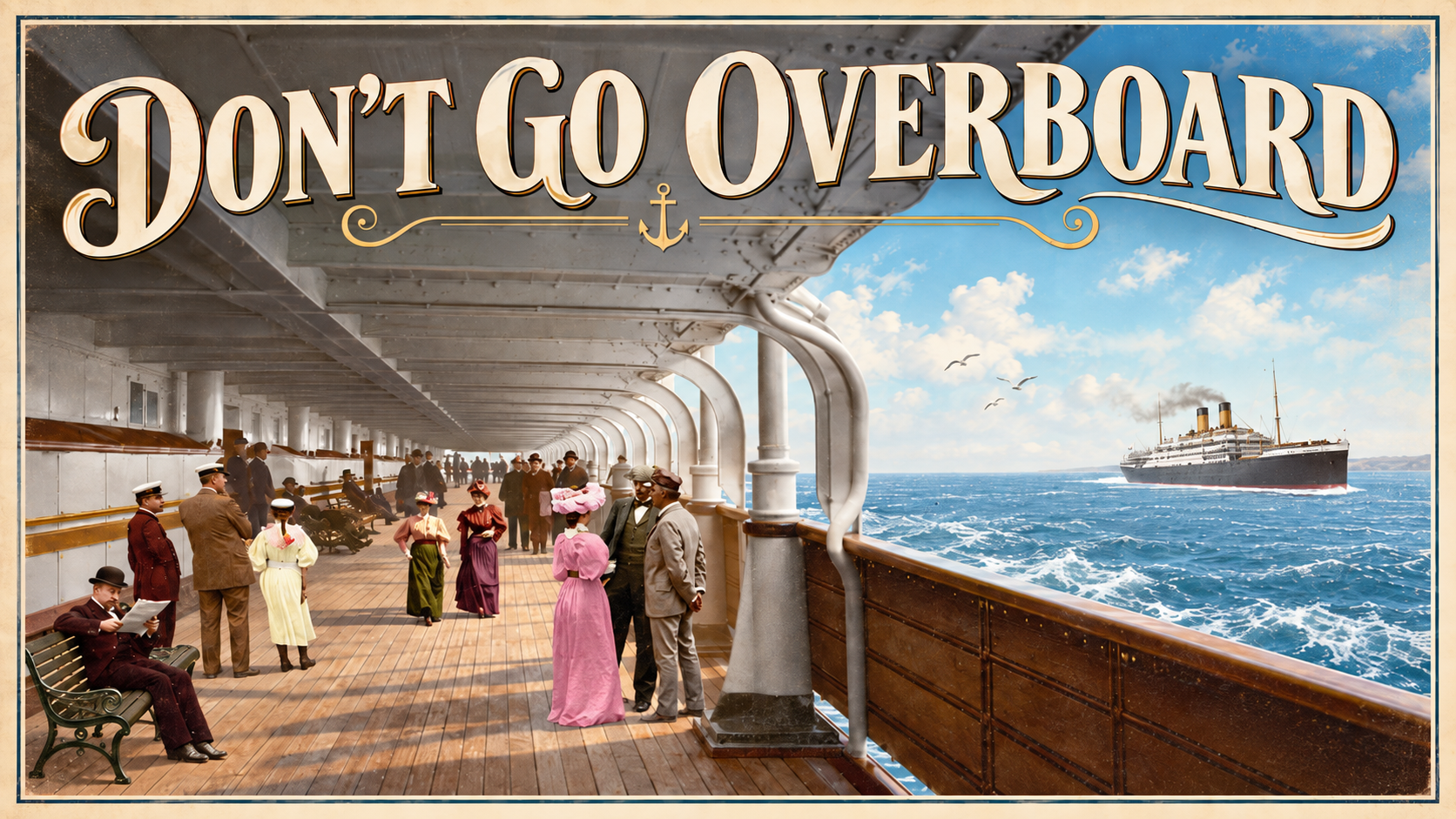
When Barnett Isaacs stepped off the boat at Cape Town in 1873, his entire commercial inventory consisted of forty boxes of cigars. He was twenty-one, raised in a slum in London’s East End, where his father dealt in second-hand clothes, closed the shop on Shabbat, and taught his sons to box in the yard. The cigars were his brother-in-law’s idea. Luxuries were scarce at the mines in South Africa.
The family scraped together his passage, a relative throwing in a silver chain to cover the shortfall. At the Cape he paid £5 for a seat on an ox-wagon and spent two months reaching the diamond fields at Kimberley.
He arrived with another useful asset: a knack for self-invention. As teenagers, he and his brother had worked the music halls billed as “The Great Henry Isaacs — and Barnett too,” until Barney suggested they compress “Barnett too” into “Bar-na-to.” Barnett Isaacs became Barney Barnato.
Kimberley was famous for its diamonds, but Barnato knew nothing about them. His cousin told him he couldn’t tell a diamond from a glass eye. So he sold his cigars, performed in the beer tents, took paid beatings as a booth boxer, and almost as an afterthought set himself up as a diamond dealer: a trestle table, scales, pliers, and a magnifying glass.
Every day he traipsed through the red dust buying rough stones from the diggers’ sorting tables, an occupation known as kopje-walloping. And while he walloped, he noticed something. When the diggers reached the hard blue layer beneath the soft yellow ground, many assumed the diamonds had run out and sold up. Barnato came to the opposite conclusion. The blue ground was not the end of the deposit. It was the heart of it.
So he bought the ground other men had written off. Within a dozen years he owned one of the largest and richest diamond mines on earth. For a decade he was locked in a commercial war with Cecil Rhodes, who had the Rothschilds behind him and was not a man people picked fights with.
The dispute ended in 1888 with a deal. Rhodes absorbed Barnato’s company into De Beers, paying him with a check for £5,338,650 — the largest check ever written until then. Barnato walked away immensely rich, and with a lifetime seat on the board of the conglomerate that had spent years trying to defeat him.
Then gold was discovered on the Witwatersrand, and Barnato did it all again. By 1895 he was reputedly earning £5 a minute and building himself a palace on London’s fashionable Park Lane. The Jewish boy from the East End slums had become one of the wealthiest men in the British Empire.
And then something changed. In 1896 his bank collapsed. Barnato, the man who had cheerfully absorbed punches for money and gambled fortunes against Cecil Rhodes, became depressed and frightened, talking obsessively about bankruptcy and his “enemies.”
The strange thing was that he was not actually ruined. De Beers was flourishing, the rand had steadied, and his fortune remained enormous. His doctors ordered a rest. In June 1897 he sailed for England with his wife, three small children, and his nephew Solly Joel. At ten past three on the afternoon of 14 June, off the coast of Portugal, Barney Barnato went over the rail into the Atlantic.
The inquest sat four days later and returned a verdict of drowning while temporarily insane. The verdict was controversial, and not without reason. There had been no autopsy. Solly testified that he had shouted “murder” as he went over — an odd word to use when falling overboard by accident. And a ship’s officer whom Solly described as dozing in a deck chair nonetheless testified that he had watched Barnato jump, and was later given £1,000 by the family.
Barnato was forty-six. The Park Lane mansion was completed without him and eventually bought by Sir Edward Sassoon, whose wife was Aline de Rothschild. And so, the great house built with money Barnato had taken off Cecil Rhodes ended up occupied by the family that had bankrolled Rhodes against him.
Every Yom Kippur we chant a paragraph that reads almost like a summary of Barnato’s life: מִי יֵעָנִי וּמִי יֵעָשֵׁר, מִי יִשָּׁפֵל וּמִי יָרוּם — “Who will be poor and who will be rich; who will be brought low and who raised high.” Barnato managed all four in a single lifetime.
We tend to hear Unetaneh Tokef as a catalogue of potential catastrophes and hopeful aspirations. But it isn’t. It is a list of pairs. Who will live and who will die. Who in their time and who before their time. Who will rest and who will wander. The point is that nobody knows in advance which side of the pair they will occupy — and the side we occupy this year may not be the side we occupy next year.
But there is a small detail in the way the paragraph ends that changes everything. In older manuscripts, every pair runs in the same direction: good first, bad second. Which meant that the sequence originally ended in a dark place.
At some point the final pairs were reversed, and the prayer we say today closes differently: not with impoverishment but enrichment; not with being brought low but with being raised high. Those who transmitted the prayer could not alter the decree. But they could alter the word we are left holding when the music stops.
It is more than a cosmetic edit. If the man on top cannot assume he will remain there, neither can the man at the bottom. The same uncertainty that makes arrogance foolish also makes pessimism irrational. Despair is what happens when we take the bad half of an unfinished pair and write it into the ledger as though next year has already ended.
Which is why the most famous line of Unetaneh Tokef is so important: “Repentance, prayer and charity avert the evil of the decree.” The words do not promise to erase the decree. They speak of averting its evil. A decree and a catastrophe are not necessarily the same thing. And the space between them is precisely where everything we do right now comes into play.
We cannot determine whether illness will disappear, money will return, relationships will mend, wars will end, or the things we fear will not happen. Yom Kippur offers no such bargain. It tells us something else: uncertainty cuts both ways.
The future is unknown when we are comfortable, which is why we should never be complacent. But it is equally unknown when we are frightened, which is why we should never surrender to despair.
Barney Barnato made his fortune from one astonishing insight. Everyone else reached the hard blue ground at Kimberley and concluded that the diamonds had run out. Barnato looked at the same ground and wondered whether what appeared to be the bottom might actually be the beginning of something richer.
He understood it about the earth. Tragically, when darkness descended on his own life, he could not understand it about himself. He saw the blue ground and thought he had reached the bottom.
But that is precisely what Unetaneh Tokef refuses to allow us to do. We do not know which half of any pair awaits us. That may be frightening when things are good. But when things are bad, it is also a reason for hope. The year ahead is unwritten. The ledger is still open. Where we find ourselves today is not necessarily where we will find ourselves tomorrow, or in a year.
So let’s leave Yom Kippur as those ancient transcribers taught us to leave it: without guarantees, without knowing what the year will bring, but refusing to end on a negative.

(For the SoundCloud audio, scroll down) On August 24th, 2022, an official of Brazil’s indigenous affairs agency, FUNAI, walked into a straw hut deep in the Amazon rainforest in the... Read More