

DON’T CROSS THE LINE
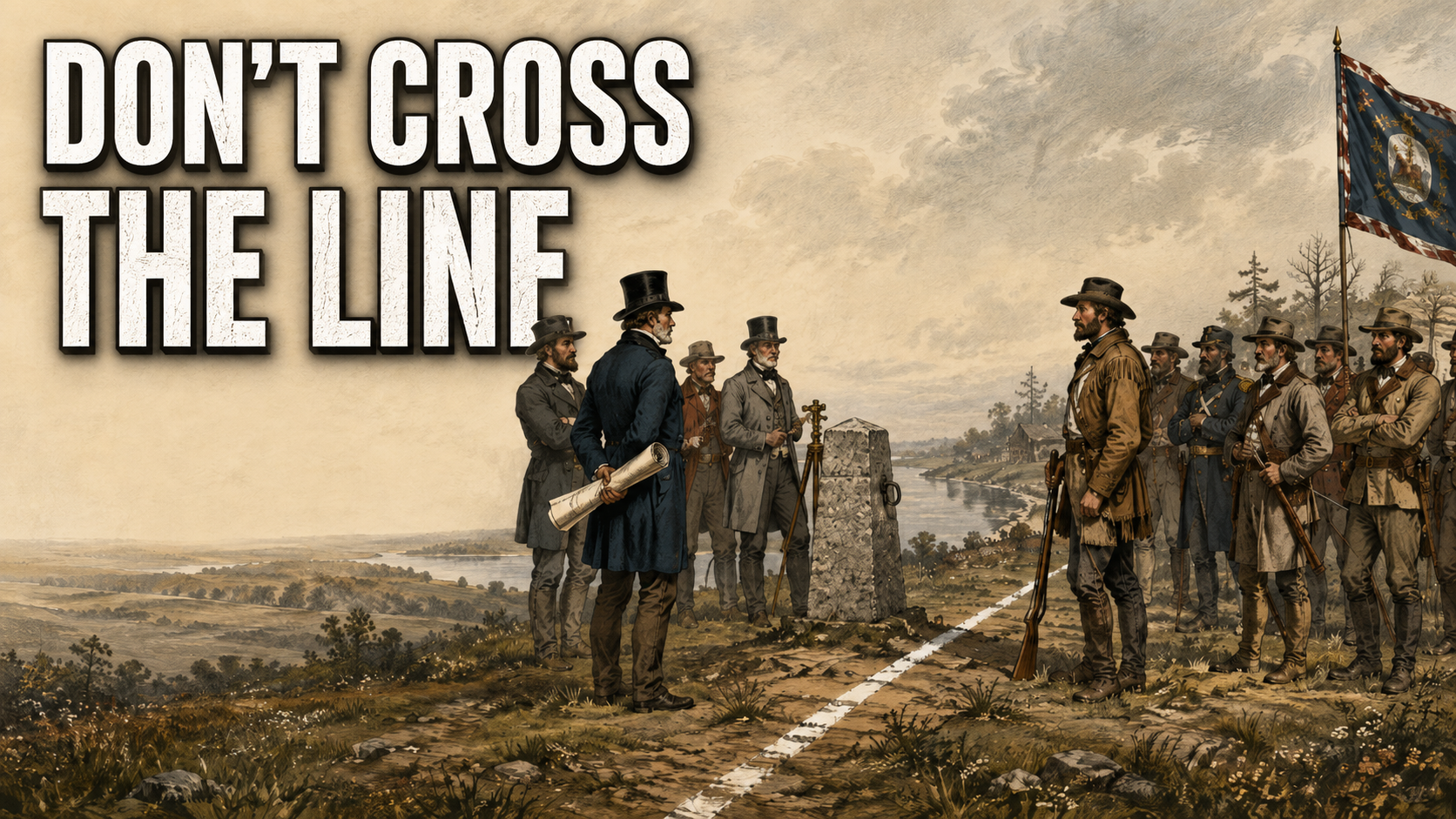
In 1835, Ohio and Michigan almost went to war. Not metaphorically. They actually mobilized militias.
The dispute concerned a narrow piece of territory containing the city of Toledo. Because of inaccurate eighteenth-century maps and conflicting interpretations of where the boundary was supposed to run, both Ohio and the Michigan Territory claimed the same strip of land.
Ohio’s governor, Robert Lucas, was determined to keep it. Michigan’s territorial governor, Stevens T. Mason, was twenty-two years old, and was equally determined not to surrender it.
Mason mobilized several hundred men. Ohio prepared a much larger militia force. Michigan arrested Ohio officials and captured surveyors. Shots were fired over people’s heads.
Although, during the entire “Toledo War,” the only serious injury appears to have occurred when a man with the splendid name Two Stickney stabbed a Michigan sheriff during a pub brawl.
Eventually President Andrew Jackson intervened. Ohio got Toledo. Michigan received most of what is now its Upper Peninsula as compensation and became a state in 1837. In retrospect, Michigan probably did rather well out of the deal, considering the enormous mineral wealth of the Upper Peninsula.
But the whole absurd confrontation was about one thing: Where is the line?
Parshat Shoftim contains a mitzvah that seems almost pedestrian compared with judges, kings, prophets and warfare (Deut 19:14): לֹא תַסִּיג גְּבוּל רֵעֲךָ – “Do not move your neighbor’s boundary.”
In the simplest sense, the Torah is talking about property markers. Your neighbor owns a field. There is a stone marking where his property ends and yours begins. You wait until nobody is looking, move the stone a few feet into his field, and suddenly your property has become slightly larger.
But there is something deeper here. We often think boundaries create conflict. If only there were fewer boundaries, we imagine, people would get along better.
The Torah understands the opposite. Good boundaries prevent conflict.
A boundary tells me where I end, and you begin. It tells me what belongs to me and what belongs to you. It allows us to stand next to each other without constantly fighting over the same territory.
And this is true far beyond real estate. Every healthy life requires boundaries.
There are boundaries in relationships. Things you can say and things you should not say. Questions you are entitled to ask and matters that are simply none of your business.
There are boundaries with money. Mine is mine; yours is yours. Your generosity does not give me a permanent claim on your resources.
There are boundaries with children. Loving them does not mean controlling every decision they make for the rest of their lives.
There are boundaries at work. A career can be enormously important without being entitled to every hour of your day.
And there are boundaries even within ourselves. Not every thought needs to be spoken. Not every desire needs to be satisfied. Not every opportunity needs to be pursued.
Modern culture often tells us that freedom means eliminating boundaries. The Torah says that without boundaries there is no freedom, because eventually the strongest person simply takes over everybody else’s space.
Shalosh Seudos is the strangest time of Shabbat. The day is almost over, but not quite. The light is changing. Soon we will make Havdalah and recite: הַמַּבְדִּיל בֵּין קֹדֶשׁ לְחוֹל – God distinguishes between sacred and ordinary.
Notice that holiness itself depends upon a boundary. Shabbat is holy because it has edges. It begins. It ends. For twenty-five hours we inhabit sacred time, and then we cross back into the week.
If Shabbat simply blurred endlessly into Tuesday and Wednesday, it would cease to be Shabbat. The boundary does not diminish its holiness. The boundary creates the space in which holiness can exist.
And the same is true of our lives. Sometimes the most loving word is “yes.” But sometimes the most loving word is “no.”
Sometimes generosity means giving more. Sometimes wisdom means recognizing that we have already given enough. Sometimes commitment means opening the door. Sometimes dignity requires closing it.
The challenge is knowing where to place the line.
The people of Ohio and Michigan nearly went to war because neither side could agree where one jurisdiction ended and the other began. And although most of us are unlikely to mobilize a militia over our backyard fence, plenty of unnecessary pain in life begins when boundaries become unclear.
We intrude where we should step back.
We surrender ground we should protect.
We allow work to invade family, resentment to invade friendship, other people’s expectations to invade our sense of responsibility, and the noise of the outside world to invade every private corner of our lives.
Parshat Shoftim reminds us that boundaries are not an unfortunate limitation on life.
They are part of what makes a healthy life possible.
When shabbat is over, we make Havdalah, and the distinction between sacred and ordinary will become explicit once again. But perhaps the goal is not simply to mourn the boundary as Shabbat leaves. It is to learn from it.
Because the people who know where to draw the right lines are the people who create the space for what really matters to flourish.

THE FESTIVAL OF THE TEMPORARY HOUSE
(For the SoundCloud audio, scroll down) Sukkot begins with a flimsy hut and ends with dancing around a Torah scroll. In between come the four species, Kohelet, Hoshana Rabba, Shemini... Read More