

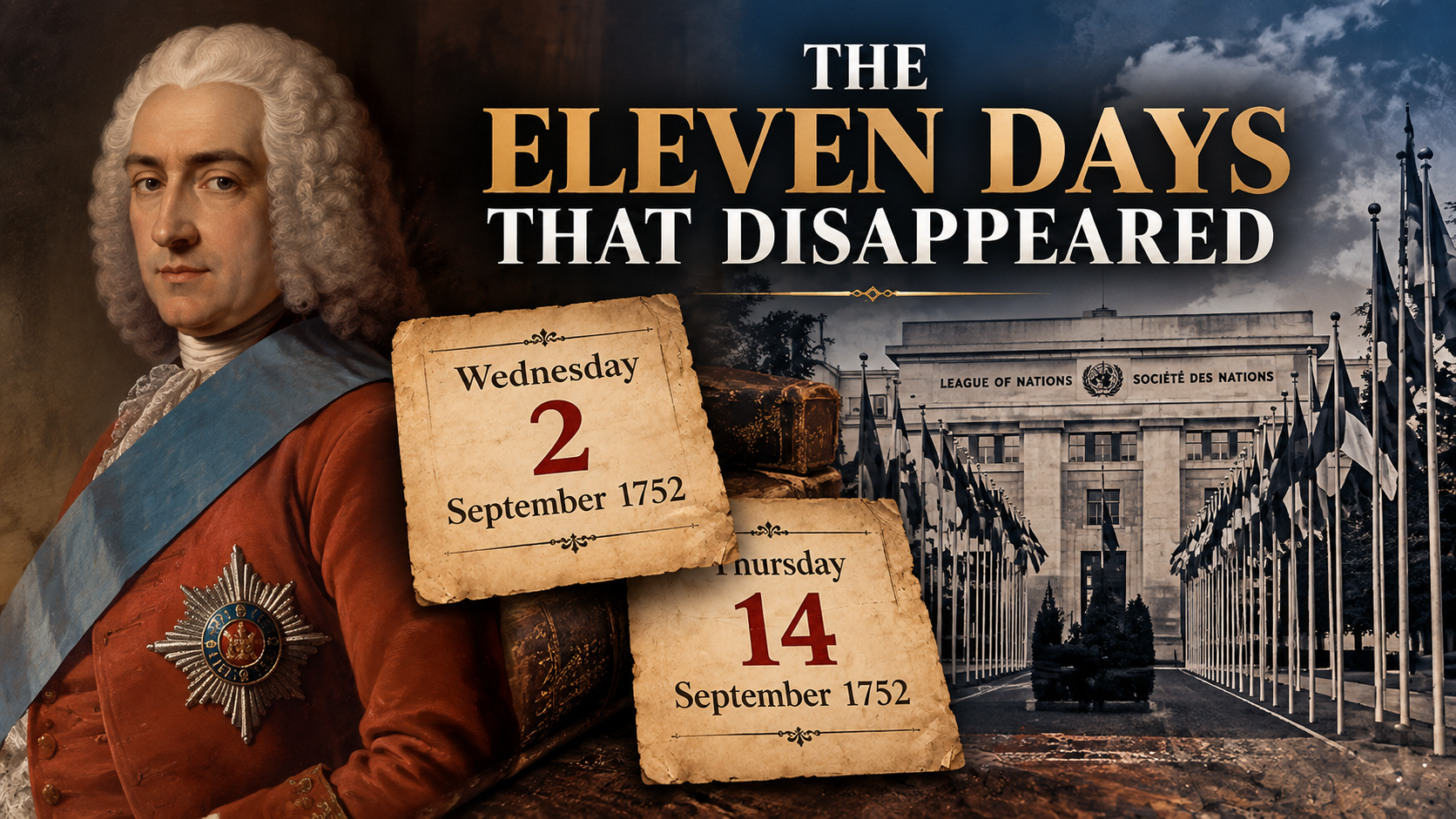
Philip Dormer Stanhope, fourth Earl of Chesterfield, was an ambassador, a Lord Lieutenant of Ireland, and one of the great celebrities of Georgian England. He is remembered today, if at all, for a book he never meant anyone to read — letters to his illegitimate son on how to get on in the world.
None of which interests me in the slightest. I am only interested in Chesterfield for one reason. In February 1751, he stood up in the House of Lords and proposed that eleven days should be abolished.
The problem was arithmetical, and very old. Julius Caesar’s calendar, the Julian calendar, assumed that a year lasts 365 days and six hours. But it doesn’t. It is about eleven minutes shorter.
Eleven minutes is nothing — but eleven minutes a year, compounded over sixteen centuries, is a fortnight, and by the 1580s, the spring equinox, which fixes the date of Easter, had drifted ten days out of position.
In 1582, Pope Gregory XIII corrected it by decree, and Catholic Europe adopted the new calendar at once. It was and is called the Gregorian calendar, and it is the one we use to this day.
But Britain was not Catholic. So Britain spent the next 170 years deliberately out of step with the rest of Europe as a matter of principle, by which time the gap had widened to eleven days.
Chesterfield’s bill closed the gap, and did so with exquisite delicacy. Nowhere does the Act mention Pope Gregory. It arrives at precisely Gregory’s calendar from first principles, rather like a boy who copies the answer from the pupil beside him and then invents his own workings to justify it.
The removal of 11 days received royal assent in May 1751, and provided that the day after 2 September 1752 “shall be called, reckoned and accounted to be the 14th Day of September, omitting for that time only the 11 intermediate nominal days of the common calendar.”
And so it was. Wednesday 2 September was followed by Thursday 14 September.
But something went wrong, that no one had even thought about. In their enthusiasm, nobody in Parliament had considered what was already scheduled to happen between the 3rd and the 13th of September.
Contracts matured in those days. Debts fell due in them. Notices expired in them. Parliament had deleted the dates and discovered, to its considerable irritation, that the obligations attached to these days had not obligingly deleted themselves. A second Act had to be rushed through.
There was another problem. A disobliging plant. That December a crowd gathered in Somerset at the Glastonbury thorn, a tree famous for flowering just in time for the festive season, and widely regarded as an annual miracle.
Gentleman’s Magazine reported a “vast concourse of people” assembling on 24 December 1752 to see whether the thorn would bloom on the new date. It did not. It flowered on 5 January. Apparently, nobody had informed the thorn about the new legislation.
Whatever one makes of believing in miraculous shrubbery, the people standing there on a cold English morning were asking exactly the right question. Was this a different date? Or was it the same day wearing a different number?
And guess what, that question was not safely buried in the eighteenth century. It came back, and it came back for us.
In 1923 the League of Nations took up a proposal to fix the year at 364 days — fifty-two exact weeks — and insert a “blank day” each December belonging to no day of the week at all. It was elegant, efficient, and backed by serious money, including Eastman Kodak.
It was also, for us Jews, a total catastrophe. A day outside the week would push Shabbat forward by one weekday every single year. Shabbat would have wandered around the week forever, and the seven-day cycle unbroken since Bereishit would have been dismantled by a committee in Geneva.
The man who stopped it was the Chief Rabbi of the British Empire, Joseph Herman Hertz. He addressed the League’s hearing in Geneva in 1931, and assembled a coalition so broad, that nobody could dismiss it as the grumbling of a few obscurantist Orthodox rabbis. He called it “the battle for the Sabbath.” He fought it for fourteen years, and by 1937 the proposal was dead.
I want to put the two stories side by side. Parliament deleted eleven days and nobody lost a minute of his life. Geneva proposed to insert one new day every year, and a chief rabbi gave fourteen years to stopping it.
The difference is not scale. A name is only a name — but Shabbat is not the name of a random day, it is the seventh day. You cannot re-number your way into it, and you cannot re-number your way out of it.
Yom Kippur is the one day in the year that appears to claim it does the work by itself (Lev. 16:30): כִּי בַיּוֹם הַזֶּה יְכַפֵּר עֲלֵיכֶם לְטַהֵר אֶתְכֶם — for on this day atonement shall be made for you, to purify you. On this day.
The Gemara calls it עִצּוּמוֹ שֶׁל יוֹם, the sheer force of the day itself. Nightfall arrives, the date changes, and a nation is cleansed.
If that were the whole of it, Yom Kippur would be the most powerful law ever passed, and Chesterfield an amateur.
But Chesterfield’s Act needed a second Act, and so does ours. Ours is the Mishnah at the end of Yoma (8:9).
עֲבֵרוֹת שֶׁבֵּין אָדָם לַמָּקוֹם, יוֹם הַכִּפּוּרִים מְכַפֵּר — for what lies between a person and God, Yom Kippur atones.
עֲבֵרוֹת שֶׁבֵּין אָדָם לַחֲבֵרוֹ, אֵין יוֹם הַכִּפּוּרִים מְכַפֵּר עַד שֶׁיְּרַצֶּה אֶת חֲבֵרוֹ — for what lies between a person and another person, it does not atone until he has made it right with the other person.
It is the same discovery. Every obligation that survived the deletion of those eleven days was an obligation between one person and another, and no act of the sovereign could touch it. A king can let you offf what is owed to the king. What you owe the man standing next to you was never the king’s to remit.
And in our case, it’s slightly more complicated. The debts of September 1752 at least had dates attached to them, which is how Parliament found them. What we owe each other has no date on it at all. There is no morning on which it quietly falls out of the calendar.
A day – every day – is not a machine that works on us. It is the unit in which we work. Which is why the word that runs through this whole season is not “year.” It is “day.”
On the Shabbat before Rosh Hashanah we read Nitzavim, and one word beats through it like a metronome. הַיּוֹם. Today. It appears a dozen times in two chapters. אַתֶּם נִצָּבִים הַיּוֹם כֻּלְּכֶם — you are standing today, all of you. רְאֵה נָתַתִּי לְפָנֶיךָ הַיּוֹם — see, I have set before you today, life and good, death and evil.
Moshe was speaking on the last day of his life, to a nation about to enter a land he would never see. If ever a speech had licence to be about the future, it was that one. Instead he strikes the same note until it is impossible to miss.
The Midrash Tanchuma asks why, and answers: מָה הַיּוֹם מֵאִיר פְּעָמִים וּמַאֲפִיל פְּעָמִים — just as a day is sometimes light and sometimes dark, so it is with you; and when it is dark for you, God will yet shine upon you an everlasting light.
Which is to say: every day on the calendar is exactly as long as every other, and no two are remotely alike. The date is fixed. What happens inside it is not. הַיּוֹם is not a measurement. It is a container.
Our davening makes the same choice. In a couple of hours, right at the end of Mussaf, we will say a short prayer in which every line opens with the same word. הַיּוֹם תְּאַמְּצֵנוּ, הַיּוֹם תְּבָרְכֵנוּ, הַיּוֹם תְּגַדְּלֵנוּ — today strengthen us, today bless us, today make us great. Not this year. Not from Yom Kippur onwards. Today.
And look at it on the page. It opens as an alphabetical acrostic — alef, bet, gimel, dalet — and then, after four letters, it gives up. We know precisely what is missing, because the complete version is still in print: the Italian machzor carries all twenty-two lines, alef through tav.
Ours had them taken out, but no one has ever felt their absence. Go figure. On the day of days, we say a prayer with days deleted from the middle of it, and it works perfectly well. Then it closes by quoting Moshe: לְחַיֹּתֵנוּ כְּהַיּוֹם הַזֶּה — to keep us alive, as on this day.
On the first of Tishrei the number changed. It was 5786, and now it is 5787. Nobody had to do anything for that to happen; it happened at nightfall, on schedule, whether we were ready or not. And the temptation of this season is to believe the number does the work — a clean slate, everything wiped, ‘eleven days’ quietly removed and nobody the wiser.
But we have had ten days since then, and they did not disappear. The slate does get wiped. But the life does not. Yom Kippur is not the day we are given our days back. It is the day we are asked what we put inside them.
Consider the most consequential date most of us will ever hold, which is a wedding day. A date goes on a document, the document is witnessed, and from that moment two people are married.
And look at what kind of document it is. The ketubah is not a certificate. It is a debt. It pledges a man’s property — “even the shirt on my back,” in its own words — against obligations he takes on that day, and it holds that property, as the text says, from this day and forever, in my lifetime and after my lifetime.
A date is written at the top, and an obligation is fastened to it that no later date can unfasten.
I heard the late Chief Rabbi, Lord Jakobovits, say to a couple under the chuppah: they will tell you this is the most beautiful day of your life, but it isn’t — because tomorrow will be more beautiful, and the day after that more beautiful still.
Nobody has ever built a marriage on the strength of the date at the top of the ketubah. That day makes it real in law and in the eyes of a community. Then come several thousand ordinary mornings on which two people either turn towards each other or they don't.
Nobody confuses a wedding with a marriage. But we do confuse Yom Kippur with a life all the time.
And there is that phrase in the ketubah — and after my lifetime. A document written on the happiest day of a person's life, which takes for granted that the obligations made on it will outlive the man who made them.
I can’t help being reminded of Yizkor.
In the middle of all those הַיּוֹם’s, Moshe says something we skip over. He lists those entering the covenant, and he says — כִּי אֶת אֲשֶׁר יֶשְׁנוֹ פֹּה עִמָּנוּ עֹמֵד הַיּוֹם, with those standing here with us today — and then וְאֵת אֲשֶׁר אֵינֶנּוּ פֹּה עִמָּנוּ הַיּוֹם, and with those who are not here with us today.
Again Hayom. Twice Hayom. In one verse. The same word, for the people in the room, and for the people who are not.
At Yizkor we say the names of parents, of husbands and wives, of brothers and sisters, of children. Every one of them had exactly what we have: a certain number of days, not one of which could be re-numbered, deleted or exchanged, and none of which they knew the number of in advance.
They are not here with us today. The verse puts them in the room anyway, standing in the covenant, on the same הַיּוֹם as the rest of us. Because what they did with their days did not stop when the days stopped. It is sitting in this room. It is in how we speak, in what we do, and what we don’t do.
So this is what I take from those eleven vanished days. Lord Chesterfield reached into the calendar and removed them, and the country slept on Wednesday the 2nd and woke on Thursday the 14th, and the sun came up as though nothing had happened.
Because nothing had. Not one minute of anybody’s life was added or taken away. All that changed was what the days were called.
Nobody can add a day to a life. Not Parliament, not the League of Nations, and not us. All any of us is given is הַיּוֹם, one day at a time, and the only question we are ever really asked is what we put inside it.
May the memories of those we remember at Yizkor be a blessing, and may we all be sealed for a year of days worth having.