

A PLACE OF HONOR
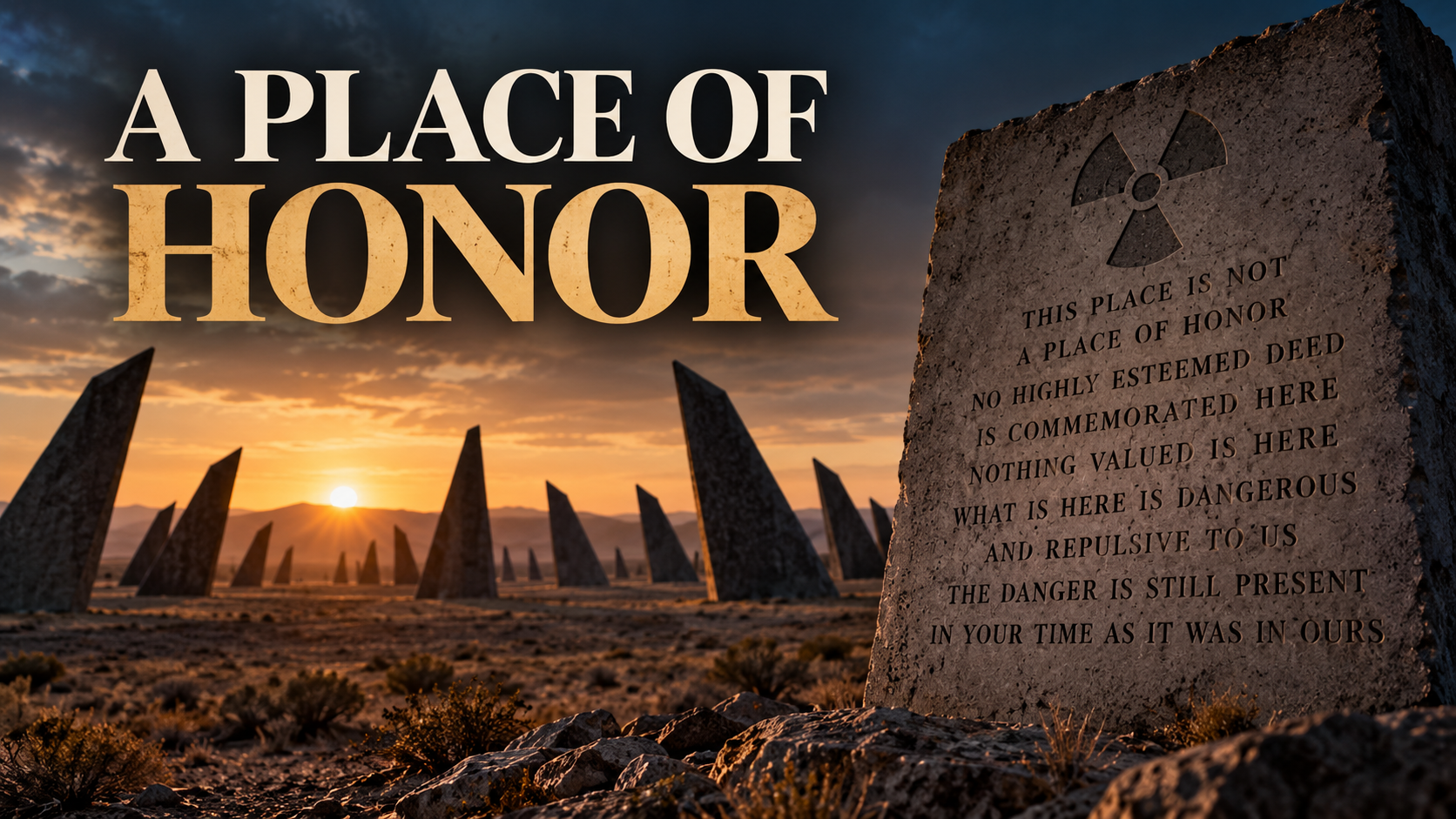
An anthropologist, an astronomer, an archaeologist, a linguist, a materials scientist, and a man who designs buildings all check into the same hotel.
It sounds like the start of a weird joke. It isn’t. It actually happened, in Albuquerque, New Mexico, in 1991. Thirteen of them altogether, in two teams, flown in by the Department of Energy to solve a problem that nobody in the history of the world had ever solved.
They were given one task. Write a warning.
The government was about to bury an enormous quantity of radioactive waste twenty-six miles east of Carlsbad, 2,150 feet down in a bed of salt. Write a sign telling people not to dig there.
And here is the clause that made it the hardest writing assignment ever issued. The warning had to work for ten thousand years. Not ten. Not a hundred. It still had to work in the year 11,991 — surviving the death of the English language, the end of the United States, and the end of whatever replaces whatever replaces the United States.
They began by trying to make the place itself frightening. Landscape of Thorns. Spike Field. Menacing Earthworks. Forbidding Blocks.
Eight designs altogether, every one of them engineered to repel — jagged forms, deliberately crude workmanship, and, this was a formal guideline: every component made of materials with little intrinsic value, so that nobody in the future would have any reason to carry it away.
Somebody suggested structures shaped to catch the wind and produce a sound that is dissonant and mournful. A building designed to howl.
Then they wrote the text: This place is not a place of honor… no highly esteemed deed is commemorated here… nothing valued is here. What is here is dangerous and repulsive to us. The danger is still present, in your time, as it was in ours.
Possibly the most frightening paragraph written in the twentieth century, and it was produced by a committee nobody has ever heard of.
It was all totally pointless. After weeks of work the committee concluded that none of it would function. Symbols drift, buildings collapse, and languages die.
So one of them asked the only question that mattered. What actually does survive ten thousand years?
The answer they came up with was amazing: religious buildings. Fortresses don’t last. Palaces don’t last. Banks don’t last. The only structures we reliably refuse to bulldoze are the ones somebody thinks are holy.
Seven years earlier, another government employee had already worked this out. In 1984 the Department of Energy had commissioned Thomas Sebeok of Indiana University — a semiotician, which is a person who studies signs; not road signs, signs — to write Communication Measures to Bridge Ten Millennia.
Sebeok worked the problem from every angle and then made his recommendation to the government of the United States. He recommended inventing a religion.
This is what he proposed, in his own words: “a ritual, annually renewed, with the legend retold year-by-year,” entrusted to custodians who would hold the text, transmit it, and choose their own successors. He called them an ‘atomic priesthood.’
An annual event. Every year, people would do something in order to remind themselves of something important. And a priestly class to preside over it.
He basically invented Yom Kippur.
There was one further provision. If the public stopped listening, the priesthood would deploy: “the veiled threat that to ignore the mandate would be tantamount to inviting some sort of supernatural retribution.”
Yup, he had also invented Unesaneh Tokef. A professor of semiotics, working from pure information theory, reached for the exact tools we reach for every year on the tenth of Tishrei.
And then, he was honest. “Of course, the disadvantage of the relay system is that there is no assurance that future generations would obey the injunctions of the past.”
You can design a ritual. You can draft a legend. You can ordain a priesthood. But you cannot guarantee that anyone will still be holding it in a hundred generations. What Sebeok needed was a guarantor. He did not have one.
We open the holiest night of the year with a legal declaration. Kol Nidre is not a prayer. There is no blessing in it, no praise, no request, and God is not addressed once. It is a legal formula in a legal language, which is why it requires three men, two of them holding sifrei Torah, standing here as a beis din.
I’ll let you into a little secret. When it first emerged, the rabbis hated it. Rav Amram Gaon, a thousand years ago, called it minhag shtus, a foolish custom. In 1844, a rabbinical conference voted unanimously to abolish it. Unanimously. When have rabbis ever been unanimous about anything?
Rabbi Mordechai Yaffe of Prague tried something gentler. He only wanted to fix the grammar, which is a mess. But he recorded that he could not do it — because changing the words would ruin the melody, and you cannot ruin the melody.
Now put that next to something the New Mexico panel wrote at the very end of its report, under a heading of five words: Beauty is conserved, ugliness discarded.
They had spent months designing something hideous on purpose, and then one of them noticed the flaw underneath the entire enterprise. A marker system, he wrote, must be one that “instills awe, pride, and admiration, as it is these feelings that motivate people to maintain ancient markers, monuments, and buildings.”
Nobody preserves what repels them. Their warning was engineered to be hated, and hatred does not survive.
A rabbi in Prague had run that experiment four centuries earlier and got the answer. The melody is not the packaging. The melody is the preservation mechanism.
Which is why almost nobody can translate Kol Nidre, and everybody sings along anyway. In fact, there are people in shuls across the world tonight who have not been inside one since last Kol Nidre. But they come for Kol Nidre.
Sebeok wanted a text that no longer needs to be understood in order to be obeyed, carried by a tune, renewed annually, in a language nobody in the room can read, surviving centuries of expert opposition and a unanimous vote to abolish it.
He should have come to any shul on Kol Nidre night. We could have saved him the trouble. Although we are not the proof of his theory. It is the other way round.
Sebeok had a message and went looking for a carrier. We were handed the carrier first. At the end of Devarim, Moshe has to make the Torah outlive him, and God tells him (Deut. 31:19): שִׂימָהּ בְּפִיהֶם — put it in their mouths. As a song.
The scroll in the ark is the backup copy. The live copy is in the mouth. לֹא תִשָּׁכַח מִפִּי זַרְעוֹ — it will not be forgotten from the mouth of his offspring (Deut. 31:21). That is not a hope. It is a statement of fact.
Isaiah spells out how it works (Is. 59:21): מִפִּיךָ וּמִפִּי זַרְעֲךָ וּמִפִּי זֶרַע זַרְעֲךָ אָמַר ה׳.
And the Gemara asks why the verse bothers to add אָמַר ה׳, “says God.” The answer could not be plainer. אֲנִי עָרֵב לְךָ בְּדָבָר זֶה — I am your guarantor in this matter.
That is what the committee in New Mexico could not fabricate. They could build the ritual. They could draft the legend. They could ordain the priesthood. But they could not sign the guarantee, because there was nobody to sign it.
And there is one more thing they could not do, which we did tonight before we sang a note.
אָנוּ מַתִּירִין לְהִתְפַּלֵּל עִם הָעֲבַרְיָנִים — before we started, we said: we have permission to pray with the sinners. A court convenes and issues a licence, so that people who do not believe they belong here are here anyway.
It comes from a Gemara: the Gemara says that a public fast that does not include the sinners of Israel is not a fast. And the proof is the ketores, the incense in the Temple. Eleven ingredients, one of which was chelbenah, galbanum — and galbanum stinks. It literally reeks. It is on the list anyway, and if you leave it out, the entire compound is invalid.
Sebeok’s priesthood was the opposite. His instructions were to narrow the circle to the reliable ones, and manage everybody else from outside with a veiled threat.
We do it the other way round. Before we sing the thing that has carried us for a thousand years, we stop, we go outside, and we bring in the people who think they don’t belong — because the compound is invalid without them.
Which means that nobody at Kol Nidre is a spectator. You may have come because your mother would have wanted it, or because you had nothing else on. But you are not a guest. You are load-bearing. You are the relay. It came to you through 100 generations of people who were never sure they deserved to be holding it, but not one of them dropped it, and the next link is you.
The New Mexico report has a last line. The panel was afraid that nothing they had designed would last long enough to do what they wanted it to do.
And so they noted that the fact that people living in our century had made the effort to warn the future would itself become the message — that the effort itself could still achieve the desired effect.
That is what you write when you cannot promise anything. It is a beautiful sentence, but it is a sentence of despair. They built the ritual, they drafted the legend, they ordained the priesthood, and then they looked at the place on the page where the guarantee should have been signed, and it was blank. So they hoped the effort would make it work.
An anthropologist, an astronomer, an archaeologist, a linguist, a materials scientist and a man who designs buildings walked into a hotel in Albuquerque.
And here is the punchline. They spent the better part of a decade and several hundred pages trying to build from scratch — out of concrete and semiotics and public money — the thing that you and I inherited for nothing, turn up to once a year, and assume is the most natural thing in the world.
They were writing a warning to last ten thousand years. We are three and a half thousand years into ours, it is still legible, and the guarantor has not withdrawn.
So let me give you back their text, read the way it should be read on the tenth of Tishrei.
Sending this message was important to us.
It was. Important enough that people carried it out of Jerusalem two thousand years ago, out of Spain in 1492, and out of Europe in 1945. The panel’s own rule was that every component had to be made of material of little intrinsic value, so that nobody would be tempted to take it. What our people carried was worth nothing to anybody else — a tune, a text, and a date in Tishrei — and not one of them put it down.
We considered ourselves to be a powerful culture.
We never did. That was never the claim. For most of our history we were the least powerful people in the world. Power was never the transmission mechanism. The song was.
And then, the last line, the one designed to make the ground itself say stay away:
This place is not a place of honor. Nothing valued is here.
No. Not us. That’s not Kol Nidre in shul.
Being at Kol Nidre is being in a place of honor. The most highly esteemed deed in human history is being performed — by the ordinary, enormous act of having come to shul on Yom Kippur. The refusal, a hundred times in a hundred generations, to be the one who let it drop.
כִּי לֹא תִשָּׁכַח מִפִּי זַרְעוֹ. God is the guarantor. We are the relay. And we will be here with the same message next year, and the year after, until Moshiach comes, and well beyond.


(For the SoundCloud audio, scroll down) Can a Jew ever be too far gone? In 1917, more than four centuries after Portugal forced its Jews into hiding, Polish Jew Samuel... Read More