

THEY ARE CHAPTERS. WE ARE THE BOOK.
(For the SoundCloud audio, scroll down)
The Tisha B’Av experience is utterly unique. You sit on the floor in the half-dark, your shoes off, your voice cracking through the dirge-like cadences of Eichah, and then you recite—line by line, calamity by calamity—the worst tragedies that have ever happened to the Jewish people.
The destruction of two Temples. The expulsions. The massacres. The Crusades. The pogroms. The death camps. It is, without question—and deliberately so—the saddest day in the Jewish calendar, a day set aside to stare directly into the abyss of our tragic history and weep.
And yet, as I went through the Tisha B’Av motions this year, sitting on the floor and reciting the Kinnot, something struck me with unexpected force. This day of mourning—this concentrated distillation of every Jewish tragedy into twenty-five hours of grief and lamentation—carries within it the very antidote to the sorrows it commemorates.
Because here is the astonishing thing: we are still here to mourn them, but every enemy catalogued in those Kinnot is gone.
Just consider that for a moment. The very fact that there is a Jew in 2026 who can sit on the floor and cry over Jerusalem destroyed by Roman legionaries is itself the punchline to a two-thousand-year-old joke that Rome did not live to hear. Titus is dust. We are not.
Or consider the Crusaders. In the spring and early summer of 1096, mobs sweeping toward Jerusalem turned their swords, clubs, maces and spears on the flourishing Jewish communities of the Rhineland—Speyer, Worms and Mainz, the great triad of communities that stood at the heart of the emerging Ashkenazi world. These were thriving centers of Torah, commerce and communal life. Within a matter of weeks, they were annihilated.
In Worms, approximately eight hundred Jews were slaughtered. In Mainz, the greatest carnage of all, more than eleven hundred were brutally murdered. Speyer escaped destruction on the same scale only because its bishop intervened to protect the community.
The chronicles that survive this tragedy read like Eichah itself. Had you stood among the mutilated bodies of Mainz’s murdered Jews in the summer of 1096, you would have been certain—utterly certain—that it was over for good. After all, who could possibly rebuild from that?
But what happened next is astounding. The Crusader horde led by the repulsive Count Emicho—many thousands strong, and convinced that the murder of Jews was a holy task—never made it to Jerusalem.
They marched toward Hungary and laid siege to the fortress of Moson. Then, just as victory seemed within reach, panic swept through their ranks. The Hungarian defenders surged out, the Crusading army disintegrated, and many of them were slaughtered or drowned.
The force that had imagined itself an instrument of divine judgment collapsed before it ever reached the Holy Land. The wheel had turned, and it turned fast.
Meanwhile, the Jews of the Rhineland began the astonishing work of rebuilding. Within years, synagogues and communities were restored. Within generations, the great centers of Rhineland Torah learning had re-emerged, producing scholars, liturgy and faith energy that would shape Jewish life for centuries.
It is a pattern so consistent that it has become almost tediously reliable. The Nazis built an empire meant to last a thousand years and to stand upon the ashes of our people. It lasted twelve. Its leaders died in bunkers, fled like fugitives, or stood in the dock at Nuremberg. Ten of the principal defendants ended their lives at the end of a hangman’s rope.
The men who orchestrated the horrors of October 7 imagined that they were writing the opening chapter of the end of Israel. Instead, one by one, they are being eliminated. Yahya Sinwar—the arch-mastermind, the man who thought he had lit the fuse of our destruction—was hunted down and killed.
And it isn’t only the leaders. A few weeks ago, the IDF eliminated Mohammed Abu Taima, a Nukhba commander who participated in the October 7 assault and infiltrated Kibbutz Nirim.
He is not the only one. Scroll through your X feed. Day after day, terrorists who participated in the massacre—some of whom filmed their crimes on GoPros—are being located, targeted and eliminated, in real time, on our watch.
I am fully aware that not everyone sees hope in the present moment. There are those who look at the world around us and predict doom. They point to the surging antisemitism on our streets and campuses, the diplomatic isolation of Israel, the exhaustion of a nation at war, the fracturing of old alliances, and the rise of politicians like Zohran Mamdani to positions of power and influence.
And they say: this time it is different. This time we will not come back.
Here is the uncomfortable truth: in a narrow and immediate sense, they may not be entirely wrong. Things may get darker before they get lighter, and the road ahead may be harder for Jews and for Israel than any of us would wish.
But darkness has a peculiar power. The final hours before dawn can feel like the blackest part of the night, deceiving the frightened eye into believing that the sun will never rise. And that is precisely the moment when judgment fails.
The Jews who survived Mainz in 1096 could not see 1120. The Jews of 1943 could not see 1948. Standing inside a disaster, it is nearly impossible to believe that there will be an afterward—and harder still to imagine that the afterward might be positive. And yet there always, always is.
To be clear, this is not naive optimism. It is the single most well-documented fact in the entire span of human history—a fact written in the disappearance of every civilization that ever raised its hand against the Jews, and in the stubborn, miraculous persistence of the Jewish people.
The Shabbat immediately following Tisha B’Av is Shabbat Nachamu. Before we have even wiped away our tears, the Haftarah roars back at us with the words of the prophet Isaiah (Is. 40:1): נַחֲמוּ נַחֲמוּ עַמִּי – “Comfort, comfort My people.”
Just days after the deepest grief, as if to insist that mourning was never intended to be a destination, the prophet who was among the sharpest in his predictions of tragedy guarantees comfort and relief from that very same tragedy.
So let the pessimists have their say. I will not argue that the night is not dark. But I will point out that we have been here before. We have stood in the ruins of the Rhineland, in the ruins of the Temple, and in the ruins of Europe. We buried our dead. We said Kaddish. We wiped our eyes. And then we got up, dusted ourselves off and rebuilt what was gone—bigger and better than before.
The Jewish people are going to fight back. And make no mistake: we are going to win. Not because we are stronger, cleverer or more numerous than our enemies. We will win for the same reason we have always won: Because they are chapters, and we are the book.
Because while the remnants of the army that thought it had ended Jewish life in the Rhineland were scattering across Hungary, there was already a Jewish child being born amid the ruins of Mainz who would grow up to teach Torah.
Be comforted, My people – the tears of Tisha B’Av are real, but they are not the end of the story. Dawn is coming—it always does—and when it breaks, as it broke over the Rhineland, over the DP camps and over a reborn Jerusalem, we will still be standing.

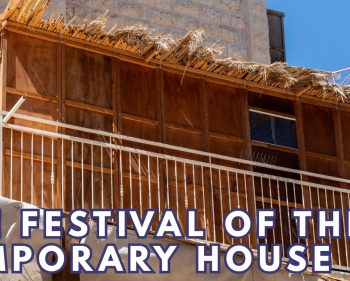
THE FESTIVAL OF THE TEMPORARY HOUSE
(For the SoundCloud audio, scroll down) Sukkot begins with a flimsy hut and ends with dancing around a Torah scroll. In between come the four species, Kohelet, Hoshana Rabba, Shemini... Read More