

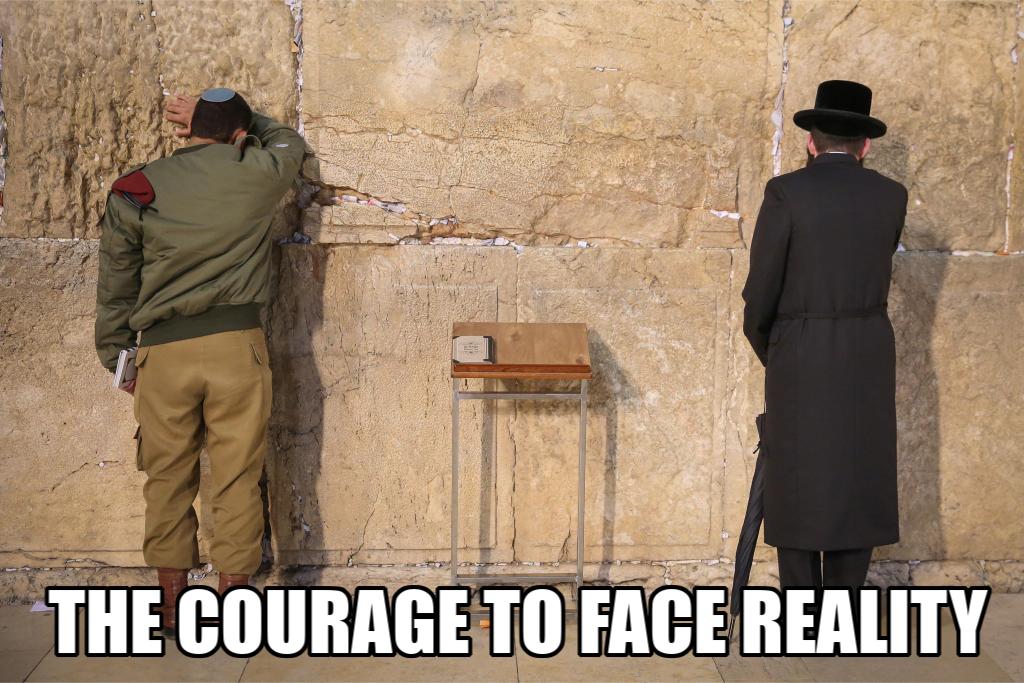
My letter this week to Prime Minister Netanyahu sparked something of a firestorm. Perhaps I should have expected it. Few issues in Israel today arouse stronger emotions than the question of Charedi participation in the IDF, and few subjects more quickly turn arguments into slogans.
In my letter, I made two points which I continue to believe with equal conviction. First, the current arrangement, under which an ever-growing sector of Israeli society remains almost entirely outside the national burden of defense, is no longer sustainable. Demography alone has made that clear. Israel cannot ask reservists, Religious Zionist yeshiva students, fathers of young families, new immigrants, bereaved families, and wounded soldiers to continue carrying this burden indefinitely while one rapidly expanding community insists that the responsibility belongs to everyone else.
Second, I argued that the government’s present tactic of arresting yeshiva students is a profound mistake. Dragging young bochurim from buses, homes, and yeshivos and placing them in military prisons is morally wrong, strategically disastrous, and historically tone-deaf. These young men are not the architects of the present crisis. They did not create the system into which they were born. They did not formulate its ideology, write its slogans, or negotiate its political arrangements. From childhood they have been taught that enlistment is synonymous with abandoning Torah, betraying their rabbanim, betraying their families, and endangering their spiritual future. To arrest them as though they personally designed this crisis is both unjust and foolish.
Every such arrest reinforces the very narrative that hardliners have cultivated for decades: that the State of Israel is at war with Torah itself. The result is entirely predictable. Moderate voices are weakened. Extremists are emboldened. And any possibility of constructive dialogue moves further out of reach. The State imagines that it is enforcing the law, but in practice, it is producing the photographs, emotions, and communal trauma that make compromise less likely than ever.
I therefore suggested to the Prime Minister that if the State wishes to enforce responsibility, it should stop treating the foot soldiers as though they are the generals. Eighteen-year-old yeshiva students did not create this impasse. Those who have spent years organizing, directing, funding, inflaming, and perpetuating a policy of blanket resistance while simultaneously exercising enormous power within Israel’s political system bear far greater responsibility for where we now find ourselves. If accountability is to begin anywhere, it should begin with those who shape the system, not with those who have been shaped by it.
That was the argument. It was not an argument against Torah. It was not an argument against lomdei Torah. It was not an argument for criminalizing religion. And it was certainly not, chas v’shalom, a call to “go after the Gedolim.” Anyone who read it that way has misunderstood what I wrote.
Since writing the letter, and publicizing it, I have received many responses. Some were thoughtful and serious. Others were less so. Two in particular captured the objections that seem to have gained traction. One was a long and sincere email from a young Charedi man who challenged almost every point I made. The other was an anonymous article on Charedim.com, written in a more polished style but advancing much the same claim. Both argued, in essence, that Daas Torah has ruled that Charedim may not serve in the IDF, that the issue was settled long ago by the Gedolim, and that any suggestion of change represents an attack on the accepted mesorah.
As I read these defensive responses, and others, I found myself increasingly struck not only by what they said, but by what they didn’t say. There was much discussion of Torah protecting the Jewish people. There were many references to Gedolim past and present. There were passionate warnings about the spiritual dangers of army service. There were accusations that I was insulting yeshiva students by calling them victims of a system, and that I was seeking to replace Torah leadership with state-approved “moderates.”
But almost nowhere did anyone engage the central question: Can a policy created for a tiny Torah community rebuilding itself from the ashes of the Holocaust really be treated as an eternal Torah principle, unchanged and unchangeable, in the radically different reality of the State of Israel today? That is the question at the heart of this entire debate. And it is the question that too many people seem determined not to answer.
I have enormous reverence for the Gedolim whose names are constantly invoked in this discussion: the Brisker Rav, the Chazon Ish, Rav Reuven Grozovsky, Rav Aharon Kotler, Rav Shach, and many others besides. They were giants of Torah upon whose shoulders we all stand. But reverence should never require us to ignore the historical reality in which they were speaking.
When those Gedolim fought to preserve the fledgling yeshiva world after the Holocaust, European Torah life had been almost annihilated. The great yeshivos of Lithuania had been destroyed. Entire rabbinic dynasties had disappeared. Communities that had formed the spiritual backbone of Klal Yisrael for centuries had been reduced to ashes. Israel’s Torah community was tiny, impoverished, fragile, and struggling simply to survive.
Ben-Gurion’s famous exemption applied to four hundred yeshiva students. Four hundred. No serious military planner imagined that exempting four hundred young men would endanger the manpower needs of the newly established Israel Defense Forces. Nor did anyone imagine that this arrangement would become permanent, let alone expand into a system encompassing tens of thousands of young men.
It is worth nothing that had the original exemption simply grown in proportion to Israel’s Jewish population, it would today number a few thousand students, not anything close to the numbers now under discussion. That simple fact alone illustrates how dramatically the arrangement has expanded beyond anything its original architects could have imagined.
Would the Gedolim of the immediate period after the Holocaust have ruled differently had they been confronting a situation in which hundreds of thousands of Charedim constituted one of the largest and fastest-growing sectors of the population? I do not know. Neither does anyone else. Which is precisely why we should be cautious about invoking their words as though they were addressing a reality they never encountered.
The Torah did not change. Halachah did not change. The sanctity of Torah learning did not change. But guess what: the metzius most certainly did. And the metzius is extremely important. Every posek in every generation applies eternal Torah principles to changing circumstances. If reality were irrelevant, there would be no need for new teshuvos, no need for new takanos, and no need for fresh applications of halachah to new situations. Torah is eternal precisely because it is capable of speaking to reality as it is, not only to reality as it once was.
That is why I find it so striking that those who constantly invoke the Gedolim in this discussion seldom mention Rav Steinman (except to deny what I am about to tell you, saying that it is not true, or it is a distorted version of the truth – which it is not). Rav Steinman never compromised his commitment to the centrality of Torah learning or to the preservation of the yeshiva world. But a generation ago, he understood something that many today seem unwilling even to discuss: not every young Charedi man is destined to remain in full-time learning throughout his life, and pretending otherwise ultimately weakens rather than strengthens the Torah world.
Rather than denying reality, Rav Steinman sought to engage it. He supported carefully constructed military frameworks that would allow young Charedi men who were not learning full-time, or couldn’t, to serve without sacrificing their Charedi identity. The emergence of Nachal Charedi did not come from anti-Torah circles. It emerged because one of the greatest Torah leaders of his generation understood that preserving Torah sometimes requires adapting frameworks without compromising principles.
The consequences of refusing to acknowledge changed reality become even clearer when one considers a very different Charedi movement altogether: Satmar.
I disagree profoundly with Satmar’s theological opposition to the State of Israel. But I have always respected one thing about Satmar’s position: it is internally consistent. If one genuinely believes that Jewish sovereignty before Moshiach is fundamentally illegitimate, then it follows that one should avoid dependence on that state wherever possible. Unsurprisingly, the overwhelming majority of Satmar Chassidim built their communities outside Israel. Whether one agrees with that choice or not, it has the courage of its convictions.
The mainstream Charedi world in Israel has chosen a very different path. Over the past seventy-five years, hundreds of thousands of Charedi Jews have made Israel their home. Indeed, for the first time since the destruction of the Second Beis Hamikdash, the center of gravity of Torah life has shifted back to Eretz Yisrael. That is one of the great blessings of Jewish history. Yeshivos are flourishing, and Torah is learned on a scale that earlier generations could scarcely have imagined. Families are growing, communities are expanding , and Torah institutions shape the public life of the Jewish state.
But blessings carry responsibilities as well as privileges. Today’s Israeli Charedi community lives under Jewish sovereignty. It votes in elections. It determines governments. Its parties negotiate coalition agreements. It receives billions of shekels in public funding for yeshivos, schools, housing, welfare, and communal institutions. It benefits from Israel’s healthcare system, its roads, its infrastructure, its emergency services, its economy, and above all, from the protection provided by the Israel Defense Forces. Yet many continue simultaneously to argue that the State itself possesses little or no religious legitimacy, that its obligations do not bind them, and that the burden of defending it belongs to someone else.
It is increasingly difficult to see how those propositions can coexist. One cannot spend decades participating in the life of a state while insisting that one bears no responsibility for its continued existence. One cannot vote, bargain, receive, influence, build, expand, and benefit, while claiming that the most basic obligations of citizenship apply only to others. This has nothing to do with whether one calls oneself a Zionist. Labels are largely irrelevant. The question is much simpler: what obligations flow from citizenship? What responsibilities accompany privilege? What does hakaras hatov demand? What does fairness demand? What does Torah demand?
Some respondents insisted that Torah learning itself is the Charedi contribution to national defense, and I do not dismiss that claim. I believe with all my heart that Torah protects Klal Yisrael. I believe that Klal Yisrael needs outstanding lomdei Torah whose lives are devoted entirely to learning. I believe the Jewish people would be spiritually impoverished beyond measure without a serious, protected, honored world of full-time Torah scholarship.
But no serious Torah society has ever consisted entirely of Yissachar. Zevulun is not a concession to modernity. Zevulun is part of Torah itself. The question is not whether Torah learning matters. It matters more than words can express. The question is whether Torah learning can be invoked as a permanent blanket exemption for an entire sector, including thousands who are not actually immersed in serious full-time learning. The question is whether the sanctity of the beis midrash is strengthened or weakened when it becomes entangled with political evasions, social pressure, and a fiction everyone privately knows is not entirely true.
If we are honest, we know there are elite lomdei Torah who should be supported and protected. We also know there are many young men in the system who are not those elite lomdei Torah. To pretend otherwise is not kavod haTorah. It is a distortion of reality, and ultimately it undermines the very Torah world it claims to defend.
This brings me to the claim that I insulted yeshiva students by calling them victims of the system. I did not mean that their Torah commitments are fake, or that their emunah is merely sociological conditioning, or that loyalty to rabbanim is something shameful. Quite the opposite. Chinuch is sacred. Mesorah is sacred. Emunas chachamim is sacred.
But it is also true that a young man raised from childhood to believe that any form of service to the state is betrayal, that any alternative path will destroy his future, that his shidduch prospects, family standing, and communal belonging all depend upon one choice alone, is not making that choice in a vacuum. He may be sincere. He may be courageous. He may be acting exactly as he has been taught to act. But sincerity does not erase the responsibility of those who created the environment in which every other option became unthinkable.
To recognize that is not contempt. It is honesty.
Nor does raising questions about the political strategy of Charedi parties amount to attacking Gedolim. This is one of the most troubling features of the current debate. Every objection to the present arrangement is immediately recast as an assault on Torah authority. Every question about politicians becomes a question about Gedolim. Every concern about public policy is treated as if it were kefirah. That maneuver may be effective rhetorically, but it is intellectually dishonest and spiritually dangerous.
Charedi politicians are not Gedolim. Askonim are not Gedolim. Party functionaries are not Gedolim. Public relations writers are not Gedolim. And even when politicians claim to speak in the name of Gedolim, it remains legitimate to ask what information has been presented, what alternatives have been considered, what interests are being protected, and whether the public policy being advanced truly serves Torah or merely preserves a system that has become too large, too entrenched, and too politically useful to reconsider. After all, it is not the Gedolim who are talking to the heads of the army, or the Prime Minister – it is other people who represent them and their point-of-view.
Throughout Jewish history, great rabbinic leaders depended on people around them for information about public affairs. Sometimes those advisers served them well. Sometimes they did not. To say so is not an attack on Daas Torah. It is a recognition of how communal leadership actually works. My concern is not with Daas Torah. My concern is with those who invoke Daas Torah to prevent any discussion before it begins.
There is another objection that deserves serious treatment: the claim that the army is not a sufficiently kosher environment for Charedi soldiers. This concern should not be dismissed. The IDF has often failed religious soldiers. It has not always enforced its own rules. It has sometimes shown arrogance toward halachic concerns. It has too often assumed that religious accommodation is a favor rather than an obligation. Anyone who wants Charedim to serve must take this problem seriously.
But a serious problem is not the same as an eternal impossibility. If the army has failed to provide appropriate frameworks, then the answer is to demand better frameworks, stronger guarantees, enforceable standards, separate units where necessary, rabbinic oversight with real authority, and consequences when commitments are violated. The answer cannot be to declare, forever and under all circumstances, that no framework can ever be built, and therefore that no Charedi man can ever serve. That position may sound principled. But when applied to an entire growing population living inside a state whose protection it depends upon, it becomes untenable.
And here we arrive at the moral center of the issue. Surely a Torah Jew must care how his actions are experienced by other Jews. Surely a Torah Jew must ask not only, “Am I convinced that I am right?” but also, “Have I acted with fairness? Have I demonstrated gratitude? Have I recognized the sacrifices others are making on my behalf?”
What does one say to the mother whose son has been in Gaza for months while a healthy young man down the road insists that the war has nothing to do with him? What does one say to the reservist who has lost his business, missed his children’s childhood, and risked his life again and again? What does one say to the Religious Zionist yeshiva student who learns Torah seriously and then serves? What does one say to the bereaved father who asks why his son’s blood purchased security for those who refuse even to discuss participation?
It is not enough to answer, “They do not understand Torah.” Perhaps sometimes they do not. But perhaps we have not done enough to show that Torah produces responsibility, gratitude, and fairness toward fellow Jews.
The Netziv famously explains why Bereishis is called Sefer HaYashar. The Avos were tzaddikim and chassidim, he says, but it is not called Sefer Tzaddikim or Sefer Chassidim. It is called Sefer HaYashar. Because above everything else, the Avos were yesharim. They dealt with others—even those with whom they profoundly disagreed—with fairness, generosity, civility, and empathy.
The generation that witnessed the destruction of the Second Beis Hamikdash, writes the Netziv, was filled with true Torah scholars, and Shomrei Torah u’mitzvos. Their tragedy was not a lack of Torah. It was a lack of yashrus. They became convinced that anyone outside their own ideological camp could not possibly be acting l’shem Shamayim. They judged fellow Jews harshly. They assumed impure motives. They ceased seeing complexity. In their eyes, disagreement itself became evidence of betrayal. That, says the Netziv, was the true meaning of sinas chinam.
His words should send a chill through every one of us. When secular Israelis are dismissed as people who “don’t understand Torah” and therefore are not worthy of consideration, when bereaved parents who ask why their sons alone must fight are portrayed as enemies of Judaism, when every suggestion of compromise is labelled “shmad” before it is examined, when anyone who questions the present arrangement is accused of hating Torah, we are no longer having a Torah conversation. We are failing the test of yashrus.
The same is true in the other direction. When Charedim are mocked, dehumanized, or treated as parasites rather than as fellow Jews, that too is a failure of yashrus. When police drag frightened bochurim into custody as cameras roll, that too deepens sinas chinam. When politicians use this crisis to score points rather than solve problems, that too is a betrayal of what this moment requires. But the existence of hostility toward Charedim cannot become an excuse for avoiding every hard question. Nor can the misuse of the draft issue by anti-religious voices absolve the Charedi world of the obligation to ask whether its own position remains morally, socially, and halachically defensible in today’s reality.
We must be able to say two things at once. The Torah world must be protected. And the status quo cannot continue.
We must be able to say that full-time Torah learning is indispensable. And we must be able to say that not every young Charedi man is a full-time Torah scholar.
We must be able to say that the army must change. And we must be able to say that Charedi society must change.
We must be able to say that arrests are wrong. And we must be able to say that permanent mass exemption is also wrong.
If our discourse cannot hold those truths together, then our discourse is broken.
The challenge before us is not whether Torah should remain supreme. It must. The challenge is whether we have the courage to distinguish between eternal Torah principles and the historical arrangements created to preserve them under very different circumstances.
History changes. Demography changes. Political realities change. Military needs change. Social structures change. It is true that the Torah does not change, but the greatness of Torah leadership has always been that it has never pretended that reality remains frozen. It has applied our eternal Torah to changing circumstances without compromising its principles.
If we forget that distinction, we risk confusing history with halachah, temporary policy with eternal truth, and ideological rigidity with fidelity. We also risk something even worse: losing the yashrus that made Avraham, Yitzchak, and Yaakov the models for all generations.
I write these words as someone who loves Torah, reveres lomdei Torah, believes deeply in the spiritual power of Torah learning, and wants the Torah world to flourish in Eretz Yisrael for generations to come. But precisely because I care about Torah, I cannot accept that Torah should be used to justify a social arrangement that is tearing Am Yisrael apart and becoming less defensible with each passing year.
There must be a path forward. It will not be found through handcuffs and prison cells. It will not be found through anonymous polemics or accusations of kefirah by those who disagree with the status quo. It will not be found by pretending that the army has no religious problems, nor by pretending that every Charedi bochur is a future gadol hador. And it will certainly not be found by politicians who benefit from permanent crisis, and who cannot be trusted to protect the best interests of the Charedi world.
If anything, it will be found through honesty. It will be found through courage. It will be found through serious frameworks that protect genuine Torah learning, create real options for those not learning full-time, enforce uncompromising halachic standards for Charedi soldiers, and insist that citizenship in a Jewish state brings obligations as well as rights.
Above all, it will be found through yashrus. Without yashrus, even Torah can be turned into a weapon. But with yashrus, Torah becomes what it was always meant to be: a source of responsibility, humility, unity, and – most importantly – life.