

Last week I journeyed through Poland, leading a group from the United States and UK through the country of Ashkenazi Jewish heritage. And if you’ve never been on a Jewish heritage trip to Poland, I encourage you to visit there at your first opportunity.
My first visit to Poland was in 1991. I went with my late father, who had concocted some elaborate backstory for my mother — that he wanted to do business in Poland, which had just opened up to the West for trade and commerce.
In the event, we spent perhaps ten or twenty percent of our time doing anything remotely business-related. The rest was purely Jewish history and exploration. We spent a few days in Warsaw, and then in Cracow. We visited Auschwitz — I’ll get to that in a moment.
It was a difficult but fascinating few days. And it convinced me — at the time — that Poland was a country soaked in Jewish blood and drenched in Jewish misery, and that spending time and money there was an insult to the memory of all those who had suffered on its soil. I decided there and then, that for a Jew to visit Poland is unnecessary, and possibly an insult to the memory of the millions of Jews who suffered there and were killed there.
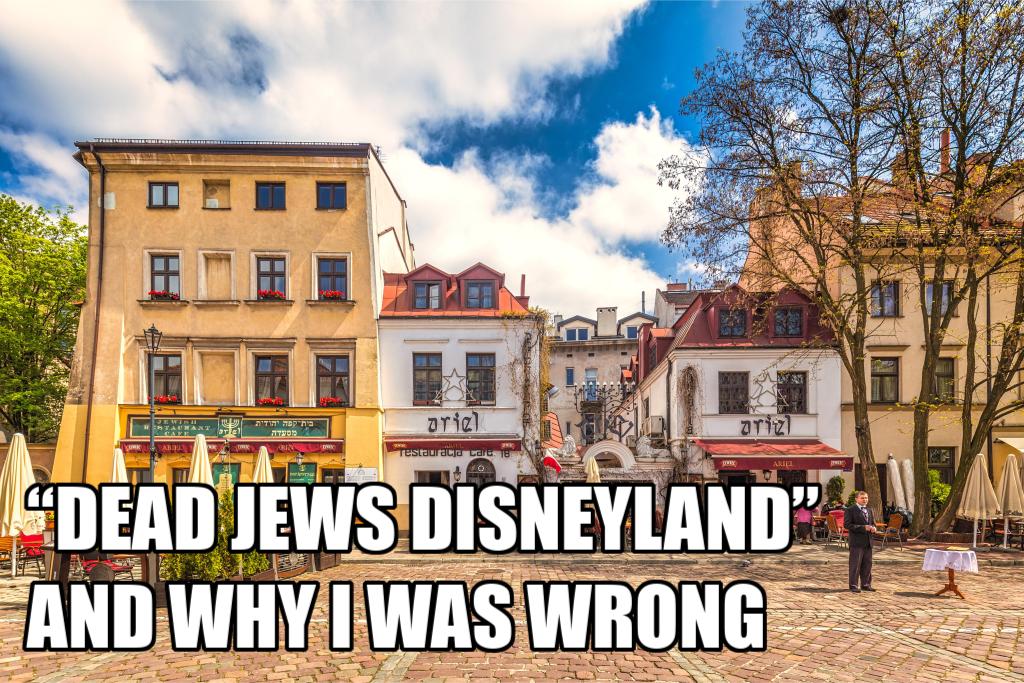
I have been back to Poland a few times since, and each visit only compounded my view. Poland, I concluded, is “Dead Jews Disneyland” — a country that has cynically developed itself into a tourist trap for Jews eager to capture some sentiment, some whiff of history, from the centuries of Jewish residence in this Central European country.
Walk through the center of Kazimierz in Cracow, and you’ll find street after street of Jewish-looking shops and Jewish-themed restaurants — run almost entirely by Polish gentiles, cheerfully relieving hapless Jewish tourists of their zlotys, tourists desperate to get even the smallest sense of a Jewish feeling in this place so steeped in Jewish history.
Never mind that the food isn’t kosher. Never mind that the “menorahs” for sale have seven branches. These details are set aside in the overwhelming drive to get into the vibe.
And Auschwitz. When we visited Auschwitz in 1991, my father parked his rental car on the side of the road next to the entrance, and we simply walked in. Just like that. No barriers, no queues, just a sleepy Polish guy in a ticket booth selling entry tickets.
Today there is a vast parking area, a state-of-the-art visitors center, timed-entry tickets — and a gift shop, diplomatically branded as a “bookstore.”
So you may be wondering: why on earth have I changed my mind? Surely things have only gotten worse since 1991? Jewish tourism to Poland has been totally commercialized. The latest estimates suggest it is worth somewhere between $150 million and $400 million a year. Mad! Absolutely mad! If I was cynical in 1991, I should be apoplectic in 2025.
And yet — here I am, a changed man. A repentant skeptic. Because the truth is this: Poland’s connection to who we are as Jews compels us to rise above all of it. What we get from our trips there is so much more than what we give, that what we give pales into insignificance.
Let me explain. And to do so, let me divide the Jewish experience of Poland into three.
First and foremost: a thousand years of Jewish history — and specifically, from the fifteenth century onwards, Poland was the cradle of Ashkenazi Jewish life, culture, and Torah.
And let’s be clear: “Poland” isn’t just the country called Poland today. It includes Lithuania, Belarus, large parts of Ukraine — all of which, at one time or another, were part of the greater Polish Commonwealth.
Where would we be without the Rema? Without the Tosfos Yom Tov, the Bach, the Taz, the Shach? Where would we be without the Baal Shem Tov, Reb Elimelech of Lizhensk, the Chozeh of Lublin, the Megaleh Amukos?
Where would we be without Bialystok and Volozhin, Brisk and Posen, Sadiger, Sanz, Bobov, Cracow, Lodz — the list goes on and on.
The Vilna Gaon and the Alter of Slabodka. Sarah Schenirer and the Bais Yaakov movement — launched in a small apartment in Cracow. Thousands upon thousands of seforim authored and published in Poland on every conceivable topic. And of course, the Yiddish language.
And yes — where would we be without gefilte fish and lokshen kugel? Some might say: in a better place! And they might be right!
But this first category — centuries of rich Jewish history — it runs deep in the heart of who we are as Jews. Every Jew — even Jews whose ancestry does not originate in Poland.
You cannot open a Gemara, a Shulchan Aruch, or a Chassidishe sefer — or eat a plate of chopped liver — without touching Poland.
Poland is not a foreign country to us. Poland is a chapter of our autobiography.
Second: praying at the graves of the holy tzaddikim — pouring our hearts out at the graves of those who inspired Jews while they were alive, and who continue to inspire us long after they are gone. All the names I mentioned, and so many more.
But here’s what struck me most. Wherever we went, it wasn’t just the graves — it was the hundreds of Jews who were there alongside us. Praying. Crying. Singing.
At the kever of Reb Elimelech in Lizhensk. At the Rema’s kever in the old cemetery of Cracow, just yards from where he wrote his commentary on Shulchan Aruch.
We encountered Jews from Belgium, from London, from Jerusalem, from New York, from Australia — literally everywhere. All of them returning to the mothership, to spend a few precious moments drawing inspiration at the final resting places of the greatest Jews of our past.
It was electrifying. These cemeteries are not dead places. I promise you — they are among the most alive Jewish places I have ever stood in.
And number three: the Holocaust. The horror of three million Jews – three million! – rounded up, ghettoized, starved, persecuted, and ultimately slaughtered. Together with millions more brought to Polish soil from across Europe to be murdered there.
And I will tell you this plainly: you cannot get a sense of it from books. Not from stories, not from movies, not from testimony, not from simply knowing it happened.
I am a historian. I have read the books — I have read more of the books than almost anyone I know. And nothing — nothing — compares to standing on location.
Standing on the ramp at Birkenau where families were torn apart with a flick of Mengele’s thumb. Standing in Majdanek. Standing next to the walls of the Warsaw Ghetto. Being there changes your perspective forever. It is life-changing. And everyone must do it.
These three reasons override my original cynicism. I stand corrected.
But here is what I really want to share with you — because it was only when I got back, and I opened the Chumash to Parshas Devarim, that it all finally crystallized for me.
אֵלֶּה הַדְּבָרִים אֲשֶׁר דִּבֶּר מֹשֶׁה אֶל־כָּל־יִשְׂרָאֵל בְּעֵבֶר הַיַּרְדֵּן — “These are the words which Moshe spoke to all of Israel on the far side of the Jordan” — and then, a bizarre travelogue — בַּמִּדְבָּר בָּעֲרָבָה מוֹל סוּף בֵּין־פָּארָן וּבֵין־תֹּפֶל וְלָבָן וַחֲצֵרֹת וְדִי זָהָב
An itinerary! A list of place names! Rashi, quoting the Sifrei, famously explains: these aren’t just geographical coordinates. Each name is a veiled reference to a place of national failure. Di Zahav — the golden calf. Chatzeiros — the rebellion of Korach. Paran — the sin of the spies.
Moshe Rabbeinu, in the last five weeks of his life, takes the entire Jewish people on a guided tour of their own catastrophes.
Moshe Rabbeinu — the greatest leader in our history — decides that the final message he must deliver, the message that will prepare this nation to enter the Land and build a future, is a heritage tour of painful memories.
He doesn’t say, “Let's look forward, let’s not dwell on the past, that’s all behind us.” Just the opposite. He says: these places are who you are.
You cannot cross the Jordan until you have revisited Di Zahav. You cannot build a future until you have walked, at least in memory, through the geography of your past — the glory and the failure, the triumph and the shame.
Devarim is Moshe Rabbeinu leading the first Jewish heritage trip in history. And Chazal tell us he delivered it (Deut. 1:5) בַּאֵר הֵיטֵב — with total clarity, in seventy languages — because this wasn’t a message for one generation. It was a template for eternity, teaching us that a nation that refuses to stand in the places of its pain will never understand the sources of its greatness.
And it goes deeper. This Shabbos is Shabbos Chazon — the Shabbos that always falls before Tisha B'Av. The Midrash in Eichah Rabbah points out something extraordinary: three prophets used the same searing word — Eichah.
Moshe, in Devarim (Deut. 1:12): אֵיכָה אֶשָּׂא לְבַדִּי טָרְחֲכֶם וּמַשַּׂאֲכֶם וְרִיבְכֶם — “How can I carry you alone?”
Yeshayahu, in the haftarah (Is. 1:21): אֵיכָה הָיְתָה לְזוֹנָה קִרְיָה נֶאֱמָנָה — “How has the faithful city become a harlot?”
And Yirmiyahu, in Megillas Eicha that we read on Tish B’Av night (La. 1:1): אֵיכָה יָשְׁבָה בָדָד הָעִיר רַבָּתִי עָם — “How does the city sit alone, that was once so full of people.”
Eichah. Eichah. Eichah. How? How? How?
I will tell you this: when you stand in Poland, that word, Eichah, is the only word in your mouth.
You stand in the magnificent, restored shul in Warsaw, or the one in Cracow, with no one to daven in them. Or in the ruins of the shul in Działoszyce, or in towns that were once fifty, sixty percent Jewish — and you say Eichah yashvah vadad — how does this town sit so alone?
You stand in Birkenau and language fails entirely, and all that is left is that one broken word: Eichah?
But here is the secret of the three Eichahs — and it is the secret of my change of heart. The word Eichah — איכה — is spelled exactly like the very first question Hashem ever asked a human being. After the sin in Gan Eden, Hashem calls out to Adam: “Ayekah?” — “Where are you?” Same letters. Different vocalization.
Every Eichah — every anguished “how could this happen?” — contains within it an Ayekah — “where are you now? And where are you going?”
Lamentation, in Judaism, is never an end in itself. The question “how did this happen” is always secretly the question “where do we go from here?”
That is why halacha ordains that mourning on Tisha B’Av breaks at midday — we rise from the floor while the day is still ongoing. Because a Jew is never permitted to hear the Eichah without hearing the Ayekah.
There’s a famous Gemara at the very end of Maseches Makkos. Rabban Gamliel, Rabbi Elazar ben Azaryah, Rabbi Yehoshua, and Rabbi Akiva are walking in Jerusalem after the destruction.
When they reach Har HaTzofim, they tear their garments. When they reach Har HaBayis itself, they see a fox emerging from the place of the Kodesh HaKodashim — the holiest spot on earth, and now it’s a den for scavengers.
The rabbis begin to weep. And Rabbi Akiva — laughs.
They turn to him, incredulous: “Akiva, why are you laughing?” And he answers: “the prophecies are linked. Uriah prophesied (Mic. 3:12) that צִיּוֹן שָׂדֶה תֵחָרֵשׁ – ‘Zion will be plowed like a field.’ Zechariah prophesied (Zec. 8:4–5) that עֹד יֵשְׁבוּ זְקֵנִים וּזְקֵנוֹת בִּרְחֹבוֹת יְרוּשָׁלִָם – ‘old men and women will yet again sit in the streets of Jerusalem.’”
Until I saw Uriah’s prophecy fulfilled with my own eyes, said Rabbi Akiva, I feared Zechariah’s might not come true. Now that I have seen the destruction — now I know I will see the rebuilding.”
And the rabbis respond: עֲקִיבָא נִחַמְתָּנוּ, עֲקִיבָא נִחַמְתָּנוּ — “Akiva, you have comforted us! Akiva, you have comforted us!”
Now, here is what nobody seems to notice about that Gemara. Rabbi Akiva knew perfectly well that the Temple had been destroyed. Everybody knew. It was hardly breaking news. He could have stayed in Bnei Brak, where he lived, and still known every detail.
So why did he and the other greatest sages of the generation travel to Jerusalem, to stand on the ruins, to look at the fox with their own eyes?
The answer is simple. Because Rabbi Akiva understood what I finally understood, standing in Poland last week: knowing about destruction and standing in the place of destruction are two entirely different experiences.
From a distance, destruction is information. Up close, destruction becomes vision — Chazon. And only vision has the power to transform.
The rabbis who stayed home wept no tears and gained no comfort. The rabbis who made the journey wept real tears — and it was precisely there, at the site of devastation itself, that they found nechamah. Not despite standing in the ruins. Because they stood in the ruins.
That fox on Temple Mount — I have seen that fox. He’s alive and well, and he’s running a “Jewish-style” restaurant in Kazimierz, in Cracow, serving treif borscht under a seven-branched menorah, with a klezmer trio made up of gentile musicians playing Jewish-sounding music.
Last week I finally learned to see the fox the way Rabbi Akiva saw it.
Because standing at the kever of the Rema, and singing next to the kever of the Tosfos Yom Tov, I realized that being there inspired me to work harder to ensure that what they did in their lifetimes will continue in my lifetime.
I stood on the ramp at Birkenau — the largest Jewish cemetery on earth, a place engineered with German precision to be the terminus of Jewish history — with a group of proud, learned, committed Jews, and we said Kaddish, and the words יִתְגַּדַּל וְיִתְקַדַּשׁ שְׁמֵיהּ רַבָּא rose over that cursed ground.
Hitler built Birkenau to ensure there would be no Jews left to say Kaddish. And there we stood, saying Kaddish.
My friends — Akiva, nichamtanu. You have to see the fulfillment of the churban with your own eyes to believe, with unshakeable certainty, in the fulfillment of the redemption. That is not “Dead Jews Disneyland.” That is the end of Maseches Makkos, playing out in real time.
Which brings me to the name of this Shabbos itself. Why is it called Shabbos Chazon — the Shabbos of Vision? The Berditchever Rav, Reb Levi Yitzchak, gives a breathtaking answer: on this Shabbos, every single Jewish soul is shown a vision of the third Beis HaMikdash. We may not consciously perceive it — but our neshamah sees it.
The Sfas Emes brings this same teaching in the name of his grandfather, the Chiddushei HaRim, founder of the Gerrer dynasty. And the Sfas Emes adds a layer of his own that, for me, is the key to everything I’ve already said.
The destruction was only ever external. The nekudah hapenimis — the inner point of kedushah — was never destroyed and can never be destroyed. Chazal say it themselves: the Shechinah, God’s presence, never departed from the Western Wall.
Destruction, in the Sfas Emes’s language, is hester — concealment, not annihilation. The outer walls may fall, but the inner point burns on, hidden and waiting.
And on Shabbos Chazon, Hashem pulls back the curtain — and shows each Jew, each according to what his or her eyes are capable of seeing, that the inner Mikdash is still standing.
Chazon is not a vision of something far away in the future. It is a vision of something already there, beneath the surface, all along.
Last week, we actually went to Gur. Góra Kalwaria — a small, sleepy town about an hour outside Warsaw. And we stood in front of the house of the Gerrer Rebbes — the house of the Chiddushei HaRim, of the Sfas Emes, of the Imrei Emes. The house from which, before the war, the largest chassidus in Poland was led — well over a hundred thousand chassidim, an empire of Torah and Avodas Hashem that shaped the entire face of Polish Jewry.
And I have to tell you — it was much smaller than I expected. Much smaller. I stood there thinking: this is it? This modest house, on this quiet street, in this unremarkable little town — this was the throbbing heart of a hundred thousand Jews?
And then I caught myself. Because that, of course, is precisely the point.
Greatness in the world of Polish Jewry was never measured in square footage. The Rebbe’s house in Gur — a modest building containing infinite worlds. The externals were always small. It was the nekudah hapenimis that was vast.
And here is a detail I will never forget. The wrought iron balcony — the balcony on which the Rebbe would stand as thousands of chassidim thronged the courtyard below, straining for a glimpse of his face — that balcony is still there. Original and intact.
The Nazis murdered the chassidim, but they never bothered to tear down the balcony. And for eighty years it stood over an empty courtyard — אֵיכָה יָשְׁבָה בָדָד — a balcony with no Rebbe on it, and no chassidim below it.
Except — not anymore. Because that house is owned once again by Gerrer chassidim. After everything — after the ghetto, after Auschwitz, after eighty years — the house of the Gerrer Rebbes in Poland belongs to the chassidim of Ger.
That is what the Sfas Emes means by Chazon. We do not visit the ruins to wallow. We visit the ruins to see — and a Jew who truly sees the churban is granted, in the very same glance, a vision of the binyan.
Eichah becomes Ayekah. The fox becomes the proof. The empty balcony becomes a promise. Chazon.
Let me finish with this. On Tish B’Av night, we will sit on the floor and we will read Megillas Eichah — the lament for a destruction we did not witness, in a city that was ruined 2,000 years before we were born.
Why? Because we are the people who refuse to let distance — in time or in geography — sever us from our own story.
We are the people of Eileh HaDevarim — the people whose greatest teacher spent his final weeks walking his nation back through the places of their pain, because he knew there is no path to the Promised Land that does not pass through them.
Poland is our Midbar. It is our Di Zahav and our Chatzeiros — and it is also our Mount Sinai, because Torah blazed there for a hundreds of years with a brilliance the world had never seen.
We do not go to Poland for the vibe, or the treif borscht, or the seven-branched menorahs. We go because Moshe Rabbeinu taught us that a nation walks into its future by standing in the places of its past.
We go because Rabbi Akiva taught us that only those who see the ruins with their own eyes can laugh with perfect faith at what is coming.
We go to say Kaddish in a place they were certain no Kaddish would ever again be said — and I promise you, there is no more powerful act of Jewish defiance, and no more powerful act of Jewish faith, available to any of us.
Tisha B’Av is called a mo’ed — a festival-in-waiting. The Midrash says Moshiach is born on Tisha B’Av. The blackest day on the calendar carries redemption inside it.
I went to Poland a skeptic. I came home comforted. Akiva, nichamtanu — nichamtanu.
May we be zocheh, speedily in our days, to the ultimate nechamah — when אֵיכָה יָשְׁבָה בָדָד, “how does she sit alone,” is answered forever by עֹד יֵשְׁבוּ זְקֵנִים וּזְקֵנוֹת בִּרְחֹבוֹת יְרוּשָׁלִָם — old men and old women sitting once more in the streets of Jerusalem, and the streets full of children playing.
And then we will all make one final heritage trip — all of us together, from Warsaw and Cracow, London and New York, Melbourne and Los Angeles — one last aliyah to a rebuilt Yerushalayim, bimheirah beyameinu, Amen.
TO FIND OUT MORE ABOUT GUIDED TRIPS TO POLAND, CONTACT PROJECT MESORAH
Image: Jewish-themed restaurants on Szeroka Street in Kazimierz district, Krakow.