

SILENCE IS THE WRONG ANSWER
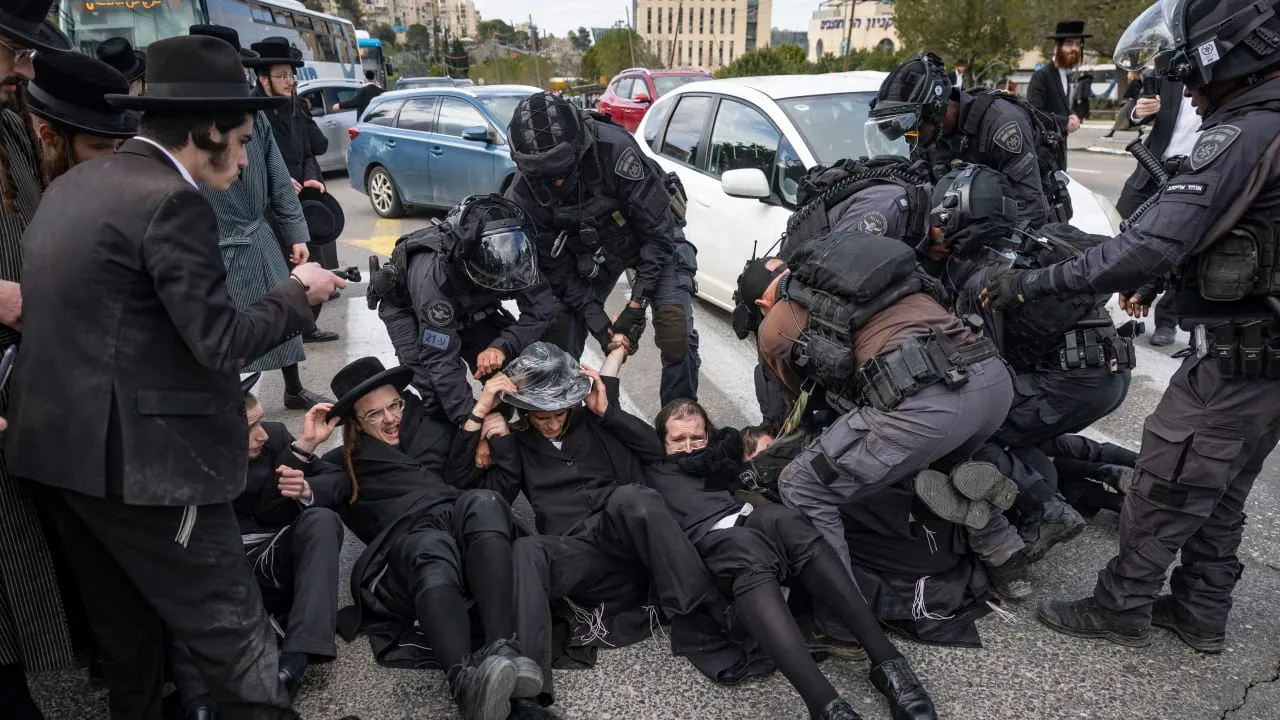
The article “Why Don’t Charedi Rabbanim Come Out Publicly Against Extremists?” is an elaborate defense of something that should be indefensible: namely, the refusal of responsible Charedi leadership to speak clearly when people acting in the name of Torah and the Charedi world create chaos, endanger the public, and cause an immense Chillul Hashem.
Its arguments may sound polished, but they collapse under examination. Let’s deal with them, one by one.
1. “The Torah already condemned it”
Of course the Torah condemns violence, vandalism, cruelty, hefkeirus, recklessness, and Chillul Hashem. Which is precisely why Charedi rabbinic leadership must say, clearly and unmistakably, that those prohibitions apply to these demonstrations in the here and now.
The Torah also condemns theft, fraud, abuse, lashon hara, lack of tznius, and countless other offenses. Nevertheless, Charedi rabbanim regularly issue public warnings when those problems become widespread, in response to egregious public examples, or when people slip into bad behavior and rationalize their conduct.
Nobody argues that because the Torah and the Shulchan Aruch already prohibited something, leaders are permanently excused from ever having to mention it again. Torah leadership means telling people how halacha should be applied today.
And especially when protesters believe they are defending Torah, they need to hear that blocking highways, stopping trains, intimidating motorists, damaging property, and endangering others are prohibited—even when the cause is presented as protecting yeshiva students.
“The Torah already spoke” is not a defense. It is an admission that the conduct is wrong, followed by a refusal to say so when saying so really matters.
2. “There is a double standard”
This is a straw man. Nobody is demanding collective Charedi guilt or asking the entire Charedi population to “grovel.” The expectation of condemnation is directed at leaders because the protests are being carried out over a central Charedi political and religious issue, in the name of protecting the Torah world.
This is not comparable to a random secular Jew committing fraud. A secular fraudster does not claim to act in the name of secular Jewry, and thousands of secular Jews do not shut down highways to support him.
Nor is it true that other communities are never expected to condemn serious misconduct committed in their name. Political leaders, military commanders, religious authorities, university presidents, and communal organizations are constantly called upon to respond when members of their constituencies engage in organized or ideologically motivated wrongdoing.
The relevant distinction is not whether the offender wears a black hat. It is whether the conduct is collective, repeated, ideological, and presented as representing the community’s interests and point of view.
Once protests are organized around the draft issue and conducted in the name of preserving Torah, Charedi leadership cannot dismiss them as the random behavior of disconnected individuals. They must react decisively.
3. “The extremists do not listen to the Gedolim”
This argument contradicts much of the rest of the article, and is also a total cop-out.
On the one hand, we are told that the protesters are entirely outside mainstream authority and would ignore anything the Gedolim said. This is truly hard to believe, and I would suggest that it is simply not true.
On the other hand, we are told that Charedi leadership effectively communicates communal standards through yeshivos, letters, internal guidance, and education.
Even assuming that the most extreme protesters would not listen, public condemnation would still serve several essential purposes.
It would tell mainstream yeshiva students not to join them.
It would tell parents and educators not to encourage or romanticize such behavior.
It would tell Charedi politicians not to excuse it or offer justifications for it.
And it would tell the police and the broader Israeli public that this conduct does not represent Torah Judaism.
Most importantly, it would draw a moral boundary. Surely that is important in and of itself.
Leadership is not judged only by whether its words instantly reform the most hardened fanatic. Leaders speak to everyone else as well. We do not refrain from denouncing terrorism, racism, abuse, or corruption merely because the worst offenders may ignore us. Public moral clarity has value even when criminals remain criminals.
And if the extremists truly reject all mainstream rabbinic authority, that is an even stronger reason for mainstream rabbanim to say publicly: these people do not represent us.
4. “Torah leaders communicate differently”
This is a red herring. Nobody has demanded X videos or television press conferences from Charedi Gedolim. A much-publicized signed letter would be perfect. A published notice that goes up in every shul would be great. Statements by Roshei Yeshiva delivered in the yeshiva beis medrash and then circulated through the normal Charedi channels would be an amazing way of communicating concern about the current anarchy.
The article itself lists the traditional mechanisms available: sichos, letters, rulings, and guidance.
Exactly. So where are they?
If the Gedolim have issued clear contemporary instructions condemning the blocking of roads, railways, attacks on police, dangerous interference with traffic, and public disorder during these protests, let those instructions be produced.
The problem is not the medium. The problem is the absence of an unambiguous message.
Saying “we communicate privately” cannot become an unfalsifiable excuse. If the public misconduct continues openly, repeatedly, and in large numbers, while the alleged internal condemnations remain invisible and ineffective, it is reasonable to ask whether a serious message was ever delivered.
In fact, the argument is circular. We are being asked to accept that the leaders are responding effectively, but any request for evidence of that response is dismissed on the grounds that it is private. Their silence is then presented as proof of their wisdom. That is not an argument.
5. “Silence is sometimes wiser”
Yes, Koheles teaches that there is a time to remain silent and a time to speak. The entire question is which time this is.
Quoting eis lachashos does not prove that silence is always appropriate. It merely states that silence is sometimes appropriate.
But when innocent people are trapped for hours, trains are halted, motorists are threatened, roads are obstructed, and the reputation of Torah Judaism is being dragged through the mud, this is very obviously an eis ledaber.
The article claims that condemnation might create another news cycle. That is another cop-out. The protests themselves are creating the news cycle. Silence does not make the events disappear. It allows the public at large to reasonably conclude that influential Charedi leaders are unwilling to oppose them.
The article turns silence into an almost mystical virtue: silence is “dignity,” it is “strength,” it is “confidence,” it is “wisdom.” But silence can also be fear, political convenience, moral confusion, or unwillingness to confront one’s own extremists. And that is the conclusion that people will come to.
One cannot establish the righteousness of silence simply by praising silence. Sometimes silence protects dignity. Sometimes—and I think this is such an occasion—silence protects wrongdoing.
6. “A headline will not change a fanatic”
Again, this misunderstands the function of leadership. A rabbinic statement is not a behavior-modification experiment aimed at the man setting fire to a dumpster. It establishes the position of the Torah community, whether or not the arsonist continues on his rampage.
Would every participant listen to the Gedolim? Perhaps not. But would some bachurim stay away if their Roshei Yeshiva or rebbes explicitly prohibited participation? Almost certainly.
Would parents think twice before encouraging their sons to join? Probably.
Would political activists find it harder to portray lawlessness as a mitzvah? Yes.
Would ordinary Israelis see that Torah leadership understands their suffering and rejects its exploitation? Yes.
A statement does not need to achieve one hundred percent compliance to be morally necessary or practically worthwhile. By the article’s logic, leaders should rarely condemn anything, because determined wrongdoers often ignore condemnation. But that is not leadership. It is abdication.
7. “The Charedi world deals with extremism internally”
The evidence offered for this is simply the claim itself. The article says yeshivos instill derech eretz, families teach self-control, and communal institutions reinforce dignified conduct. All of that may be true in general. But it does not answer the specific issue.
And right now, it seems as if all these internal safeguards—if they exist as claimed—have failed completely.
In any event, when these mass disturbances break out, the relevant question is not whether most Charedim are decent people. Of course they are. The question is whether leaders have done enough to prevent Charedi young men from participating in public lawlessness, to stop activists from glorifying it, and to make clear that a supposedly righteous cause does not permit conduct that harms the public.
The fact that most Charedim do not riot is not proof that the leadership has adequately confronted those who do. Most members of every community are law-abiding. But that does not relieve leaders of responsibility when organized extremists claim to act on the community’s behalf.
8. “The protesters are merely a tiny fringe”
Even if this were completely true—and the scale and frequency of these demonstrations make that claim difficult to accept—it would not solve the problem.
A small number of people can create enormous damage, particularly when they repeatedly block major arteries and railway lines. The moral significance of the behavior is not determined by the percentage of the community participating.
But the “tiny fringe” defense also obscures an uncomfortable reality. These protests do not emerge from nowhere. They operate within a broader atmosphere in which draft enforcement is described in apocalyptic terms, arrested evaders are treated as martyrs, and confrontation with the state is often celebrated as resistance to persecution.
Responsible leadership cannot cultivate maximalist rhetoric, benefit politically from communal anger, and then declare that the people who take that rhetoric into the streets have nothing to do with them. Leaders are responsible not only for explicit instructions but also for the culture, language, and expectations they create.
9. “Public condemnation is merely performance for hostile outsiders”
This is perhaps the most revealing argument in the article. The assumption is that any public statement must be directed toward the media, The New York Times, X, or secular approval.
But a public condemnation would first and foremost be directed toward the people whose journeys were ruined, toward parents trapped in cars with children, and toward those trying to reach hospitals, airports, work, funerals, weddings, or military bases.
And how about toward Charedim who are embarrassed by conduct committed in their name?
This is not about satisfying hostile outsiders. It is about Kiddush Hashem, moral responsibility, and elementary concern for one’s fellow Jews.
10. “The Torah world does not need outside approval”
Correct. It does not need outside approval. But does that mean it has no obligations toward outsiders—or toward every Jew affected by its actions?
Torah leadership is not accountable to social media fashion. But it is accountable to Torah, and to upholding halacha.
That includes bein adam lachaveiro. It includes preventing damage. It includes concern for public safety. And it includes avoiding Chillul Hashem.
It also includes accepting responsibility when behavior associated with one’s community causes widespread suffering.
The issue is not whether the Torah world needs validation from the secular public. The issue is whether it owes the public basic decency. Any rational person would say that it does.
11. The article confuses condemnation with collective guilt
A leader who condemns wrongdoing is not accepting collective guilt. On the contrary, he is explicitly rejecting it.
A clear statement would say: these actions are not ours, they are not sanctioned by Torah, they are not a legitimate expression of our struggle—and those who are doing it should stop.
That does not humiliate the Charedi community. It protects its honor. What damages the community is not condemnation of rioting. What damages it is the spectacle of people behaving disgracefully, who are clearly Charedim, while their recognized leaders appear incapable of saying—or unwilling to say—a public word against it.
12. The real question the article avoids
The real question is not: “Why has no Gadol held a Western-style media press conference every time a fringe Charedi behaves badly?”
The real question is: “When organized protests carried out in defense of the Charedi position on army service repeatedly descend into mass disruption, danger, intimidation, and Chillul Hashem, why do the most influential Charedi leaders not issue a clear, public, and contemporary statement to say that such conduct is forbidden?”
The article never answers that question. Instead, it speaks about solitary fringe individuals, hostile media, X, press conferences, Neturei Karta, secular double standards, and the philosophical virtues of silence.
All of this is beside the point. Nobody is asking the Gedolim to apologize for every badly behaved individual wearing a black hat. But when organized groups act in the name of Torah, over an issue at the very center of Charedi public life, and inflict widespread suffering on the public, responsible Torah leadership must say clearly and publicly: This is wrong. This is forbidden. And it must stop.
That is not capitulation to hostile outsiders, it is not public relations, and it is not “groveling.” It is leadership. It really is that simple.

(For the SoundCloud audio, scroll down) Why can a person have everything and still feel empty? Parshat Ki Tavo offers a startling answer: fulfillment depends not on what we possess,... Read More