

THE PRICE OF A POLITICAL FAVOR
If you were looking for a nineteenth-century American politician who looked exactly like a nineteenth-century American politician ought to look, it would be difficult to find someone better than the unimprovably named Roscoe Conkling.
Conkling was a Republican senator from New York during the Gilded Age, and he looked the part. He was handsome, vain, flamboyant, and magnificently dressed.
While other senators generally dressed in sober black, Conkling appeared in bright green pants, shocking red coats, gold lace, striped shirts and—wait for it—yellow shoes. And above all, there was the hair: an elaborate curl on his forehead, accompanied by a rabbinic looking beard that commonly accompanied political office in late nineteenth-century America.
But Roscoe Conkling was not just a dashing dandy. He was one of the most powerful political bosses in the United States.
Let me explain why. It was all about something called the ‘spoils system’. For much of the nineteenth century, thousands of civil service jobs were handed out as political rewards. The expression the ‘spoils system’ came from the phrase “to the victor belong the spoils.” If you won an election, you suddenly had jobs to distribute among the people who had helped you win.
There was no piece of political currency more valuable than the New York Custom House. New York was America’s great port, and the Custom House collected enormous sums in import duties and employed hundreds of people. Roscoe Conkling used control over those appointments to build one of the most formidable Republican political machines in the country.
One of Conkling’s most trusted lieutenants was Chester Alan Arthur. Inevitably, Arthur was almost as visually impressive as Conkling. He had enormous side-whiskers, exquisite clothes, expensive tastes, and reportedly owned something approaching eighty pairs of trousers. He became known as the “Gentleman Boss.”
Chester Arthur was undoubtedly intelligent and administratively gifted, but he owed his political rise to Conkling. And it wasn’t just jobs – the money flowed like water. Custom House employees were expected to make political contributions known as “assessments,” effectively kicking back part of their salaries to the Republican machine.
Arthur was not accused of pocketing government money, but he operated comfortably inside a system where public employment and partisan loyalty were intertwined, and being art of that machine was financially lucrative.
In 1878, President Hayes removed Chester Arthur as part of a civil-service reform effort. Conkling was furious. To him, control of appointments was simply how politics worked. He called it “snivel service reform.”
Then came the presidential election of 1880. Conkling led a group called the Republican Stalwarts, who defended patronage. James Garfield, who wasn’t a Stalwart, emerged as the presidential nominee, but he placed Chester Arthur on the ticket as vice president to appease Conkling and his faction.
Garfield won, and almost immediately there was trouble. He had no intention of allowing Conkling to control every important federal appointment in New York.
When Garfield nominated someone Conkling opposed to run the Custom House, Conkling went crazy, and – as was later reported – “raged and roared like a bull” on the Senate floor.
In an attempt to force Garfield’s hand, he dramatically resigned his Senate seat expecting to be triumphantly reelected. But he wasn’t.
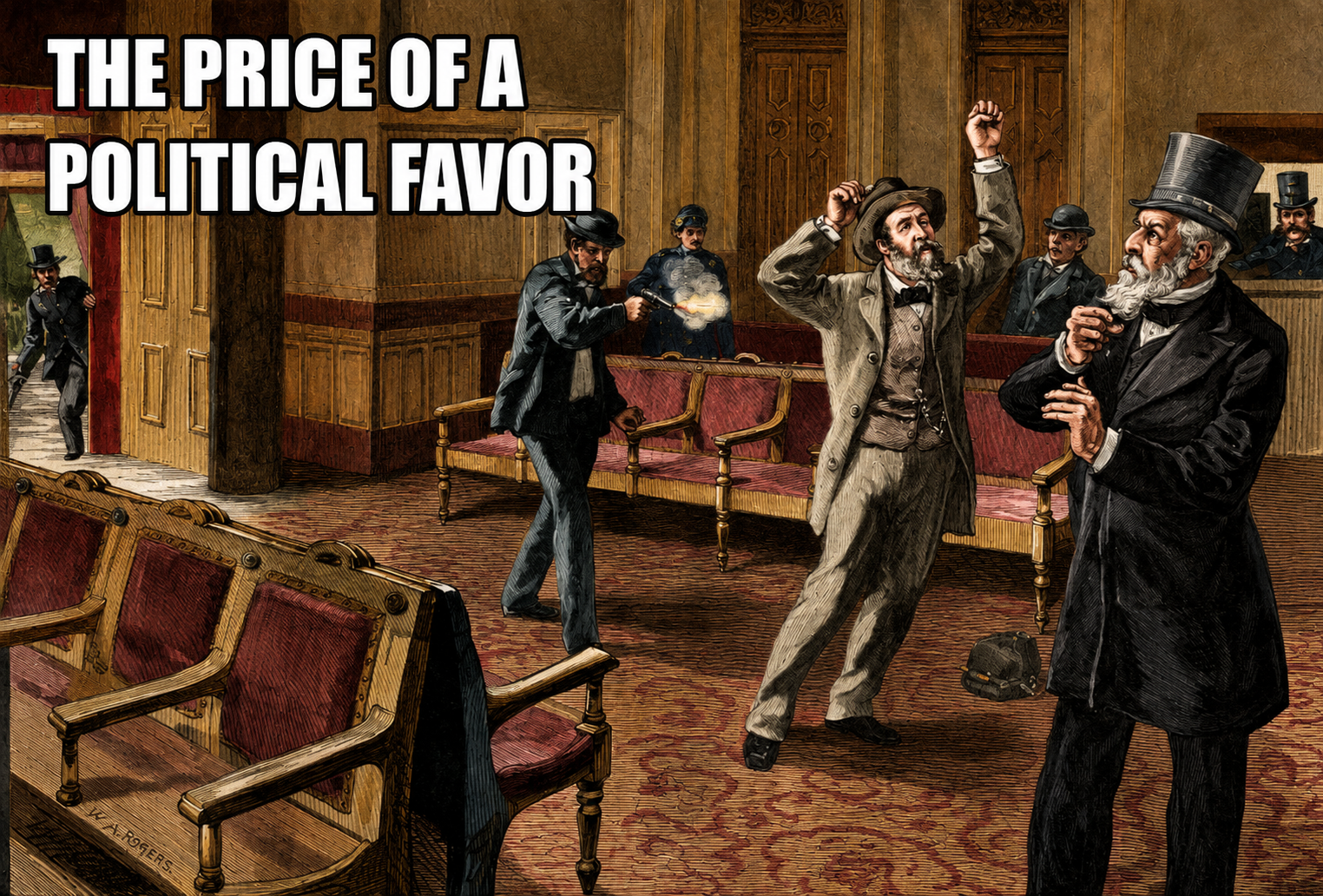
And then things became much darker. Among the odd characters hovering around Washington was Charles Julius Guiteau, a deeply unstable man convinced that he deserved a diplomatic appointment for his supposed contribution to Garfield’s election success.
Guiteau wanted to be American consul in Paris. There were several problems with this proposal, but perhaps the most relevant one was that he had no qualifications whatsoever to be American consul in Paris. But under the spoils system, he believed that because he had helped Garfield, he was owed a job. He repeatedly appeared at the White House and State Department until people stopped seeing him.
So Guiteau reached an extraordinary conclusion: if Garfield would not reward him, perhaps Chester Arthur would—if Arthur were president.
On July 2, 1881, Guiteau approached Garfield at a Washington railway station and shot him. Garfield lingered for eleven agonizing weeks before dying on September 19. And then the unthinkable happened: Chester Arthur became the 21st president of the United States.
We will get back to that in a moment, because first I want to turn to Parshat Shoftim.
Parshat Shoftim begins (Deut. 16:18): שֹׁפְטִים וְשֹׁטְרִים תִּתֶּן לְךָ בְּכָל שְׁעָרֶיךָ — “Judges and officers shall you appoint for yourself in all your gates.”
We usually focus on what comes next: judges must judge fairly, and so on. They must not distort justice, they must not show favoritism, they must not accept bribes. Which is all true and good.
But notice what the Torah says first: תִּתֶּן לְךָ — you shall appoint. Before the Torah discusses how a judge behaves once he is sitting in the judges chair, it addresses the people responsible for putting him there.
Justice can be corrupted long before they accept a bribe. You can have impressive robes, beautiful courtrooms, and elaborate procedures. But if a judge is chosen because they are somebody’s cousin, or donor, or political ally, or obedient supporter, then the corruption happened before the first case was ever heard.
The Torah is telling us: justice begins with appointments.
Rashi explains that we must appoint judges who are qualified and righteous. The Rambam is even more specific, listing seven qualities required of judges: wisdom, humility, fear of God, hatred of money, love of truth, love of people, and a good reputation.
These qualities recall the criteria laid out in Parshat Yitro.
Which reminds me of a great story. Soon after Israel’s creation, Rabbi Yehuda Leib Maimon, the first minister of religions, proposed reestablishing the Sanhedrin.
David Ben-Gurion asked him: “But where are you going to find seventy-one rabbis who hate money?”
Maimon grinned. “For money, you can buy anything—even people who hate money.”
Needless to say, the modern-day Sanhedrin never came into being.
But Chazal go even further. The Gemara in Sanhedrin says that someone who appoints an unsuitable judge is like someone who plants an Asherah, an idolatrous tree, beside the altar.
That is astonishing. Appoint the wrong person for the wrong reason, and the Talmud does not call it a minor administrative error. It compares it to idolatry.
Why? Because an appointment reveals what the institution really serves. If I give someone authority because he is wise, honest and qualified, the institution serves its purpose.
But if I give them authority because they are rich, or connected, or loyal to me, or useful to me, the institution no longer serves justice. It serves me.
And that is a form of idolatry. Something meant to serve God and His people has been turned into an instrument serving human power.
Which brings us back to Conkling and Arthur. The deepest problem with the spoils system was not that an occasional incompetent postmaster got a job. It was that public office had become private property—so completely that one deranged man ultimately shot a president because he believed political support entitled him to an appointment.
This is precisely why Parshat Shoftim places appointment before judgment. If you appoint people because they flatter you, eventually you will be surrounded by flatterers. If you promote people because they never disagree with you, soon nobody will tell you when you are wrong. If loyalty matters more than competence, competence will disappear.
There is an enormous temptation in leadership to surround yourself with people who agree with you. They are easier to deal with. But easy is not necessarily good.
And here is where Chester Arthur’s story becomes remarkable. When Garfield died, Americans were horrified not only because their president had been assassinated, but because of who would replace him.
Chester Arthur? Roscoe Conkling’s man? The Gentleman Boss? The former Custom House collector whose career had been built inside the patronage machine? It seemed almost as if the spoils system itself had assassinated Garfield and moved into the White House.
But something unexpected happened. Chester Arthur changed.
As president, he increasingly acted independently of the machine that had created him. In January 1883, he signed the Pendleton Civil Service Reform Act, beginning the process of replacing political patronage with a professional civil service in which appointments increasingly depended upon merit and competitive examinations.
There is something wonderfully ironic about this. The man who rose through the spoils system helped dismantle it. The beneficiary of patronage helped establish merit. The political operative became president, and discovered that responsibility required him to rise above the people who had put him there.
And that is also part of the lesson of Shoftim. We often imagine corruption as a question of good people and bad people. But real life is far more complicated.
Systems shape people. A decent person inside a rotten system can begin doing things they would once have regarded as unacceptable. “That’s how things work.” “Everybody does it.” “That’s how you get things done.”
But sometimes the reverse happens. Responsibility can elevate someone. A person can inherit a flawed institution and decide not simply to continue what everyone before them did. If they understand צֶדֶק צֶדֶק תִּרְדֹּף—justice, justice shall you pursue, then whatever propelled them to power can take second place to what the position now demands of them.
Chester Arthur did not become a saint. His presidency was complicated, and some of his policies were deeply objectionable. But on the issue that had defined his political rise, he did something genuinely impressive: He refused to remain the creature of the system that created him.
And perhaps that is the real challenge of Shoftim. We worry whether people in authority will make good decisions. The Torah asks us to look one stage earlier: how did they get there? Why were they chosen? What did those who appointed them expect in return?
Because צֶדֶק צֶדֶק תִּרְדֹּף does not begin with the verdict. It begins with who gets the chair.
And guess what, every one of us makes appointments every day. We decide which voices we trust, which habits we allow to govern us, which fears we give authority to, and which values get the final word when life becomes difficult.
We appoint certain people to enormous influence over us for all the wrong reasons. Or we allow anger or our own bias to become a judge. We allow convenience to become an adviser. We allow social pressure to become a supreme court.
And once those appointments are made, the decisions that follow are rarely neutral. If ego is sitting in the judge’s chair, it will almost always find in our favor. If resentment is on the bench, every piece of evidence will somehow confirm that we were wronged. If convenience is making the ruling, duty will suddenly seem unreasonable. If fear has been given authority, courage will always look reckless.
Parshat Shoftim is asking us to look one stage earlier. Before we ask whether the decision was right, we have to ask: who, or what, did I allow to make it? What have I given authority over my judgment? What have I promoted within myself simply because it tells me what I want to hear?
Because every life has a court, and every day we make appointments to the bench. The quality of our decisions will depend, more than we realize, on who we allow to sit there. We need to make sure, for ourselves, that we always appoint the right judges.

(For the SoundCloud audio, scroll down) Last week, California State Senator Scott Wiener introduced a proposal that is pure San Francisco. He wants the tunnel through Yerba Buena Island, which... Read More