

THIS DELIVERY IS FOR MRS. TOTTENHAM
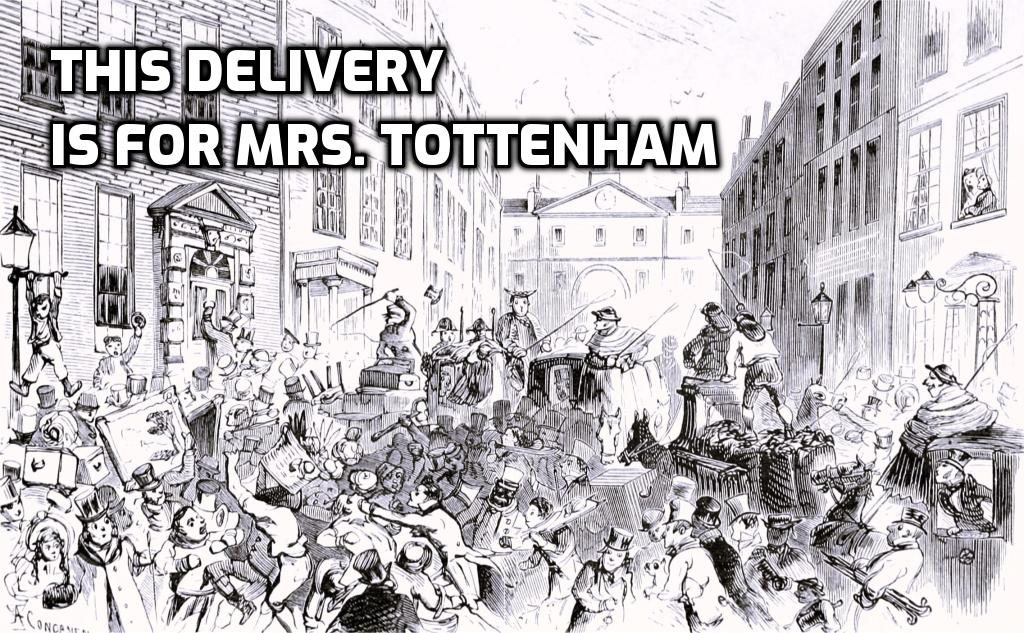
In the early nineteenth century, a young English writer named Theodore Hook made an extraordinary, apparently spontaneous wager with a friend. He claimed that he could transform any ordinary house in London into the most talked-about address in the city. His friend was intrigued and took the bait.
The house Hook selected was 54 Berners Street, the respectable home of an unsuspecting woman called Mrs. Tottenham.
But the wager was not quite as spontaneous as it appeared. Hook had already spent several weeks writing thousands of letters to tradespeople, businesses and service providers. Each letter contained a request, an order for goods, or an urgent summons—but every one of them directed the recipient to the same address.
The pretext differed depending on who received the letter, but the instructions were always the same: call on Mrs. Tottenham at 54 Berners Street.
The results, which came to be known as the Berners Street Hoax, were spectacular.
At 5:00 a.m. on November 27, 1810, chimney sweeps began arriving at the house. They were followed by carts laden with coal, bakers carrying elaborate wedding cakes, bootmakers with leather for shoes, doctors, lawyers, furniture dealers, piano merchants, and tradesmen of every imaginable description.
At some point, an undertaker arrived with a coffin made to Mrs. Tottenham’s measurements.
Then came the dignitaries. The Lord Mayor of London appeared in full regalia. So did the Chairman of the Bank of England and the Duke of Gloucester. Each was responding to a carefully crafted letter persuading him that his presence was urgently required by Mrs. Tottenham at 54 Berners Street.
Before long, Berners Street was completely gridlocked. Carriages could not move. Deliveries were abandoned at the roadside. Crowds gathered to watch the spectacle, and the police were called to restore order.
Meanwhile, Hook and his friends had rented rooms in the house opposite 54 Berners Street so that they could observe the proceedings. And they watched all day as forty fishmongers, forty butchers, fifty pastry chefs carrying a total of 2,500 raspberry tarts, and countless other visitors knocked on the door and asked for Mrs. Tottenham.
It was, by any measure, a brilliant practical joke. It was also appallingly cruel.
Mrs. Tottenham had done nothing to deserve the ordeal. It would appear that Hook did not even know her personally. The tradesmen lost time, money and merchandise. Horses and carts became trapped. The authorities were forced to waste valuable time intervening in a crisis manufactured for someone else’s amusement.
In the immediate aftermath, Hook decided that it would be wise to leave London for a while. Although he was widely suspected as time went on, he suffered no consequences.
But the most fascinating aspect of the Berners Street Hoax is not simply that Hook pulled it off. It is that while it was unfolding, he did nothing but watch.
He did not deliver the coal. He did not bake the cakes. He did not carry the furniture. He did not summon the dignitaries or bring the coffin.
All he did was write a collection of letters. Then he sat back and watched everyone else do the work.
Everyone else delivered the lie for him. Each person arrived believing that he was responding to a legitimate request.
Taken separately, every action of every visitor to 54 Berners Street was perfectly reasonable. A baker delivered a cake. A chimney sweep arrived to clean a chimney. An undertaker responded to a bereaved family.
But when hundreds of reasonable actions were combined, they produced complete chaos—because every one of them had been triggered by false information.
The Berners Street Hoax occurred more than two centuries ago, but it is difficult to imagine a story more perfectly suited to our own age.
There is, however, one significant difference. Theodore Hook needed weeks of preparation, an enormous quantity of stationery, and the logistical ability to deliver thousands of letters.
Today, all he would need is a smartphone, an X account, email, and WhatsApp.
We have all seen it happen. A false accusation is posted online. A misleading video is circulated without context. An anonymous message appears in a WhatsApp group. Within minutes, thousands of people have forwarded it, commented on it, and added their own seemingly trivial but potentially damaging observations.
No one has checked whether the original claim is true. Like the chimney sweeps and the Lord Mayor of London, they assume that the message is genuine, and they run with the ball. Meanwhile, the smartphone hoaxer is sitting across the road from 54 Berners Street, as it were, enjoying the show.
Reputations are damaged. Careers are destroyed. Communities are divided. There can even be violence.
Everyone involved offers the same defense: “I didn’t create the problem. I only shared it.”
But that is precisely the problem.
Theodore Hook created the lie, but the lie could do nothing on its own. It needed hundreds of perfectly respectable people to give it life. It needed their carts, their horses, their merchandise, their time—and, above all, their willingness to act on something they had received without first establishing whether it was true.
The opening words of Parshat Eikev speak to precisely this point, but from the opposite direction. Theodore Hook’s victims listened to a lie and turned it into action. Eikev describes what happens when people listen to truth and turn it into action (Deut. 7:12): וְהָיָה עֵקֶב תִּשְׁמְעוּן אֵת הַמִּשְׁפָּטִים הָאֵלֶּה וּשְׁמַרְתֶּם וַעֲשִׂיתֶם אֹתָם – “And it shall be, as a consequence of your listening to these laws, and observing them and carrying them out…”
The word eikev is usually translated here as “because” or “as a consequence of.” But it is an unusual choice. The more familiar meaning of eikev is “heel.”
Rashi, quoting the Midrash, famously explains that the verse refers to those commandments people regard as minor—the mitzvot they casually trample beneath their heels. God promises His blessing when we take even those apparently insignificant obligations seriously.
But perhaps there is another message hidden in the extraordinary juxtaposition at the beginning of the verse: eikev tishme’un—the heel and listening.
The verse brings listening and the heel into a single phrase. What enters through our ears does not necessarily remain there. It travels through us, shapes our judgment, influences our behavior, and eventually expresses itself in the way we walk through the world.
The Torah’s use of the word shema—to hear or listen—frequently implies far more than the passive reception of sound. To listen in Torah language means to absorb, to engage with, and ultimately to respond.
The Berners Street Hoax reveals the reverse side of exactly the same process.
Every person who appeared at 54 Berners Street had put feet beneath Theodore Hook’s lie.
They received a message, accepted it as true, and acted on it. They carried the falsehood out of Hook’s imagination and into the real world. That was how an envelope containing a letter became a cartload of coal, a wedding cake, a coffin, and eventually a completely paralyzed London street.
When the information we absorb is false, misleading or malicious, and we nevertheless act on it, the same mechanism that can produce blessing instead produces chaos.
Every piece of information has an eikev—a consequence. And the person who passes it on becomes part of that consequence.
Listening is not morally neutral. The moment we allow what we have heard to influence our actions—or transmit it so that it influences the actions of others—we acquire responsibility for what follows.
We may not be responsible in the same way as the person who invented the lie, but neither are we innocent bystanders.
This casts new light on the Torah’s striking formulation in Shemot (Ex. 23:1): לֹא תִשָּׂא שֵׁמַע שָׁוְא – “Do not carry a false report.” The Torah does not say, “Do not invent a false report.” Nor does it say, “Do not believe a false report.” It says: do not carry one.
A lie needs carriers. Without them, it remains where it began—in the mouth, in the mind, or on the smartphone of the person who invented it. Its destructive potential is unleashed only when others agree to pick it up and take it somewhere else.
Forwarding a message can seem meaningless. It takes less than a second. One tap of the screen, and it is done. We did not compose the accusation. We did not claim firsthand knowledge. We simply passed along something that someone else sent us.
We reserve our moral concern for what we regard as serious wrongdoing: theft, violence, fraud and deliberate cruelty.
But forwarding an unverified message? Reposting a sensational accusation? Adding an indignant comment to a story whose details we have not checked?
These seem like small things. Eikev warns us that small things are often not so small at all.
The mitzvot people trample beneath their heels are a problem precisely because they do not feel consequential. We treat them casually, almost absentmindedly, without considering where they may lead.
The same is true online. One repost may appear insignificant. One forwarded message seems unlikely to make any difference. One speculative comment feels harmless.
But thousands of supposedly insignificant actions can destroy a reputation, rupture a family, tear apart a community, or inflame an already dangerous situation.
The temptation is particularly strong when the information confirms something we already believe. When a damaging report concerns someone we dislike, we become remarkably undemanding about evidence. When it supports our political position or reinforces our opinion of another group, we rarely stop to question its source.
We want the story to be true so badly that we allow wanting it to be true to substitute for knowing that it is true.
Of course, no one can conduct a full investigation into every piece of information they receive. But when a claim has the potential to harm another person, we have an obligation to pause.
Who is the source? Is the account firsthand? Is there supporting evidence? Has the message been edited or stripped of context? Would we repeat it publicly if our own name and reputation were attached to it?
And perhaps the most important question of all: what will happen if I carry this message forward and it turns out not to be true?
Eikev begins with blessing, but the blessing depends on how we listen. Not everything that reaches our ears deserves to reach our heels. Not every message we receive deserves movement. Not every allegation deserves a delivery service.
Theodore Hook wrote the letters and set the deception in motion. But his prank only became the Berners Street Hoax because hundreds of perfectly ordinary people converted his words into action.
Had they paused, checked, or refused to carry what they could not verify, 54 Berners Street would have remained an entirely unremarkable London address.
That is the warning embedded in Eikev. What enters through our ears does not remain there. It travels into the world through our decisions, our actions, and the things we choose to pass on. Once we give a lie movement, we can no longer claim that its consequences belong only to the person who invented it.
Theodore Hook wrote the lie. London delivered it.
A lie may have one author—but everyone who carries it becomes part of its consequence.


(For the SoundCloud audio, scroll down) Can a Jew ever be too far gone? In 1917, more than four centuries after Portugal forced its Jews into hiding, Polish Jew Samuel... Read More