

LUBLIN YESHIVA LIVES ON
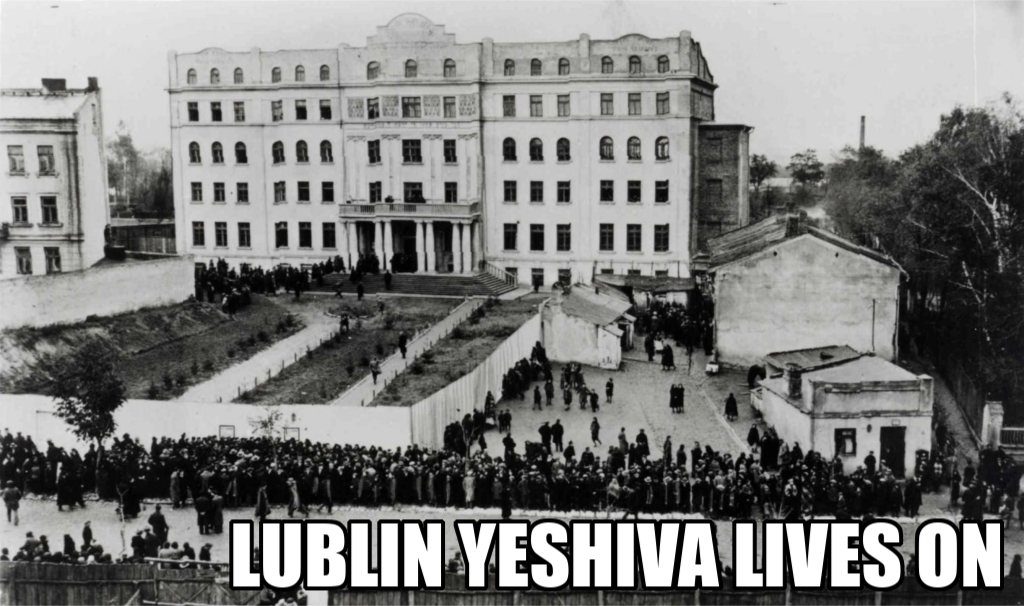
Earlier this week, together with a group from America and the UK brought together by Project Mesorah, I stood inside the original building of Yeshivas Chachmei Lublin, in Lublin, Poland.
Initiated in 1924, and opened in 1930, this magnificent structure was a superlative center of Jewish learning in the last years before the Holocaust. It was only active as a yeshiva for 9 years, before being shut down following the Nazi invasion of Poland, never to reopen again.
As we moved through the various rooms and spaces in the still impressive structure, I shared stories of the towering figures who shaped the yeshiva during its brief period of existence — Rabbi Meir Shapiro, the visionary founder of the yeshiva; Rabbi Avraham Shimon ha-Levi Engel-Horowitz, the encyclopedic powerhouse better remembered as Reb Shimele Zelichover; and Rabbi Aryeh Tzvi Frommer, the Kozhiglover Rav, whose depth and fire left an indelible mark on his students and so many others.
Initially, I focused on the fact that these giants had once existed and flourished, but now were gone. But the more I spoke, the more I realized that the real story of Chachmei Lublin is not simply what happened there when the yeshiva was up and running. Because truthfully, the real story is that Yeshivas Chachmei Lublin is much more than a nostalgic memory – it is still very much alive in the here and now.
That may sound strange. After all, the Nazis destroyed Lublin and all its great scholars. The vast majority of the students were murdered, and the few that remained were scattered across the globe, mere reflections of the full glory of the yeshiva that produced them.
And meanwhile, back in Lublin, the beit midrash that once thundered with Torah learning is an empty, silent room – almost mockingly silent compared to what it once must have been. And the institution itself is no more. By every ordinary historical measure, Chachmei Lublin is a story of destruction and decay.
But Jews do not measure history in ordinary ways. During the Three Weeks, we mourn the destruction of the Jerusalem Temple, which was ripped away from us some 2,000 years ago.
The thing is, if the Temple is gone, and Jewish life is thriving without it, why mourn it at all? Why mention it every day in our prayers? Why break a glass under the chuppah in its memory? Why leave part of our home unfinished, to recall a distant and irrelevant ruin?
Indeed, why turn our faces toward Jerusalem when we pray? Or sit on the floor on Tisha B’Av to weep over a building that has not stood for nearly two thousand years.
The reason is that rather than having been airbrushed out of our existence, the Temple very much lives on – in our shuls, in our homes, and in our prayers. It lives on for the very reason that we refuse to allow its destruction to be the final word. And that is how I felt this week in Chachmei Lublin.
The late Rabbi Pinchas Hirschprung of Montreal, one of the great students of the yeshiva who survived the Holocaust, returned to his alma mater in 1977, almost forty years after the Nazis had forced its doors to shut for good.
During his visit, he stood in the room where he had once slept as a young boy — Room 62 – and he sat in the very same seat where he had once prayed and studied as a student decades earlier.
He commented later that he had never experienced the intense feelings he felt during that visit, not even on Yom Kippur. He truly wept over the loss of his beloved yeshiva. He wasn’t just remembering the yeshiva, he was reliving it. He sat in his old place, and suddenly the decades of separation were irrelevant.
The young boy was there again. The beit midrash was alive again. The impassioned voices resonated. The holiness returned. And yes, the pain returned too — but it was not the pain of a vacuum. Rather, it was the pain of a memory that refuses to let that holiness disappear.
The next day after our visit to Chachmei Lublin, our group visited Auschwitz-Birkenau. There are no adequate words for Auschwitz. There are facts, there are numbers, there are photographs, there are the rooms full of shoes, glasses, suitcases, pots and pans, and the shocking sight of the hair of thousands of victims. But words fail in the face of a place that was engineered for the industrial annihilation of a people.
As we stood there, surrounded by that vast factory of death, one member of our group — the child of Polish Holocaust survivors — took my hand. In a voice that shook with emotion, he asked, “Rabbi, how do you explain the murder of six million Jews? How does it make any sense?”
I looked around me at the vastness of Auschwitz-Birkenau, and I had no meaningful answer. Because there is no neat answer. There is no theological formula that makes the evil, the screams, the children, the mothers, the fathers, the starvation, the selections, the gas chambers, or the ashes, make any sense.
So I told him the only thing I could honestly say. Auschwitz and the death of millions of Jews in that senseless slaughter does not offer any answers. But what it does offer me is a sense of responsibility.
It inspires me to do more to build Jewish identity and to strengthen Jewish life. It motivates me to teach Torah more passionately and to bring Jews closer to who they are, and to ensure that the devastation we saw at Auschwitz is not an end, but a beginning. That is the deeper Jewish response to destruction. He did not answer me; he simply pressed my hand a little tighter, and we stood in silence together.
When we remember a destruction properly, it is no longer only destruction. Of course it remains painful and unbearable. But when we live it, speak it, cry over it, and build from it, destruction is transformed into obligation, memory becomes rebuilding, and absence becomes presence.
A memory that only weeps in loss is incomplete; but memory that builds something new in place of that loss is memory redeemed.
Which is why Yeshivas Chachmei Lublin is still alive. It is alive in every yeshiva that treats its students as princes of Torah. That was Rav Meir Shapiro’s great revolution.
Chachmei Lublin was not merely a school he built. With it he restored dignity to Torah learning. He looked at the young men of Eastern Europe who wished to drink from the wellsprings of Torah — many of whom had wandered from town to town, sleeping wherever they could, eating whatever they were given — and he said: this is not how princes of Torah should live.
So he built them a palace. Chachmei Lublin had dormitories, dining facilities, a magnificent beit midrash, and a library that reflected the grandeur of the legacy of Torah. Every student who entered felt that they mattered and that their learning mattered. The message they imbibed is that studying Torah is not an afterthought – it is the center of Jewish life.
And that idea did not die in Lublin – it lives on wherever a yeshiva understands that young people must be uplifted, and wherever a rabbi looks at his student and sees a soul to ignite.
This is exactly what we must take from Three Weeks. It is the paradox of Jewish mourning. If we forget, then the destruction is complete. But if we remember — remember as we should — then even the ruins become alive.
And so that silent beit midrash in Lublin is not silent after all. To the ear that remembers, it still thunders — and every student, in every yeshiva, who is treated as a prince of Torah is another voice that is answering back.


(For the SoundCloud audio, scroll down) At the end of the nineteenth century, the United States Post Office employed a remarkable woman whose work required detective instinct, linguistic brilliance, an... Read More