

ISRAEL’S UNBREAKABLE SPIRIT
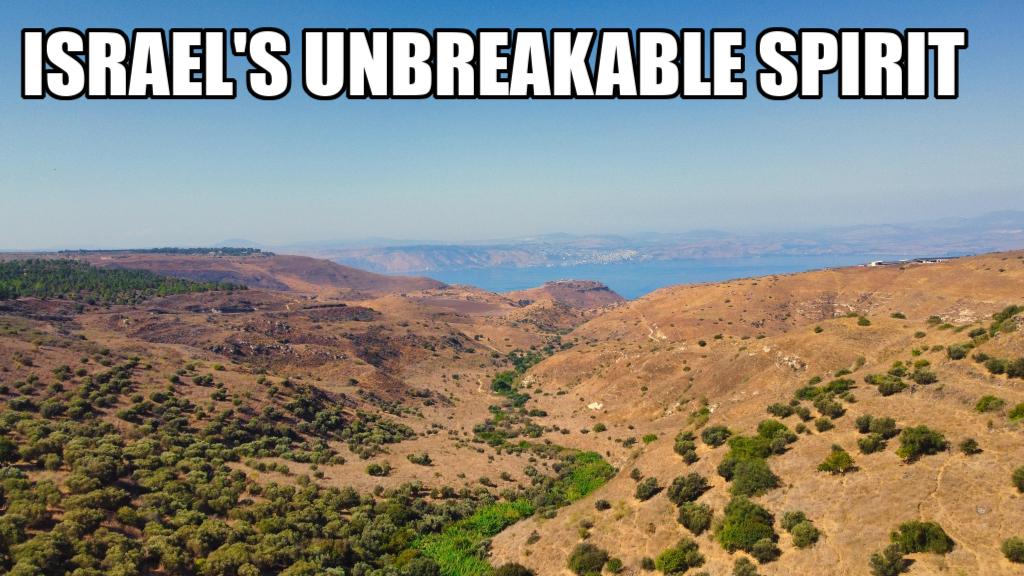
This week, I traveled through Israel. Not the Israel of Western media headlines, international panels, diplomatic statements, campus encampments, sanctimonious editorials, or foreign politicians who suddenly discover Jewish morality the moment Jews stand up for themselves. No, I traveled through the real Israel.
The Israel of bereaved parents who keep building despite their loss.
The Israel of rocky hillsides transformed into thriving yeshivot.
The Israel of medical centers being built where the world would prefer Jews not to live.
The Israel of civic leaders who should have collapsed long ago under the pressure, but instead draw from some hidden reservoir of supernatural strength.
The Israel of boys learning Torah in the shadow of murder.
And the Israel of thousands of Jewish athletes marching into a thumping Teddy Stadium in Jerusalem to declare that the Jewish people are alive, proud, and home.
At Beit Midrash Nachalat Binyamin, the Rosh Yeshiva, Rabbi David Turner, pointed out that this is the very season when the meraglim — the spies sent by Moses — once toured the Land. They left the wilderness at the end of Sivan and walked through the Land during the month of Tammuz.
They saw its mountains, valleys, cities, produce, and mighty inhabitants. And when they returned, they gave a report that broke the nation’s heart. “We cannot go up,” they said. The challenges were too great, and the odds were impossible.
Truthfully, they weren’t wrong. Any clear-eyed strategist might have said exactly the same thing. So what was their sin? It was simply that they only saw the danger. They had facts, but no vision, and they mistook difficulty for impossibility.
And now, thousands of years later, as I traversed the same beloved Land in the same season, the Rosh Yeshiva suggested: perhaps this journey could be a tikkun for the sin of the meraglim. Perhaps my task is to return to Jews outside the Land with a different report. Not propaganda, not fantasy, but a truthful report that sees the pain, pressure, loss, enemies, criticism, and fractures — and then says: nevertheless, the Land is very, very good.
And Parshat Pinchas is the perfect parsha for such a report. It begins after a terrible crisis – plague has swept through the Jewish people, and thousands have died. The nation is shaken, and the future seems hopeless.
But then, immediately, God does something extraordinary: He orders a count of the people. The message is clear: move on from the negative and focus on life.
The census in Parshat Pinchas is not a bureaucratic exercise. It is an act of national defiance. The Jewish people have suffered, sinned, mourned, and buried their dead — but they are still here, still going strong, and they still have a future.
Israel has buried too many of its children, but somehow, after every tragedy, it counts life again. We build again, we plant again, and we sing again. And we refuse to let bad news have the final word. That is Israel.
This week I saw it with my own eyes, together with a select group of rabbinic colleagues who joined the I.NEXT.G mission led by Moshe Rubin.
Yisrael Gantz, the indefatigable leader of Binyamin, seems to operate on a different clock from the rest of humanity. Fearless, tireless, and unstoppable, he is helping to bring the new Nanasi Medical Center in Sha’ar Binyamin into being — a facility that will change lives for families across the region.
For years, residents of Binyamin have had to travel long distances for serious medical services. Now, in the heart of Binyamin, a mini-hospital is being built — the first such medical center in Judea/Samaria — enabling local residents to access health services without having to travel long distances.
The world sees Jews in Judea and Samaria and reaches for political slogans. But Yisrael Gantz and his team couldn’t care less. No opposition will stop them from doing what has to be done. That is Israel.
Then I went to Beit Midrash Nachalat Binyamin. It is hard to describe the power of the place. There, on a rocky hillside in eastern Binyamin overlooking the Jordan Valley, a yeshiva was planted to commemorate a terrorist murder.
In April 2024, 14-year-old Binyamin Achimeir left his family farm early on a Friday morning to shepherd his flock and never returned. His body was later found mutilated with stab wounds and blunt force trauma. A Jewish boy, barely a teenager, was murdered for being a Jew in the Land of Israel.
In other countries, a murder site might warrant a plaque and some flowers. In Israel, it became a yeshiva. Nachalat Binyamin now has around seventy boys studying Torah in a beautiful, newly built Beit Midrash, with plans for a permanent campus.
The terrorists planned to uproot Jewish life, but they only made Jewish life stronger. That is Israel.
Then I sat with Yehoshua Sherman, a vice-chairman of KKL. I had no idea that his son, 18-year-old Yehuda, was murdered only three months ago. We spoke for an hour about the amazing work he is doing, strengthening communities in Judea and Samaria and the Binyamin region, partnerships with Diaspora Jews, and the future.
Only forty-five minutes into the meeting, when I asked about his family, did he mention his own tragedy. For a brief, difficult moment, his voice broke. A tear rolled down his cheek. And then, almost as quickly, he fortified himself. He told me he would not allow his loss to hold him back, nor would he let grief extinguish his spirit. His holy work is too important.
I sat there in awe. That is Israel.
In Samaria, I met with Yossi Dagan, another extraordinary figure — a man whose energy feels almost supernatural. He has built strong alliances in Washington, but also, astoundingly, in Europe, including a most unlikely and remarkable relationship with Slovenian Prime Minister Janez Janša, who, unlike so many European leaders, understands that Samaria is not an obstacle to Jewish destiny — it is part of Jewish destiny.
And Yossi Dagan made it happen. That is Israel.
On Wednesday night, I found myself in Teddy Stadium in Jerusalem for the opening ceremony of the Maccabiah Games. A packed stadium, Jewish athletes from around the world, marching not only for sport, but for solidarity.
They came despite the war, and the warnings, and the hostile atmosphere that surrounds Jewish identity in so many places. They came to compete, but more than that, to stand with Israel.
In a world that wants Jews to be nervous, apologetic, and quiet, Teddy Stadium was full of Jews who were loud, joyful, and unashamed. That is Israel.
Parshat Pinchas also contains the story of the daughters of Tzelafchad. Their father died in the wilderness, and they came to Moshe with a bold request (Num. 27:4): תְּנָה לָּנוּ אֲחֻזָּה — “give us a portion in the Land.”
These remarkable women were the antidote to the meraglim. The spies said, “The Land is not for us.” The daughters of Tzelafchad said, “We need the Land.” And it was this message that I heard all week.
The meraglim returned from Israel and convinced a generation that the dream was impossible. We must return from Israel and tell the next generation the truth: yes, the dream is difficult, costly, criticized, contested, and soaked with bitter tears. But it is alive, it is holy, and it is flourishing.
The Land is very, very good. And the people who live in it are even better. That is Israel.

(For the SoundCloud audio, scroll down) Last week, California State Senator Scott Wiener introduced a proposal that is pure San Francisco. He wants the tunnel through Yerba Buena Island, which... Read More