

HOLINESS WITHOUT BORDERS
(For the SoundCloud audio, scroll down)
Arnold Toynbee, the great twentieth-century historian, devoted his life to studying civilizations — how they rise, how they flourish, and then, inevitably, how they fall.
His conclusion was disarmingly simple: civilizations rarely collapse because they are conquered from the outside. They collapse because they fail to adapt. They mistake their moment in the spotlight — even if it lasts for centuries — for permanence.
And almost always, that confidence attaches itself to a particular place — a city, a capital, a sacred center that seems to radiate eternity.
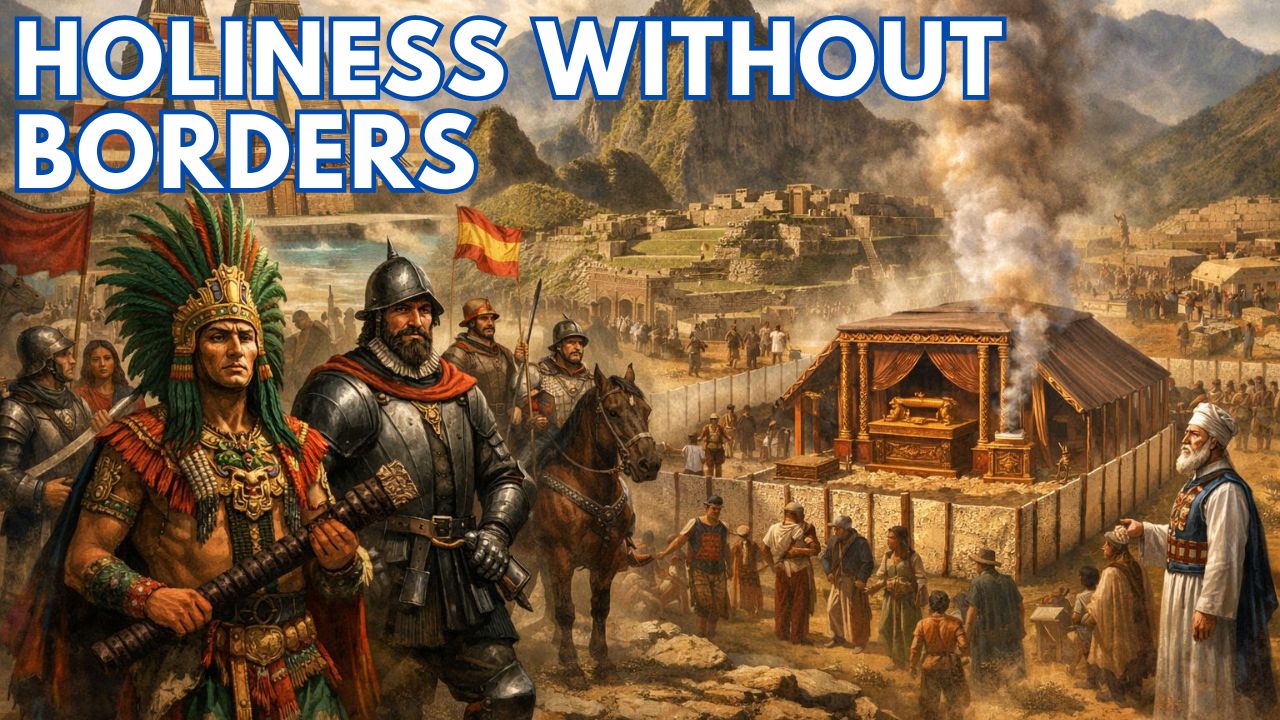
For the Aztecs, that center was Tenochtitlan — an island city rising out of Lake Texcoco. Majestic white temples gleamed in the sun, with the great central shrine, the Templo Mayor, dominating the skyline.
Priests in feathered headdresses moved through the sacred area with ritual precision. This was an empire utterly convinced that heaven and earth met right there—in the middle of its city.
Then, in 1519, a few hundred Spaniards appeared on the horizon. At their head was Hernán Cortés, a young, ambitious, calculating adventurer who had no interest in the Aztecs’ view of themselves as an eternal people. Within two years, Tenochtitlan was rubble. The sacred precinct was stripped — its stones repurposed to build churches.
Today, if you stand in Mexico City, you can see excavated fragments of the Templo Mayor beside traffic lights and fast-food stands. The empire that believed it stood at the center of the world survives only in stone, in memory, and in the scattered descendants of a civilization that long ago lost its sacred center.
It’s a similar story with the Incas — a civilization of perhaps twelve million people stretching down the western spine of South America. They, too, had their version of eternity. Their bustling center, brimming with wealth, was Cusco, in the Peruvian Andes. Their vast empire stretched across mountains, deserts, and jungles — all radiating outward from Cusco, which they called the “navel of the world.”
Then, in the 1530s, another small Spanish expedition arrived, this one led by Francisco Pizarro. The timing could not have been worse. A brutal civil war was already tearing the Inca empire apart. Smallpox — a disease carried unknowingly by Europeans — had spread ahead of them, weakening the Inca population and destabilizing their leadership.
But even that did not prepare the Incas for the ruthless rampage of the conquistadores. Pizarro seized the emperor, Atahualpa, holding him hostage until an enormous ransom room was filled with gold and silver. The ransom was delivered as promised, but Atahualpa was executed anyway, and by 1536, Cusco was in ruins.
As in Mexico, temples were stripped of their treasures, and the Gold was melted down and dispatched to Spain. Churches rose where sun temples once stood. The imperial order that seemed as solid as Andean granite unraveled with astonishing speed.
And this is not just a story about the New World. It is the rhythm of history. Mesopotamia believed itself to be eternal. Assyria did. Egypt did. Greece did. Carthage did. Rome certainly did.
Each, in its moment, assumed it stood at the gravitational center of human civilization. And then it didn’t. Monuments rise. Architecture declares permanence. Believers insist: “We are not going anywhere.” And then the center of gravity moves. It always moves.
The Jewish story should have followed the same pattern. In fact, by any reasonable civilizational metric, we were the least likely people to survive.
We began in Egypt as slaves. We wandered through the desert. We settled in the Land of Israel. We split into two kingdoms. We were exiled by the Assyrians. Conquered by the Babylonians. Rebuilt. Destroyed again by the Romans. Scattered across continents. Ruled by ruthless powers we did not control, living under laws we did not write.
No nation in history has experienced so many shifts in its center of gravity. And yet — we are still here. The question is not only why – it is how. The answer, I think, begins in Parshat Terumah. Before there was even a single stone laid on the Temple Mount, we were given something else — a sacred center that was real, but not fixed.
At the beginning of Terumah, God commands the construction of a sanctuary — not a monumental edifice carved into mountains or anchored to bedrock, but something built of curtains and poles, rings and sockets, designed to be dismantled and rebuilt wherever the people found themselves.
You might imagine the Mishkan as a temporary solution — a stopgap until the “real” thing in Jerusalem could be constructed. But that is to misunderstand it entirely. The Mishkan was not a placeholder. It was a principle. Long before we had a permanent Temple, we were taught something far more revolutionary: wherever you are, build Me a center there — and I will be among you. As the Torah puts it (Ex. 25:8): וְעָשׂוּ לִי מִקְדָּשׁ וְשָׁכַנְתִּי בְּתוֹכָם – “Let them make Me a sanctuary, and I will dwell among them.” Not in it — but among them.
The Temple in Jerusalem would later become the focal point of Jewish life. It was magnificent. It was the beating heart of the nation. Pilgrims streamed toward it three times a year. The Divine Presence rested there in revealed intensity.
And yet here is the astonishing fact: when the First Temple was destroyed, and the nation was exiled across the Persian Empire, we survived. When the Second Temple was destroyed by Titus in 70 CE, and the nation was scattered across the Roman world, we survived again.
Civilizations do not usually survive the destruction of their sacred center. The Aztec temples fell — and their world collapsed. Cusco fell — and the Inca nation unraveled. When Jerusalem fell, the Jewish people did not disappear. We regrouped. In Yavneh. In Sura. In Pumbedita. In Toledo. In Aleppo. In Frankfurt. In Warsaw. In Vilna. In New York. Even in Los Angeles!
The Temple may have been our center of gravity, but it was never the source of our gravity. That source had been implanted much earlier — in the wilderness — in the Mishkan.
The Mishkan precedes permanence. Long before we possessed a fixed center, we were taught how to create one that moves with us. Portable holiness was written into Jewish DNA. While other civilizations anchored holiness to geography, Judaism anchored holiness to covenant.
This does not diminish our longing for the Temple in Jerusalem. We pray daily for its rebuilding, and we turn toward Jerusalem in every Amidah. The Temple matters profoundly. But our survival without it proves something radical: God’s presence — and our identity as God’s people — was never confined to masonry.
The prophet Ezekiel, speaking in exile, refers to the synagogue as a מִקְדָּשׁ מְעַט — a miniature sanctuary (Ez. 11:16). In other words, a Mishkan. Wherever Jews gathered — in Babylon or Spain, in Poland or America — the portable sanctuary reappeared. In a synagogue. In a study hall. Around a Shabbat table. And God dwelt in our midst.
Which is why it is no accident that our first national sanctuary was made of curtains and poles, dismantled and reconstructed again and again over forty years of wandering. Exile was written into the Jewish story from the beginning — but so was the architecture of survival.
And so today, as the global center of gravity threatens to shift yet again, the Jewish people remain what we have always been: a nation capable of carrying its center with it.
Wherever Jews gather — in Los Angeles, New York, London, Sydney, in a grand synagogue or a makeshift minyan in a dorm room, a hospital ward, or even a military base — if there is prayer, if there is Torah, if there is yearning for God — then God dwells among us.

(For the SoundCloud audio, scroll down) Yom Kippur can feel like a day to endure: fasting, confession, white garments, and hours in shul. But beneath the solemnity lies one of... Read More