

WHO WE REALLY ARE
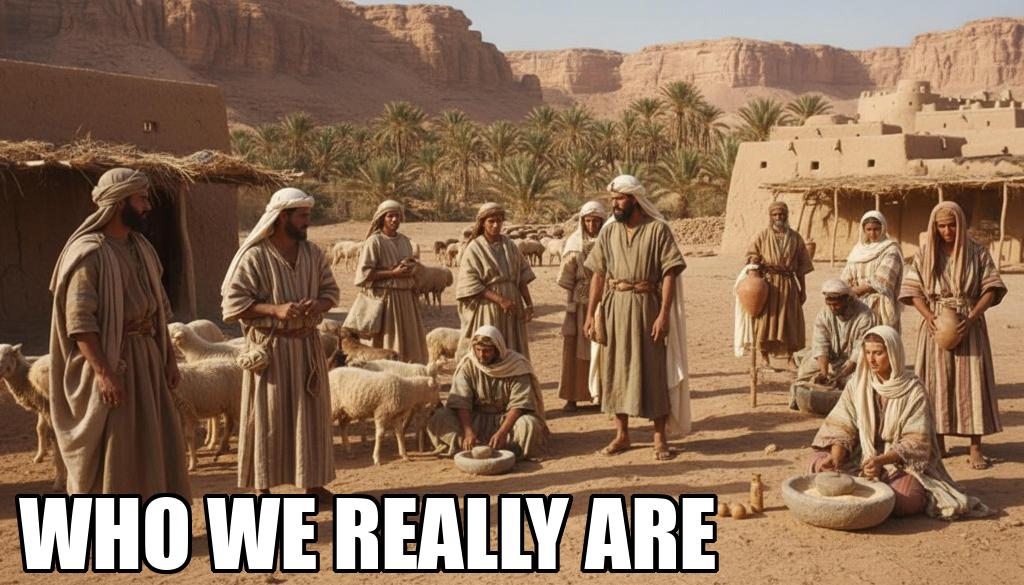
Yaakov Avinu spent the last and arguably most settled chapter of his life outside the Land of Israel. After decades that were marked by danger, flight, rivalry, and loss, it is in Egypt that he finally experiences stability.
There is food, security, political protection through Yosef, and the comfort of family reunited. Egypt works. It provides. It delivers precisely what a weary old man might reasonably want.
And yet, as Yaakov approaches the end of his life in Parshat Veyechi, one issue suddenly becomes urgent. He makes Yosef swear — carefully, solemnly — that he will not be buried in Egypt. Instead, he insists that his body be taken back to Hebron, to the Cave of Machpelah, to the land that was promised to Avraham and Yitzchak, and to him and his descendants.
This insistence is striking, because it is clearly not just about funeral arrangements. The Torah devotes unusual attention to this request because it is conveying an important message for all time. The bottom line is this: Yaakov Avinu is drawing a line between where Jewish life can function and where Jewish identity ultimately belongs.
The Ramban gives us the framework to understand Yaakov’s insistence. He explains that the full and natural fulfillment of mitzvot takes place specifically in the Land of Israel.
When Jews observe mitzvot outside the land, he writes, it is not because exile has become an equal alternative, but because Jewish life must remain intact until return is possible. We keep mitzvot in chutz la’aretz, the Ramban says, so that they will not be unfamiliar to us when we return to the land.
It is an astonishing idea. The Ramban is not dismissing Jewish life in exile. He is explaining it. Judaism outside Israel is not a mistake — but it is not the end goal either. It is preservation, not culmination. Continuity, not completion.
And suddenly, Yaakov’s insistence on burial in Israel takes on even sharper meaning. Yaakov lives in Egypt. He functions there. He prospers there. But he understands, intuitively and deeply, what the Ramban later articulates explicitly: exile can host Jewish life, but it cannot define Jewish destiny.
Yaakov is not rejecting Egypt. He is resisting the idea that Egypt might define him. That distinction is essential.
What does this mean for us? What does it mean for Jews living in Chutz Laaretz? It means something very simple: the danger is not exile – the danger is forgetting that exile is exile.
Living in America as a Jew is legitimate. Loving America is legitimate. Building strong, vibrant Jewish communities here, and maintaining them, is not a failure of faith or vision.
Jewish history is filled with periods of Jews living outside Israel that were not about living in exile – and were enormously productive for the Jewish faith and the Jewish people.
But Parshat Vayechi insists on clarity. Exile can be good without being final. Comfort can be real without being eternal.
And this is precisely the tension that occupied the thinking of Rav Kook.
For years, Rav Kook lived among deeply Westernized Jews in Switzerland, and then London, many of whom were influenced by nineteenth-century enlightenment ideas that believed Judaism had outgrown peoplehood, land, and national destiny.
These Jews argued that Judaism’s future lay in universal ethics and spiritual ideals, not in a return to a particular land. To them, Eretz Yisrael was poetry — inspiring, symbolic, but ultimately unnecessary.
In his letters and writings, Rav Kook warned that a Judaism which denies its bond to the Land of Israel has not become more universal, but more fragile. Ethical ideals without a national vessel, he argued, float above reality. They inspire — but they cannot endure. A Judaism stripped of land, language, and destiny becomes abstract, and abstraction does not survive history.
On one occasion, Rav Kook encountered Jews who spoke passionately about Jerusalem as an idea. They cherished it in prayer, in song, and in metaphor — but they recoiled from the practical notion of an actual return to the land, and the renewal of a Jewish homeland in Eretz Yisrael.
Rav Kook’s response was gentle but piercing. He told them that it was clear they were prepared to keep Jerusalem in their siddur – but not in their lives. Longing for Zion, he explained, was never meant to replace Zion. It was meant to sustain Jews until return became possible. Once return was possible, continued refusal to return was theologically unacceptable.
Perhaps most hauntingly, Rav Kook addressed Jews who believed that exile itself provided safety. Integration, loyalty, and enlightenment, they argued, would protect them better than national visibility. Rav Kook did not dismiss their fear, but he rejected their conclusion.
In exile, he wrote, Jews confuse tolerance with permanence. Comfort creates dependency, and dependency dulls the instincts needed for survival. A people that relinquishes responsibility for its own destiny eventually finds itself unprepared when the welcome wears thin.
These were not angry warnings. They were mournful ones. And history, tragically, vindicated his warnings.
This is why Yaakov Avinu’s desire to connect his final moments with Eretz Yisrael in Parshat Vayechi is so relevant to American Jewish life today. America remains generous, open, and largely welcoming. But the subtle shift many Jews feel — the erosion of certainty, the conditional nature of belonging — is not new. It is the recurring rhythm of exile.
Yaakov teaches us how to live properly within that reality. He does not flee Egypt. He does not curse it. He does not deny what it gave him. But he refuses to eternalize it. He insists that the final word of Jewish life cannot be spoken anywhere but in the land where the Jewish story began and where it ultimately unfolds.
And, critically, Israel was Yaakov’s name. Because Israel is not only the name of a land. It is the name of a people. The land is called Israel because Israel was Yaakov’s name — because Jewish identity, Jewish destiny, and Jewish geography are inseparable. To belong to Israel is not simply to inhabit a territory, but to carry forward the mission that Yaakov embodied.
When Yaakov insisted on being buried in Israel, he was not thinking only about himself. He was speaking to his descendants across generations. About you and me. About our children and grandchildren.
Live where you must. Build where you are living. Contribute fully to the societies that host you. But never ever forget who you are, and never forget where Jewish history ultimately lives. Never forget where you truly belong.
Yaakov enjoyed Egypt. But he refused to let it define who he was. And that refusal may be one of the most important messages he ever left his children — including us.
We are Bnei Yisrael – the Children of Israel. It is what we have been since the days of Yaakov Avinu. And it is what we will be for all time, until Moshiach comes, and when Moshiach comes.

(For the SoundCloud audio, scroll down) On August 24th, 2022, an official of Brazil’s indigenous affairs agency, FUNAI, walked into a straw hut deep in the Amazon rainforest in the... Read More