

WHEN POWER BECOMES BLIND
(For the SoundCloud audio, scroll down)
There is a particular kind of self-destructive confidence that exists only at the very top of a brutal regime. It isn’t courage, and it certainly isn’t principle. It’s raw hubris, reinforced by a self-belief so detached from reality that objective facts become little more than a distraction.
Napoleon spent his final days as leader of France convinced that one more maneuver could reverse his fate, even as Europe closed in around him. And 130 years later, in a Berlin bunker, Hitler issued orders to imaginary divisions as the Third Reich disintegrated above his head.
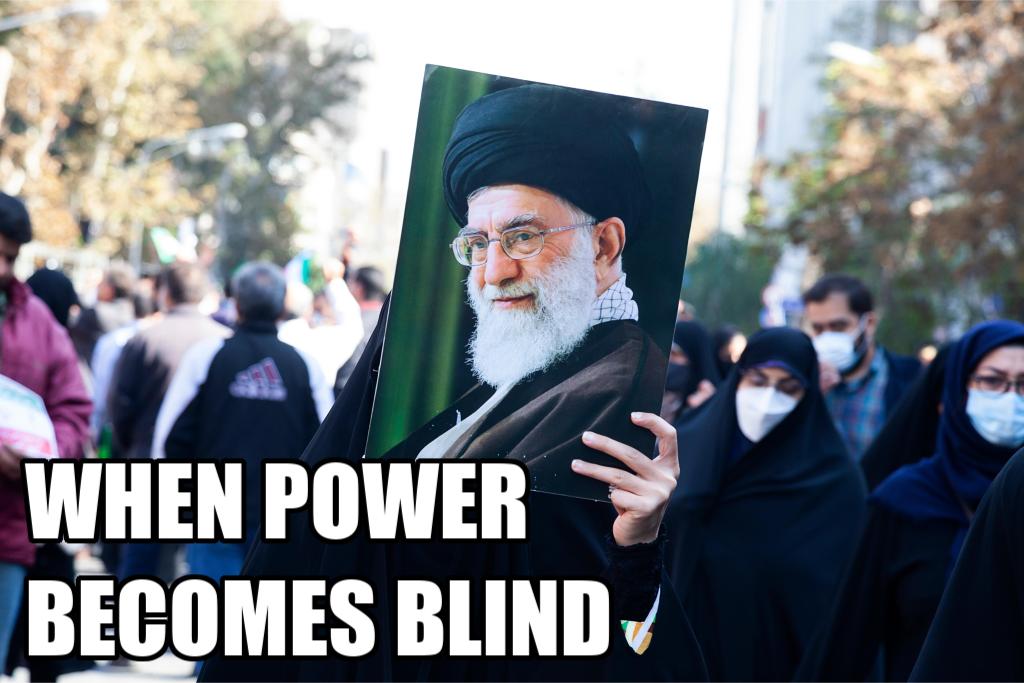
If you’ve been watching events in Iran over the past couple of weeks, that same detached hubris has been on full display. As protests spread from city to city – sparked by economic collapse and rapidly morphing into thousands openly calling for regime change – the response from the Islamic Republic’s highest echelons has been depressingly familiar: extrajudicial killings, mass arrests, internet blackouts, and the ritual denunciation of protesters as “vandals,” “terrorists,” or foreign agents doing America and Israel’s bidding.
Ayatollah Ali Khamenei, who has conveniently hidden himself away from any public contact, insists that the Islamic Republic “will not back down.” President Masoud Pezeshkian has expressed sympathy for the economic pain endured by ordinary Iranians, even as he authorizes the brutal crackdown.
Protesters have been shot and killed, hospitals are overwhelmed with casualties, and the death toll – including police and government workers – continues to climb, all while the leadership doubles down, as though sheer refusal to yield can still bend reality to its will.
It’s horrifying. But it’s also strangely predictable. Authoritarian regimes rarely collapse because they recognize their mistakes; they collapse when the protective bubble around their leaders finally bursts. Until that moment, what passes for strength is not power at all, but blindness — an inability to see the wood for the trees.
By the time you read this, the Iranian regime may have fallen, or it may have clawed its way through yet another crisis. Either way, the pattern is unmistakable, and the writing is on the wall: systems built on fear and insulation eventually join their predecessors in the dustbin of history.
Religious narrative often prefigures political reality. Which brings us to Pharaoh, the antihero of the opening chapters of the Book of Exodus. We first encounter him in Parshat Shemot as a brutal dictator, imposing unbearable suffering on the Hebrews through enslavement, persecution, and ultimately genocide.
By the time we reach Parshat Va’era, the stakes have escalated dramatically. Pharaoh refuses to relent to Moses’ demands to free the Hebrews, and Egypt is struck by a cascade of calamities: its water supply is contaminated, frogs overrun homes, lice infest the land, and so it goes on.
Life in Egypt grinds to a halt. The economy is crippled, normal existence becomes impossible, and yet, despite all this, Pharaoh barely flinches.
The Torah tells us that Pharaoh’s heart is hardened — first through his own stubbornness, and eventually by God, who gives him the strength to resist pressure to alleviate the suffering of his people.
But that explanation only deepens the puzzle. Why is Pharaoh so immune to the devastation unfolding around him? Why doesn’t he learn? Why doesn’t he adjust? Why does each plague simply provoke the next act of defiance?
The easy answer is that Pharaoh is wicked. But that answer isn’t very satisfying. Wicked people can still be pragmatic, and history offers plenty of examples of evil tyrants who knew when to retreat. Pharaoh doesn’t — and the reason is subtle but crucial.
Like so many brutal rulers across history, Pharaoh never truly experiences the consequences of his stubbornness personally. His advisers plead, the people suffer, the nation groans — but Pharaoh himself remains untouched. Power has wrapped him in cotton wool. He is insulated from reality, and it is precisely that insulation that allows him to harden his heart.
The Torah is teaching us something uncomfortable here. The most dangerous leaders are not the ideologues or the fanatics, but those who never pay a price for being wrong. When suffering is always outsourced – to citizens, soldiers, or convenient scapegoats – there is no internal mechanism that forces change.
And that is exactly what we are seeing in Iran. The clerical elite and the Revolutionary Guard leadership are not standing in breadlines. Their children are not dodging bullets in the streets. Their electricity has not been cut, their access to water remains secure, their wealth is intact, and their personal safety is guaranteed. The pain is being borne entirely by others – and so, like Pharaoh, they respond to an existential crisis not with reform or retreat, but by doubling down on repression and violence.
There is a tragic irony here, borne out by countless historical examples – from the time of Pharaoh through the four millennia that have followed. The more violence a regime unleashes, the clearer it becomes that it has run out of ideas.
Brutality against the people a government claims to represent and protect is not strength – it is the language of exhaustion. When leaders can no longer persuade, they intimidate. When they can no longer inspire fear, they escalate it instead.
It is precisely this dynamic that plays out in ancient Egypt. Each plague strips away another illusion of control, but instead of adapting, Pharaoh tightens his grip. He banishes Moses – the one person capable of ending Egypt’s day-to-day nightmare – and in doing so inflicts wave after wave of suffering on his own people.
The Torah does not portray Pharaoh as a strategic mastermind undone by clever tactics. It portrays him as a man trapped by his own power, unable to imagine a world in which he is not obeyed.
That, ultimately, is why the plagues have to escalate. Only when Pharaoh’s firstborn son dies in Parshat Bo – and Pharaoh, himself a firstborn, suddenly fears for his own life – does he finally relent, and even then, only briefly.
Hubris returns almost immediately. He pursues the Hebrews in a last, futile attempt to destroy them or drag them back into slavery, and his army is annihilated at the Red Sea. The Midrash leaves Pharaoh alive, the sole survivor, condemned to live on as a witness to the ruin he brought upon himself and his people.
History suggests that this pattern is remarkably consistent. Regimes that respond to dissent with ever harsher measures, deaf to the realities unfolding around them, are not demonstrating strength but buying time – and borrowed time always runs out.
Whether Iran’s current uprising ends tomorrow, next month, or further down the road is impossible to know. What is clear is that we have seen this story before, not only in modern history, but in the Torah itself.
Pharaoh’s story reminds us that hearts hardened by power rarely soften while there is still a chance to escape the deluge. Change is imposed when consequences can no longer be deflected, and when a system built on fear finally collapses under the weight of its own cruelty.
Pharaoh learned that lesson too late. History has been relearning it ever since.

(For the SoundCloud audio, scroll down) Iran’s increasingly reckless attacks across the Middle East have reached a new level. This week, debris from an Iranian missile struck the Church of... Read More