

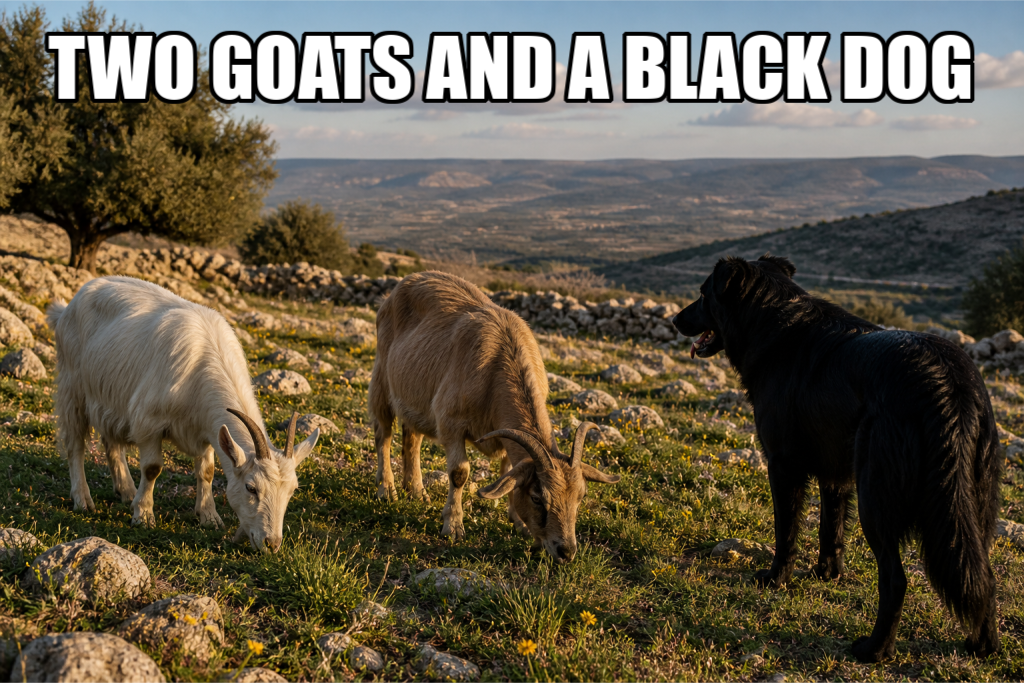
TWO GOATS AND A BLACK DOG
There are some mitzvot in the Torah that feel instantly relatable — honoring parents, keeping Shabbat, giving charity.
And then there are goats being sent off cliffs. The “Sa’ir la’Azazel” feels, at first glance, very bizarre. Two identical goats are brought before the Kohen Gadol on Yom Kippur. A lottery decides their fate. One becomes a korban. The other carries the sins of the people into the wilderness.
Why two goats? Why not one korban and done?
Rabbi Sacks offers a brilliant explanation. He says that Yom Kippur isn’t only about kapparah — forgiveness. It’s also about teharah — cleansing. And there’s a big difference between the two.
Forgiveness deals with what you did. Cleansing deals with what it did to you.
A person can be forgiven and still feel stained. Anyone who has ever said something cruel, or betrayed a friend, or lost their temper, or failed someone they love – knows this. Even after the apology is accepted, something lingers. There’s a residue. And that’s what the second goat is about.
The first goat represents atonement. The second goat represents letting go.
But Rabbi Sacks goes even deeper than that. He says, maybe the two goats aren’t really two separate goats. Maybe they represent two sides of us, meaning that internally we have two separate goats.
Every one of us carries two impulses. The yetzer tov and the yetzer hara. The generous self and the selfish self. The disciplined self and the impulsive self.
There’s the part of you that wants to pray — and then there’s the part of you checking your watch: ‘when is davening going to be over?’ There’s the part that says “don’t say it” — and then there’s the mouth that says it anyway.
It’s the same person, but two separate goats. And that’s the point of the second goat. Holiness isn’t about pretending the darker part isn’t there. It’s about choosing which part of ourselves gets brought close to God — and which part gets sent away into the wilderness.
Judaism is kind of obsessed with responsibility, which is why the very first narrative in the Torah is all about the sin of evading responsibility. Adam blames Chava. Chava blames the serpent. And human beings have been scapegoating ever since.
“It wasn’t me.” “It’s because of them.” “I had no choice.”
Yom Kippur is all about changing that dynamic. There’s no excuses. I did it. And I need to own it before I get rid of it.
And strangely, this idea is not crushing. It’s actually liberating. Because if I caused some of the problem, I can become part of the solution.
Victims stay stuck. Responsible people can change.
That’s why the Torah’s scapegoat is the opposite of what “scapegoating” means today. Today, a scapegoat is someone else we blame. In the Torah, the scapegoat exists so we stop blaming anyone else but ourselves. We own our failings, and then we let them go.
This is exactly what teshuvah is all about – not just saying “I’m sorry,” but refusing to drag yesterday’s failures into tomorrow.
Everyone has heard of Sir Winston Churchill — we can all picture the bulldog face, the ever-present cigar, the raised V-for-victory sign, the mischievous grin. Churchill cheerfully defying Hitler. Churchill somehow looking both rumpled and triumphant at the same time. History remembers his confidence. His defiance. And most of all, his exuberance under pressure.
But most people don’t know that Churchill lived for much of his life with terrible bouts of depression. He had a name for it. He called it “the Black Dog.” When dark moods descended, he would tell his wife Clementine that the Black Dog had come to visit.
What an extraordinary phrase. He never defined himself by the struggle. Instead, he described it as something that prowled around him, something menacing, something real — but something inside him that he wanted to be separate from him.
Churchill understood something that modern psychology has rediscovered, and that the Torah knew all along — you have the power not to be every impulse that enters your mind. You are not every dark instinct, every destructive urge, every despairing thought. There may be a “black dog” that follows you, but it is not your master unless you hand it the leash. And if you know that, you can get rid of it.
And when I think of that, I think of the two goats in our parsha. One part of us, the first goat, longs upward — toward discipline, holiness, generosity — toward God. And the other goat pulls downward — toward impulse, resentment, fear, appetite, and anger.
The Torah takes those two forces and dramatizes them in the most unforgettable way imaginable. One goat is brought close. The other is sent into the wilderness.
And maybe the message is simple: every life is lived deciding which goat we feed. Churchill spent his life making that decision. He did not conquer the Black Dog by pretending it wasn’t there. He conquered it by refusing to let it run the house. He fought back.
Many people don’t realize that Churchill was a serious painter. He took it up relatively late, after political disaster and personal turmoil, and ended up producing hundreds of paintings — landscapes, ponds, gardens drenched in light. It wasn’t a hobby. It was therapy. He once wrote that when he painted, the Black Dog receded. He also taught himself to lay bricks, and he would do it for hours at a time, because it took his mind off the bad thoughts.
Think about that. The man holding together the free world was also standing before a canvas, painting sunlight on fields to keep despair at bay, or he was slapping cement onto bricks and laying them on a wall, so that he keep his mind occupied instead of being depressed.
And perhaps that is why Churchill was able to lead when others collapsed. Because he had wrestled privately with forces many never saw.
People often imagine heroes as people untouched by inner conflict. The Torah suggests the opposite. Greatness often belongs to those who have struggled hardest with themselves and managed to rid themselves of the second goat. And you need to do it again and again, like every Yom Kippur.

THE FESTIVAL OF THE TEMPORARY HOUSE
(For the SoundCloud audio, scroll down) Sukkot begins with a flimsy hut and ends with dancing around a Torah scroll. In between come the four species, Kohelet, Hoshana Rabba, Shemini... Read More