

NO MORE MOWING THE LAWN
(For the SoundCloud audio, scroll down)
George Washington once observed, “To be prepared for war is one of the most effective means of preserving peace.” And as it turns out, sometimes the best way to preserve peace is to go to war—and finish the job.
Until October 2023, Israel—and, to a large extent, the United States as well—operated under a doctrine that seemed sensible enough: avoid war whenever possible, and when provoked, respond in a limited, carefully measured way.
When rockets were fired, Israel retaliated just enough to signal displeasure. When terrorist leaders threatened destruction, their words were dismissed as overheated rhetoric, aimed at rallying an eager audience of haters rather than signaling an intention to wage war. And when enemies amassed weapons, the assumption was that overwhelming military superiority would deter their use.
The theory behind this approach was simple. Escalation is dangerous, and war is costly—financially and, of course, in human lives. Restraint, it was believed, would keep life relatively stable. Israel responded when necessary, but always carefully, operating on the assumption that a rap on the knuckles would be enough to signal that continuing attacks was a bad idea.
The problem, as October 7 revealed with horrifying clarity, is that not every enemy shares this logic. For some enemies, it isn’t about equilibrium or stability; it’s about inflicting violence on those you hate—again and again, without pause or restraint.
For decades, Israel’s main adversaries—Hamas, Hezbollah, and above all the Iranian regime—made their intentions clear. Their slogans were blunt: “Death to Israel,” “Death to America.” Israel, like much of the West, preferred to believe these words were exaggerations, not literal plans.
And so life went on. Gaza was tolerated as a hostile enclave, and every so often Israel “mowed the lawn.” Hezbollah, entrenched on Israel’s northern border with tens of thousands of missiles, was considered a threat that would never fully materialize. Iran, distant and absorbed in its own problems, was seen as dangerous but manageable.
The hope was that monitoring, occasional strikes, persistent warnings about a nuclear Iran, and deterrence would prevent catastrophe.
Then came October 7. The brutal massacre on Israel’s southwestern border shattered those assumptions. The belief that terror groups and their backers could be contained collapsed overnight. The idea that economic incentives or agreements might moderate radical regimes suddenly looked naïve.
Israel—and under President Trump, the United States as well—realized something fundamental: you cannot coexist with movements or regimes whose very purpose is your destruction. The rules of the game have changed.
The new doctrine is simple: if terrorists and radicals are running for their lives, they cannot threaten yours. When those plotting your destruction are forced onto the defensive, their ability to act collapses.
Over the past two years, the consequences of this shift have been dramatic. Hamas’s military structure has been dismantled and its leaders eliminated. Hezbollah’s leadership was taken out, and much of its vast missile arsenal destroyed.
And now, in a stunning development few would have imagined possible even a month ago, the Iranian regime itself has suffered devastating blows—its supreme leader eliminated in a precision strike and the IRGC crippled.
For decades Iran acted as the conductor of the anti-Israel, anti-America orchestra, funding and arming terror movements across the region while feverishly pursuing a nuclear weapon. The regime assumed it could operate safely behind its proxies, directing violence from afar while remaining immune to consequences at home. That illusion has now been shattered.
What Israel has finally rediscovered is an ancient truth: when there is a serious threat, delay is dangerous. It must be confronted quickly and decisively. This principle is not only a lesson from modern security doctrine; it has deep roots in Jewish tradition, vividly illustrated in Parshat Ki Tisa.
The central drama of this portion is the catastrophic episode of the Golden Calf. After forty days of waiting for Moses to descend from Mount Sinai, something shifts in the Israelite camp. Egged on by the pagan hangers-on who joined the Israelites during the Exodus, the people demand a replacement leader, and within hours they have constructed a golden idol.
Interestingly, most of the nation did not actively participate. They stood on the sidelines as this shocking desecration of the covenant with God unfolded before them. Perhaps they assumed it didn’t really affect them—that life could continue as normal as long as the upheaval remained confined to a relatively small group.
But when Moses descends the mountain and sees what has happened, the Torah describes an extraordinary sequence of events. Moses does not attempt to “mow the lawn.” He does not deliver a carefully calibrated response. He does not negotiate with the idolaters or seek a diplomatic compromise. Instead, he acts with stunning decisiveness.
First he shatters the tablets. Then he completely destroys the calf, grinding it into powder and scattering it on water. Then he confronts the people and demands that they make an immediate choice (Ex. 32:26): מִי לַה׳ אֵלָי — “Whoever is for God, join me.”
No equivocation, no wishy-washy middle ground: you are either with me or against me. The tribe of Levi rallies to him, and the rebellion is crushed before it can spread any further and cause irrevocable damage.
Commentators emphasize that Moses’ actions were not impulsive rage but deliberate leadership. The Ramban explains that breaking the tablets was meant to shock the nation into grasping the gravity of the situation.
Rav Hirsch observes that Moses’ call eliminated ambiguity: in moments of existential crisis, neutrality is impossible—one must choose. The Sforno adds that swift punishment of the instigators prevented the sin from becoming normalized. Moses understood what history repeatedly confirms: some crises must be confronted decisively.
Had Moses hesitated, what began as a limited aberration—serious though it was—might have metastasized into something far worse. If he had attempted compromise, or even hinted that the problem could be contained, the rot would have set in, and before long everything might have collapsed.
Instead, decisive action restored clarity. The Golden Calf was destroyed. Those who built it were eliminated. And then the covenant was renewed with a second set of tablets. The lesson is unmistakable: destructive forces must be confronted with overwhelming force before it is too late.
That pattern—crisis, decisive response, and renewal—recurs throughout Jewish history. In our own time there have been painful moments of reckoning. As a result, both the Western world in general and Israel in particular have had to rediscover the necessity of strength.
For far too long, the United States and Israel hoped that a cautious approach toward Iran and its proxies would stabilize the region. But peace and tranquility are not built on illusions. When a regime like Iran spends decades arming itself and its proxies while openly proclaiming genocidal ambitions, those ambitions cannot be ignored. If they are not confronted, the threat only grows—and eventually leads to disaster.
The war against Iran—aptly codenamed “Epic Fury”—may well be seen as a turning point. It marked the moment when the strategic assumptions that shaped the Middle East for decades were finally set aside.
The Jewish people learned long ago that survival demands difficult decisions and decisive leadership. For a time Israel drifted away from that mindset. But the ancient lesson still resonates—and has now returned with renewed conviction.
The lesson is clear: when those who threaten your destruction are confronted with resolve and strength, they can be defeated.

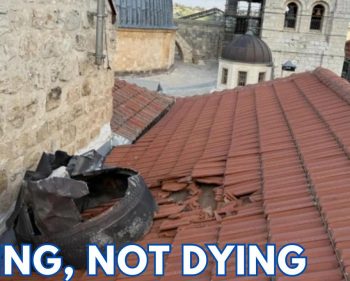
(For the SoundCloud audio, scroll down) Iran’s increasingly reckless attacks across the Middle East have reached a new level. This week, debris from an Iranian missile struck the Church of... Read More