

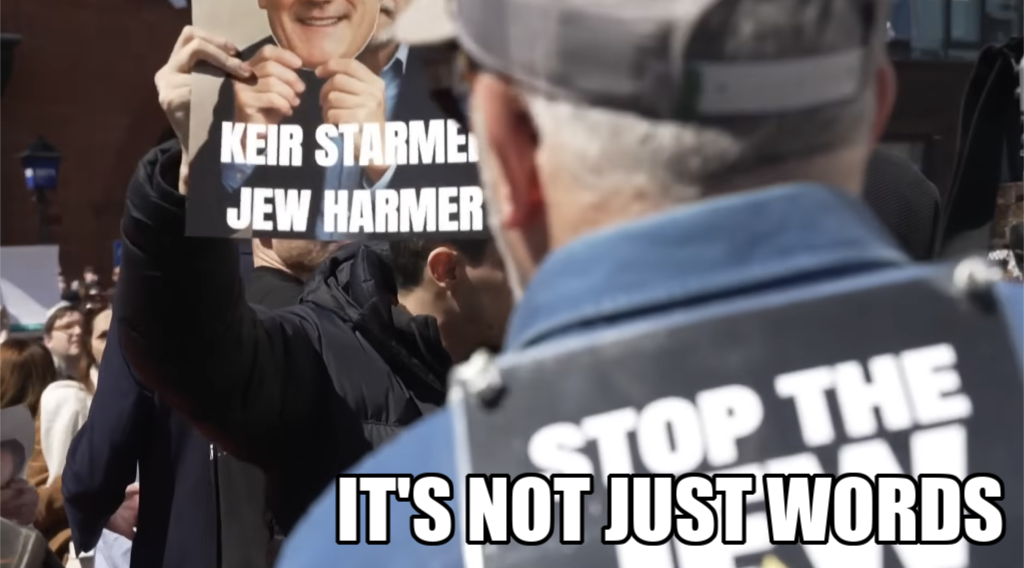
There’s a debate raging right now in London. It’s not theoretical, and it’s not abstract. On the contrary, it’s very real.
Last week, a man stabbed two Jewish residents in Golders Green—right near where I grew up. In the aftermath of this horrific outrage, the conversation everywhere has turned to a deeply controversial issue—something that has been simmering for months, but has now moved front and center on every news program and talk show: the weekly pro-Palestinian marches that wind their way through central London, marches that have featured openly antisemitic language and have increasingly become a magnet for Jew-haters.
At those marches, you hear slogans like “Globalize the Intifada.” And now people are asking—what exactly does that mean?
Those chanting it insist that it’s harmless—that it’s simply an expression of solidarity with the Palestinian cause. It’s political speech. It’s protest. It falls under the rubric of free expression.
But for Jews walking the streets of London—for people who remember buses exploding, cafés bombed, random stabbings in the street—the word intifada doesn’t sound like political speech or harmless rhetoric. It sounds like violence.
Because the two intifadas were not a slogan—they were campaigns of terror, and hundreds of Jews were murdered.
And so the question being asked in the UK right now is a very uncomfortable one: Is free speech absolute? Or are there limits—especially when words start bleeding into real-world consequences?
They’re now using a phrase in London—they call it “ambient antisemitism.” A kind of atmosphere. A background noise. A steady drip of language that creates a climate where Jews feel unsafe—and where, as it turns out, it’s not just a feeling or some exaggerated anxiety, but something that actually translates into real attacks against Jews.
Which means that what sounds abstract—free speech, civil liberties—suddenly becomes very concrete. Because words don’t just sit in the air. They make a difference. They land. They shape people. They influence behavior.
So the question becomes unavoidable: Is free speech so absolute, so untouchable, that we tolerate it even when there is a cost?
Or do we say—no. There are things you cannot say. Because saying them is not just jaw-jaw—to invert Winston Churchill’s famous phrase—but can actually lead to war-war.
There is a striking story right at the end of Parshat Emor. After all the detailed laws about kedusha, about the Kohanim, about the moadim—we are suddenly confronted with a strange and jarring episode: the story of the מקלל—the blasphemer.
A man stands up in the middle of the encampment and curses God. Everyone is stunned. These are the people who encountered God at Sinai, who witnessed His miracles firsthand—and now, in their midst, someone is publicly cursing Him.
Even Moshe Rabbeinu doesn’t know what to do. The case is brought before God. Moshe essentially asks: what do I do with this man? And the response is unequivocal. This is a capital offense.
And at first glance, it’s hard to relate. All he did was say a few words. What’s so terrible? But that reaction reflects our mindset. We live in a world where speech is treated as… speech. You can say what you want. Believe what you want. Express what you want.
As the old saying goes, “Sticks and stones may break my bones, but words will never hurt me.”
But the Torah doesn’t believe that. The Torah has no category called “just words.” As far as the Torah is concerned, words create realities. Words shape worlds. Words have consequences.
When someone curses God in public, the Torah does not see it as a private outburst of frustration or anger. It sees it as a rupture in the moral and spiritual fabric of the community. Because once God can be cursed openly, the entire framework begins to erode.
And in that formative moment, when the Jewish people are becoming God’s ambassadors in the world, that kind of rupture cannot be dismissed with, “It’s only words.” Because it’s never only words.
And that’s exactly the point that feels so relevant right now. Because when people chant “Globalize the Intifada,” free speech purists say—come on, it’s just words.
Whenever rhetoric becomes aggressive, dehumanizing, or threatening, people fall back on the same defense: it’s just speech. But we, the Jewish people, know better. We know that language creates atmosphere. And atmosphere shapes behavior. And behavior, eventually, leads to outcomes.
There’s the famous line from Justice Holmes in his 1919 Supreme Court ruling about not having the right to shout “fire” in a crowded theater. He later refined that position, but the core idea remains powerful.
He wasn’t really talking about speech—he was talking about consequences. He was pointing out that words can trigger panic, chaos, and harm. Because at a certain point, speech stops being expression and starts becoming action. That is the power of speech.
And that is exactly the Torah’s perspective. Never underestimate the power of words. There is no such thing as “just words.”
The story of the blasphemer is in the Torah to teach us that speech can destroy—and that when speech crosses a red line, it cannot simply be ignored. It must be confronted. It must be addressed. Because if it isn’t, the consequences won’t remain theoretical for very long.
Although – and I don’t want to end on a negative – there’s another side to this as well. Because if it is true that words can destroy, then it is true that words can also build. If speech can create an atmosphere of hatred, it can also create an atmosphere of dignity, of respect, of holiness.
That’s why so much of Jewish life revolves around speech—tefillah, brachot, Torah learning. It’s exactly because we believe that words matter. They shape who we are and they shape the world around us.
And maybe that’s the deeper message of this moment we’re living through. The debate about free speech is not going away. And we’re not necessarily the ones setting policy in London or anywhere else. But we are responsible for the way we use words. In our homes. In our communities. In our conversations.
The question is not just what we’re allowed to say. The question is what kind of world our words are creating. Are they darkening the ambient atmosphere? Or are they elevating it? Are they contributing to a culture of anger and division? Or are they contributing to a culture of respect and responsibility?
And if you think this idea—that words create consequences—is theoretical, just look at the world we’re living in right now. We’re watching it happen in real time.
A single post—just a few lines—can move markets. We’ve seen it recently with Donald Trump posting on Truth Social about the war with Iran, and within seconds, markets react. Billions of dollars shift. Investors panic or celebrate. All from a few words.
And history has known this for a very long time. The famous story from British history of Thomas Becket is a perfect example. In 12th-century England, Thomas Becket was the Archbishop of Canterbury, and he was locked in a bitter dispute with his former friend, King Henry II.
The king, frustrated and angry, is said to have uttered a line in exasperation: “Will no one rid me of this turbulent priest?”
Four knights heard those words—and took them as a call to action. They rode to Canterbury, entered the cathedral, and brutally murdered Becket at the altar. A king’s words resulted in murder. Just a few words. That’s the power of speech.
And it’s not just medieval history. It’s happening in London, right now – and even here in the United States. Crowds chanting “Globalize the Intifada,” and people insisting—it’s just words.
But we know better. That’s why the story of the blasphemer – a seemingly pointless story – is in the Torah. It is not pointless at all. It is there to teach us that speech is not neutral, that speech is not harmless, and that speech is not “just words.” Speech can build or it can destroy.
We live in a world obsessed with what we are allowed to say. But the Torah is conscious that what we say—at home, in shul, in public, online—is either building something… or breaking something.
And that means that the responsibility we carry is enormous. We must choose words that elevate. Words that heal. Words that bring the Ribbono shel Olam into the world—instead of pushing Him out.
Because if words can destroy life… then words can also create one. And that is what we need to be doing.