

HOW MUCH MONEY IS ENOUGH?
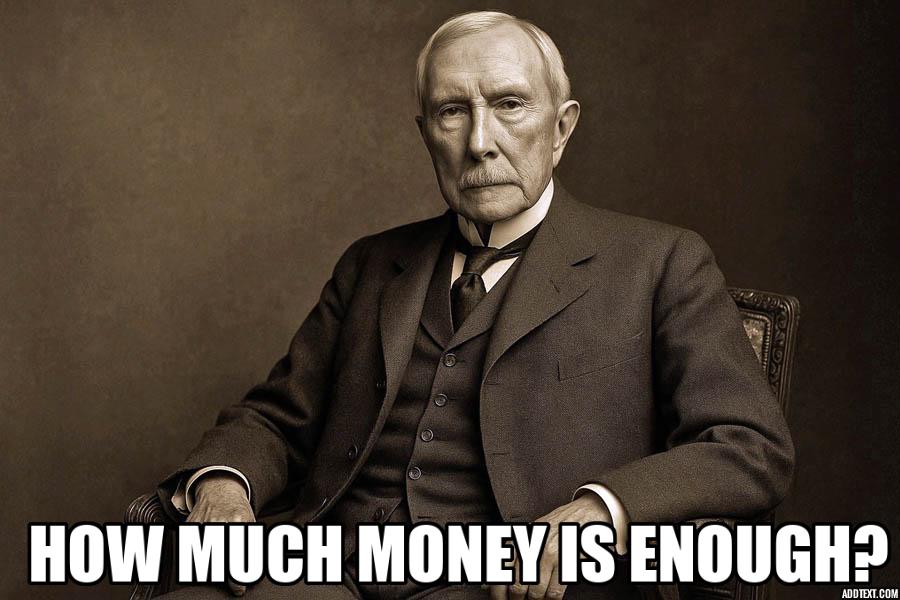
“How much money is enough?”
That question was once put to John D. Rockefeller, one of the richest men who ever lived.
And his answer has become famous: “Just a little bit more.”
Think about that for a moment. Here is a man who had more wealth than almost anyone in history — more than he could ever spend, more than generations of his family could spend — and yet, when asked how much is enough, his answer was not a number. It was a mindset. “Just a little bit more.”
And if we’re honest, that doesn’t just describe Rockefeller. It describes us.
One more achievement. One more success. One more thing. One more purchase. One more experience. Then another one. And another one.
We tell ourselves that satisfaction is just around the corner — that once we get there, wherever “there” is, things will finally settle into place.
And yet, if you look at the data — and it’s actually quite striking — we are living in one of the most materially comfortable eras in human history, and at the same time, levels of anxiety, levels of dissatisfaction, and levels of unhappiness continue to rise.
People have more, and somehow – it’s never enough. It’s a strange paradox.
And that mindset is so deeply ingrained in us that we barely even notice it anymore. It’s the air we breathe.
Which makes one of the most famous songs in the Haggadah a little puzzling: Dayenu. On the surface, it sounds like a song of gratitude. A list of everything God did for us — and after each step, we say: Dayenu. It would have been enough.
But when you actually listen to the words carefully, it starts to sound almost… absurd.
אילו הוציאנו ממצרים ולא עשה בהם שפטים — דיינו: If God had taken us out of Egypt but not punished the Egyptians — it would have been enough.
If He had split the sea, but not taken us through it — it would have been enough.
If He had brought us to Sinai, but not given us the Torah — it would have been enough.
Really? That would have been enough? Of course not. We needed the next step. We needed the Red Sea to split to open and to walk through it. We needed Mt. Sinai and the Torah. Without the continuation, the story is incomplete. So what are we saying?
And the answer, I think, is that Dayenu is not describing reality. It’s training us how to experience it. Because Dayenu is not a song of gratitude. It’s a discipline. It forces us, step by step, to imagine a stopping point — to pause and say: if it had ended here, I would have had enough to be grateful for. Not because the story is complete… but because I refuse to let my sense of satisfaction depend only on what comes next.
And that runs completely against the grain of how we live.
All we are ever thinking is: What’s next? What’s missing? What haven’t I achieved yet? And even when something good happens, we barely sit with it before moving on to the next thing.
Dayenu comes along and says: stop. Look at what already is. Recognize it. Appreciate it. Let it be enough — at least for a moment.
Because if you don’t learn how to do that, then nothing will ever be enough.
You can leave Egypt — and still feel stuck. You can cross the sea — and still feel like you’re lacking. You can stand at Sinai — and still be waiting for something more.
And do you know what: that’s a kind of slavery. Not slavery to Pharaoh… but slavery to an endless sense of insufficiency. And that’s why Dayenu sits right at the heart of the Seder. Because leaving Egypt was not just about leaving a place. It was about becoming a different kind of person.
We need to become a person who can say: I have something, and I recognize it, and I’m happy. We must not be constantly defined by what is missing. We must be a person who can experience a moment of completeness, even within an incomplete journey.
Don’t get me wrong – being that way does not mean we stop striving. Of course, we move forward. Of course, we grow. Of course, we build. Ambition is not a bad thing. But there is a difference between striving from a place of gratitude… and striving from a place of constant dissatisfaction.
One is freedom. The other is just a more sophisticated form of being stuck.
Dayenu teaches us how to say “this is already enough” — I’m happy with what I’ve got — Dayenu. Because real freedom is not just having more. It’s knowing when to say: I have enough.
And if you think this is just a nice idea, a kind of philosophical exercise — it isn’t.
The greates rabbis of Jewish history actually lived this way. Take the Chofetz Chaim. He ran a small shop in Radun. It wasn’t a large business — it was just enough to support his family in a simple way.
But there’s a well-known description of how he approached his business. He would calculate, very simply, how much he needed for the week. Basic needs. Bread, a little food, the essentials.
And once he had earned that amount… he closed the shop. He had what he needed. Dayenu. If you wanted whatever that shop was selling, you’d better buy it early in the week, because otherwise you’d need to wait until next week to get it!
And the rest of the time — the Chofetz Chaim devoted to learning, to writing, to living a life that was not driven by the endless pursuit of more.
It’s almost impossible for us to imagine. Because our instinct is exactly the opposite. If our business is doing well — stay open longer. If money is coming in — maximize it. If there’s an opportunity — take it.
But the Chofetz Chaim lived with a completely different internal calculation. Enough was enough.
And you find the same pattern, in a very different form, among the great Chassidic Rebbes.
People would come to Reb Elimelech of Lizhensk with פדיונות — money given together with requests for bracha, for yeshuah, for help. And over the course of a day, significant sums could accumulate.
What would a normal person do? You would put something aside. You would plan for tomorrow. You would build some level of financial security.
But that’s not what he did. By the end of the day, the money was gone. Distributed to the poor. Given to those in need. Passed along almost as quickly as it arrived.
Because Reb Elimelech did not see himself as someone who needed to hold the money. He was a conduit. What came in today was for today. Tomorrow would be taken care of tomorrow. Dayenu.
And there are countless variations of this idea.
Gedolim who lived simply, even when they could have had more.
Who refused to accumulate beyond what they needed.
Who experienced what they had as sufficient, not lacking.
When you hear these stories, they sound almost extreme. Almost unrealistic. But that’s exactly why the Haggadah gives us Dayenu in the form that it does.
Not because we are meant to replicate those lives exactly… but because we are meant to internalize the mindset.
To learn that there is such a thing as enough. That a person can look at what they have — materially, spiritually, emotionally — and say: this is already something. This is already meaningful. This is already worthy of gratitude.
Because if you don’t learn that lesson… then no matter how much you accumulate… you will always still be Rockefeller, quietly saying: “just a little bit more.”
And if you do learn it… then even in the middle of an unfinished journey… you can say: Dayenu.
