

FIGHTING YESTERDAY’S BATTLES
There are moments when something happens and it sends a jolt through the entire Jewish community — an instant, collective spike in adrenaline. This week gave us one of those moments. On Wednesday, an event at Wilshire Boulevard Temple was suddenly stormed by protesters who barged inside shouting anti-Israel slogans, turning a synagogue—a synagogue!—into a stage for their rage.
And the reaction across the Los Angeles Jewish community was immediate and visceral. Phones buzzed, WhatsApps exploded, parents checked school security updates, rabbis called police contacts — everyone was asking the same breathless questions: “Did you see what happened? Are we safe? What’s next?”
It wasn’t subtle. It wasn’t gradual. It was a stomach-dropping sensation — something had pierced the bubble we rely on to feel normal. And in that moment, the entire community seemed to shift into panic mode, as if one nerve ending had been struck and the whole body flinched at once.
So with all this jittery, communal adrenaline rushing around, the real question is: why do we react like this? Why does one incident send us into full alert mode? Let me tell you a story…
A few years ago, a well-known organizational psychologist told me about a man who was, without exaggeration, a superstar. He was the CEO of a wildly successful beverage startup that sold some kind of weird health drink that tasted disgusting but apparently cured everything from indigestion to depression.
Silicon Valley loved him. Investors adored him. His company valuation kept getting higher, even as his product kept getting stranger.
Anyway — he was brilliant. He was a visionary. He spoke at conferences. He appeared on magazine covers wearing the obligatory black T-shirt that all tech CEOs apparently receive at orientation.
But he had… one issue.
Every time something didn’t go exactly according to plan — a delayed shipment, a mildly critical tweet, an intern who forgot to alphabetize a spreadsheet — he completely fell apart. Not just worried. Collapsed. Full-on panic. The board once watched him have a total meltdown because a competitor launched a rival health drink, and he was convinced this was the end of civilization as we know it.
After one particularly melodramatic disintegration during an investor meeting (“WE’RE FINISHED! DO YOU HEAR ME? FINISHED!”), his executive coach gently pulled him aside. The coach looked him straight in the eye and said: “Hey, you do realize you’re not reacting to the problem in front of you. You’re reacting to the problem from eighth grade, or something. Because otherwise this doesn’t make any sense.”
And suddenly the truth spilled out. When this whiz-kid CEO was thirteen, he’d tried to run for class president. He printed posters. He wrote a speech. He had a slogan. And then — he lost. Not just lost. He lost spectacularly. His opponent won with 83% of the vote, which, in middle-school terms, means the teachers must have also voted against him.
And ever since that day, whenever he sensed even the faintest whiff of failure, his teenage self took over. Not the CEO. Not the visionary. The eighth-grade boy with the nerdy glasses who couldn’t get elected for class president.
His coach told him: “Listen carefully, because this is going to save your life — your company is run by a 13-year-old with unresolved trauma. You’ve got to fire him.”
And that was the breakthrough. Because until that moment, he — like so many of us — wasn’t living out his current life. He was living out an old story. One that hadn’t been true for decades.
The reason I love this story — aside from the fact that it confirms my long-held suspicion that half of Silicon Valley is run by emotionally fragile teenagers in very expensive sneakers — is because it shines a bright light on something profoundly human: most of us are walking around reacting to events that happened years ago. Sometimes decades ago. Our present-day challenges trigger old memories, old insecurities, old narratives we haven’t bothered to update since the days of dial-up internet.
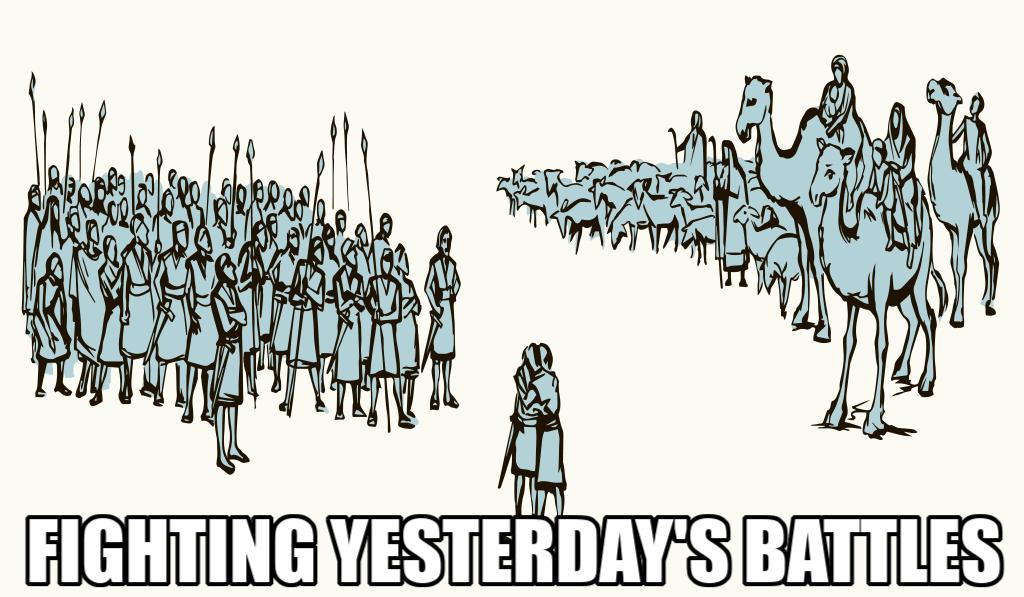
Which brings us to Yaakov Avinu — the original biblical case study in how old stories can hijack present reality. At the beginning of Parshat Vayishlach, Yaakov is preparing to meet Esav. But if you look closely — really closely — something feels off. The Torah describes an almost comical level of panic.
He divides the camp. He sends waves of gifts. He rehearses speeches. He prays. He prepares for war. He prepares for surrender. It’s the full disaster-management plan of a man absolutely convinced that everything is about to go sideways.
You can almost hear the inner monologue: “Four hundred men? FOUR HUNDRED MEN?! They’re probably dangerous, highly trained mercenaries! Professional assassins! Esav hasn’t forgotten! Esav never forgets! Why did I ever take those blessings? Why am I coming home?! I must be crazy!”
This is not the behavior of a calm, collected patriarch. This is a man spiraling into oblivion.
But that’s the point: this isn’t someone responding to an external enemy. He is responding to an old story. The Yaakov who stands on the banks of the Yabok isn’t just thinking about Esav’s four hundred men marching towards him. He’s thinking about the Esav from twenty years ago — the one who threatened to kill him, the one he ran away from, the one who occupied far too much emotional real estate for far too long.
And this is the key: Yaakov is not responding to Esav. He is responding to his memory of Esav. He is living inside a story written decades earlier, and like the health drink CEO, he’s being controlled by a younger version of himself. Which means that the great confrontation of Parshas Vayishlach is not Yaakov versus Esav at all. It is Yaakov today versus Yaakov of twenty years ago.
And then… after all the panic, all the strategizing, all the late-night overthinking … what happens?
Absolutely nothing. No violence. No ambush. No four-hundred-man attack brigade. Not even a dirty look. Esav runs toward Yaakov, throws his arms around him, kisses him, and cries. It is the ultimate biblical anticlimax. You can almost hear Yaakov thinking: “Are you kidding me? This is what kept me up all night? This is what I rehearsed speeches for? This is why I sent enough goats for Esav to start his own petting zoo?”
It turns out the entire crisis existed mostly in Yaakov’s imagination. Esav had moved on. The only one still living in the old story… was Yaakov.
And here’s what’s remarkable: from this moment onward, Yaakov becomes a completely different person. Watch the text carefully and you’ll see it. The man who panicked is gone. The man who catastrophized everything is gone. The man who expected the worst at every turn is gone.
In his place stands someone cool, calm, collected — almost unrecognizable compared to the Yaakov of the Yabok River.
When Shechem abducts Dina? Yaakov is measured. In fact, he is angry with Shimon and Levi for what he sees as their overreaction.
When Rachel dies on the road? He grieves with dignity, buries her, plants a marker, and keeps going.
When Yosef has crazy dreams and his brothers go crazy, Yaakov reserves judgment (Gen. 37:11): וְאָבִיו שָׁמַר אֶת הַדָּבָר.
And then, when Yosef disappears and the brothers bring back the bloody coat — Yaakov suffers terribly — but he does not fall apart. He mourns. He refuses to be comforted. But he remains present. He doesn’t fall apart.
What changed? It changed here at the beginning of Vayishlach. It was an “Aha!” moment. After panicking, he finally came to realize that he was no longer that Yaakov of the past, and a newer, calmer Yaakov took hold. This is the moment he becomes Yisrael in practice, not just in name. For the first time, he’s not living in the shadow of his demons and anxieties. He is living the life of who he really is.
And that is our task today. Antisemitism has reared its hideous, familiar head — in ways we thought belonged to another century. Jews around the world, and now here in Los Angeles, are anxious, shaken, and confused. Social media feels like a digital Esav marching toward us with four hundred influencer warriors full of rage. And the Jewish world is panicking.
But if we are honest with ourselves, some of that panic isn’t about today. It’s about the stories we carry from yesterday.
We are reacting not just to the present danger, but to the ghosts of the past — to memories of vulnerability, to inherited trauma, to centuries of being chased, scapegoated, expelled, hunted. Those memories matter; they are real; they shape us.
But they are not today. Today we are not Yaakov running away. Today we are Yaakov coming home.
Today we are not a frightened family in the dark. We are a sovereign nation with an army, a homeland, and we are a global people who refuse to walk with heads bowed.
Today’s Jewish world is not powerless. We are not without allies. We are not standing alone by the river waiting for disaster. We are standing as Yisrael — a people who have wrestled with every empire on earth and somehow are still here, still breathing, still building, still dreaming.
So yes, we need to take the threats seriously. But we also need to take a breath.
We need to stop allowing the old story — the story of helpless Jews in a hostile world — to dictate our reactions.
We need the courage to face reality without meltdown, without overreaction, without emotional paralysis.
Because the truth is: today is today. Today we are strong. Today we can confront the challenges in front of us — political, cultural, ideological — without assuming that Esav is poised to destroy us.
The lesson of Vayishlach is that once Yaakov stopped running from his old story, he could finally start living his real life.
And perhaps that is our calling now. We need to acknowledge the past, but not be imprisoned by it. We need to remember our traumas, but not be governed by them. We need to face the darkness, but not assume that every shadow contains a threat.
We need to become, in our own moment, what Yaakov became that night: a people who walk forward, maybe wounded, but unafraid — we are no longer Yaakov, we are Israel.

(For the SoundCloud audio, scroll down) Iran’s increasingly reckless attacks across the Middle East have reached a new level. This week, debris from an Iranian missile struck the Church of... Read More