

FIGHTING FIT
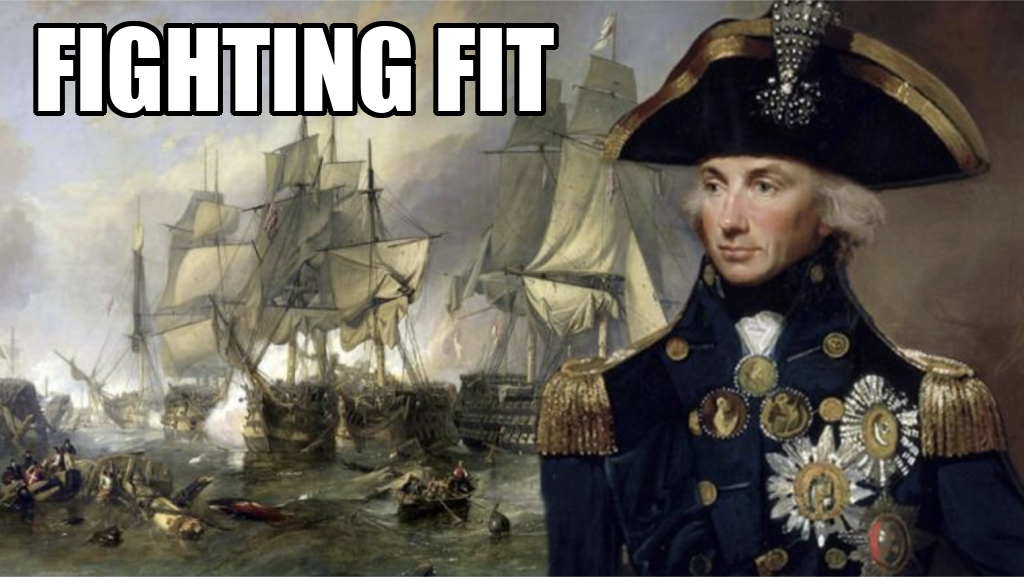
I was listening recently to a series of podcasts about Admiral Horatio Nelson — the heroic British naval commander best remembered for defeating the combined French and Spanish fleets at the Battle of Trafalgar in 1805.
Although Nelson featured prominently in my history education growing up, I realized how little I actually knew about him. For example, I discovered that he and Lady Emma Hamilton were among the first truly international celebrities.
His face was everywhere. There were souvenirs, memorabilia, engravings — an entire industry built around his image and exploits. Long before social media, Nelson was famous across the Western world.
I also learned something more sobering. Despite his extraordinary success, Nelson was chronically short of money. After his death — despite the provisions in his will — Lady Emma and his daughter Horatia fell into real poverty.
Emma herself died not long afterward, and her estate could not even cover the cost of her burial. The hero of Trafalgar reshaped European history, but the personal aftermath was far less triumphant.
Of course, what made Nelson immortal was the Battle of Trafalgar. In a matter of hours, his fleet shattered Napoleon’s naval ambitions and secured British control of the seas for more than a century. It was a victory that altered geopolitics for generations — and it cost Nelson his life.
And that raises a fascinating question — one historians have debated for more than two hundred years: How was Nelson’s fleet so overwhelmingly successful?
The battle itself lasted only a few violent, chaotic, smoke-filled hours. Cannons roared. Ships collided. Men shouted orders over thunder and flame. And in that compressed window of time, history pivoted.
So what happened in those few hours that produced such staggering results? Was it simply genius? A flash of brilliance? Tactical daring in the heat of the moment?
The deeper you look, as I learned listening to the podcast, the more you discover that the answer lies somewhere else entirely.
Trafalgar is exactly the kind of victory we like to romanticize. We imagine a brilliant commander standing on deck, scanning the horizon, making bold, decisive moves in the heat of battle. We attribute the outcome to genius, daring, and instinct refined by years of experience.
But what fascinated me most was not the victory itself. It was what made the victory possible.
The British ships were not necessarily larger. They did not always carry more cannons. In several cases, the opposing French and Spanish vessels were technically superior on paper — heavier ships, formidable firepower, and very robustly designed. If you compared specifications alone, the advantage was not obviously British.
So why did they win so decisively? Because the Royal Navy, under Nelson’s leadership, had become almost obsessive about drills.
Every ship operated with mechanical precision. Every sailor knew his assigned task. Gunnery crews practiced loading and firing their cannons over and over again until the movements became automatic. Timing was measured carefully. Procedures were standardized. Coordination was refined through repetition.
They drilled in calm seas and in rough waters. They drilled when the weather was miserable. They drilled when it was tedious. They drilled when there was no enemy in sight and no immediate threat on the horizon. The work was repetitive. It was unglamorous. But it was relentless.
And that discipline created a decisive advantage. In the chaos of battle, when smoke filled the air and visibility dropped, British ships could fire faster and more accurately than their opponents. While a French or Spanish crew might discharge a broadside every ninety seconds, British gunners could often do so in nearly half the time.
Over the course of a few hours, that difference compounded dramatically. More shots fired. Greater accuracy. Sustained pressure. And the cumulative effect was overwhelming.
The battle itself was brief. But the victory it secured was forged over years of repetition.
Nelson once remarked, “I have always been of opinion that a fleet of British ships of war are the best negotiators in Europe.” It’s a bold line. But behind that boldness was relentless preparation. Behind the confidence was competence. And behind the competence was something far less glamorous — routine.
History loves the dramatic moment. It loves the smoke and cannon fire, the signal flags raised against the sky. What it rarely lingers on are the sailors scrubbing decks at dawn, running through gunnery drills in calm seas, repeating the same movements until they no longer had to think about them. And yet that is precisely where supremacy was built — not in the chaos of battle, but in the monotony of preparation.
The pattern repeats itself across history. Thomas Edison, reflecting on his thousands of failed experiments, famously said, “Genius is one percent inspiration and ninety-nine percent perspiration.” We quote the line so often that it risks becoming a cliché, but it is so true. Inspiration may ignite the spark. But it is perspiration that keeps the flame alive.
The same truth runs through athletics. Michael Jordan once observed, “I’ve failed over and over and over again in my life. And that is why I succeed.” Championships are decided in games, but games are won in practice — in drills, in repetition, in refining your abilities long before the crowd is watching.
And it is precisely this point that emerges in Parshas Tetzaveh, as we encounter a simple command regarding the Menorah: לְהַעֲלֹת נֵר תָּמִיד — to kindle the lamp continually. Not dramatically. Continually.
The Mishkan would be magnificent. It would inspire awe. But what made it function was not its architecture; it was its daily rhythm. The Menorah did not burn simply because it stood in a sanctuary. It burned because someone brought pure olive oil each day. Because someone cleaned the lamps. Because someone trimmed the wicks. Because someone lit and maintained the flame.
Every day. Day after day. Week after week. Month after month. Year after year.
That is what “ner tamid” means. A flame that does not depend on mood, or on spectacle, or on an emotional surge — but on discipline.
Whenever I speak under a chuppah, I say something that surprises people. Everyone tells a couple that their wedding day will be the best day of their lives. I tell them it shouldn’t be. Because the day after the wedding should be better. And the day after that better still.
Do you know why? Because love deepens through repetition. Because each day you choose patience, choose generosity, choose forgiveness – you are building something durable. Over time, care becomes instinctive. Kindness becomes muscle memory. Commitment becomes second nature.
That is how a marriage becomes real. Not in the ceremony or the great party that follows — but in the daily tending of the flame long after the wedding is over.
The same is true of parenting. Parenting does not hinge on one powerful conversation about life, or on the spectacular birthday party you organized, or on that one memorable afternoon when you sat down to help your kid with a school project. Those moments are lovely — but they are not what shape a child.
What shapes a child is routine. Bedtime stories — every night. School runs — every day. Homework supervision — again and again. Listening to your child describe the same playground drama, the same classroom politics, the same small triumphs — patiently and repeatedly.
It is the steady rhythm of presence that builds security. It is repetition that builds trust. And over time, consistency becomes the atmosphere in which a child grows.
Torah learning works the same way. It is not built on a single brilliant shiur or an especially inspiring Shabbos drasha. It is built on studying Torah, page after page, year after year.
The siyum at the end of a masechta is emotional — of course it is. But the siyum rests on something far less glamorous: the daily grind of opening the Gemara when you are tired, reviewing a passage you did not fully grasp, showing up to a shiur even when inspiration is nowhere to be found.
That is the key: the drill and the discipline.
And communities are no different. Communities are not sustained by one stirring speech or one magnificent event. They are sustained by people who set up the shul week after week, who answer emails no one else wants to answer, who show up to meetings, who balance budgets, who visit the sick, who come to minyan consistently, day after day.
The strength of a community lies not in the beauty of the shul building, but in the regularity and consistency of its members — showing up, regularly and consistently.
And that is what לְהַעֲלֹת נֵר תָּמִיד means. Not a dramatic flame that dazzles for a moment, but a light that is tended faithfully — again and again — until it becomes part of the fabric of life. The Jewish secret was never spiritual fireworks. It was maintenance. It was and is לְהַעֲלֹת נֵר תָּמִיד.
Nelson won at Trafalgar because his sailors had practiced in calm waters long before the storm. The Kohen did not wait to feel inspired before tending the Menorah. He showed up. He cleaned. He refilled. He lit the flame and made sure it endured.
And the Jewish people have endured because, generation after generation, someone brought the oil and lit the flame. Again. And again. And again. That is what *we* need to look like if we are to ensure that the next generation continues in our path.
It can happen. We just need to be there regularly to make sure it dies.


(For the SoundCloud audio, scroll down) Iran’s increasingly reckless attacks across the Middle East have reached a new level. This week, debris from an Iranian missile struck the Church of... Read More