

ECHOES, RHYMES, AND REDEMPTION
There’s a line people love to quote—usually attributed to Mark Twain—that “history doesn’t repeat itself, but it often rhymes.” It’s clever, memorable—and almost certainly not something Twain ever said.
The now-famous “rhyming” version seems to have emerged in a 1965 essay by psychoanalyst Theodor Reik, who suggested that while events don’t replay exactly, they follow very familiar patterns with subtle variations. However you phrase it, the idea lingers—because every so often, the present arranges itself in ways that feel so familiar, it’s as if we’re watching history echo in real time.
And right now, that echo is getting harder and harder to ignore. If you’ve been paying even passing attention to the news, you’ll have noticed something unsettling—not just isolated incidents, but a pattern.
Israel is now under daily missile attack from Iran, a regime that has made no secret of its ambitions. Their goal is explicit: to obliterate Israel—and with it, the millions of Jews who live there. The threats are now being matched with action—direct, sustained, and deadly.
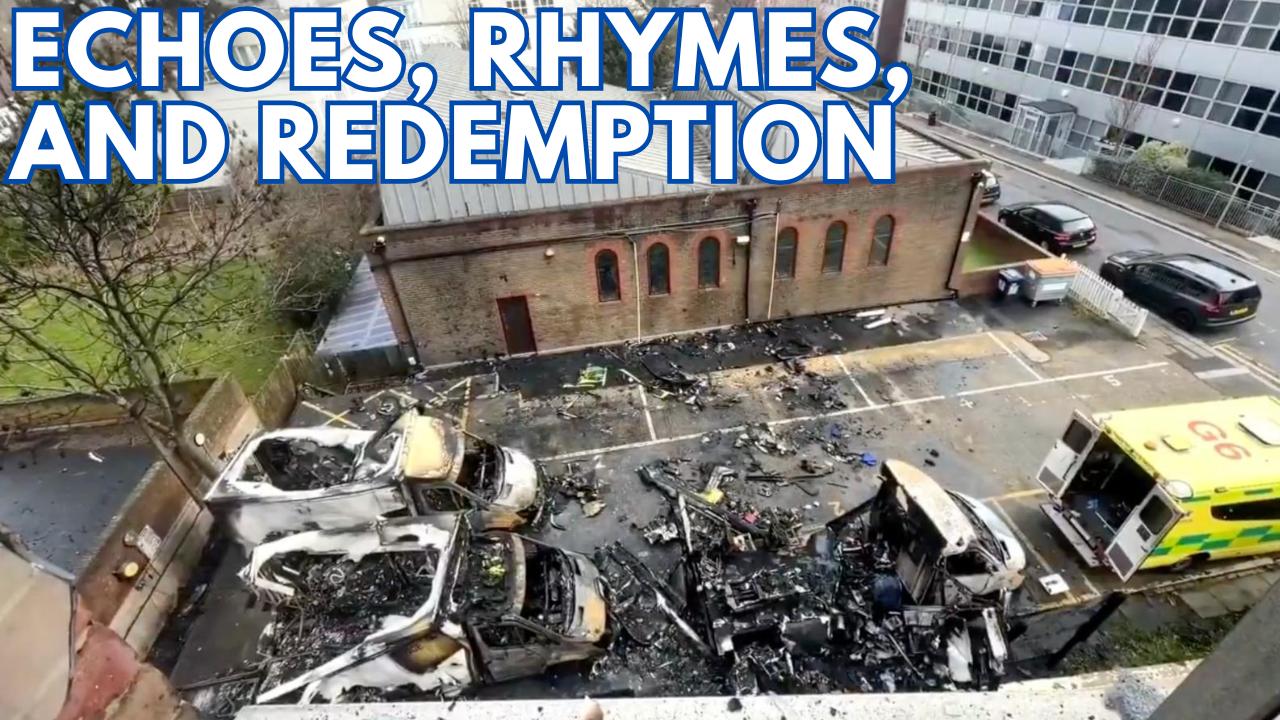
Meanwhile, thousands of miles away, in places that pride themselves on liberal tolerance, something darker is stirring. Antisemitic attacks are rising at a pace not seen in generations. This week in London, three men were caught on camera torching ambulances belonging to Hatzolah, a volunteer emergency organization whose sole purpose is to save lives.
The attackers didn’t care. A shadowy group claiming responsibility didn’t just justify the act—they promised more. “This is only the beginning,” they warned.
And in Los Angeles—a city synonymous with diversity—a lawsuit filed by Madison Atiabi tells an almost unbelievable story. According to court documents, Puka Nacua, who plays for the Los Angeles Rams, allegedly launched into an unprovoked antisemitic outburst on New Year’s Eve.
The lawsuit goes on to allege that later, Nacua physically assaulted her, biting her shoulder with such force that it left a visible imprint. Nacua seems to have form. In December, he apologized after performing a gesture that plays upon antisemitic tropes on a live stream.
Different continents. Different contexts. But it’s the same hatred. And with it comes a powerful sense that we’ve been here before. Not exactly like this—history never replays with perfect symmetry—but the echo is unmistakable. Which brings us to Passover—and to the Haggadah.
Every year at the Seder, we say the familiar words: בְּכָל דּוֹר וָדוֹר חַיָּב אָדָם לִרְאוֹת אֶת עַצְמוֹ כְּאִלּוּ הוּא יָצָא מִמִּצְרַיִם — “In every generation, a person is obligated to see themselves as if they personally left Egypt.” We are not being asked to remember. We are being asked to see ourselves as having left Egypt—a seemingly impossible task, given that the Exodus took place over thirty-three centuries ago.
The answer is that the Exodus was never intended to be a one-off event. It was meant to become a template—a lens through which we interpret history as it unfolds in real time.
Read the Exodus story carefully, and you’ll notice something unsettling: things got worse before they got better. When Moses first appears, demanding the Israelites’ release, Pharaoh doesn’t just refuse—he escalates.
As conditions deteriorate, the people turn on Moses in frustration: “May God judge you… You have made us loathsome in the eyes of Pharaoh, placing a sword in their hand to kill us.”
And then comes one of the rawest moments in the entire Torah. Moses turns to God and says: “Why have You done evil to this people? Why did You send me?” He had come as the redeemer—and instead, everything had spiraled downward.
If you had been there, watching hope collapse into despair, you would have said—quite reasonably—this isn’t redemption; it’s a disaster. And yet, we know how the story unfolds. What looked like deterioration was in fact the prelude to transformation—the pitch darkness before the first crack of dawn.
Suddenly, the words of the Haggadah don’t feel abstract anymore. They feel current. We are living through a moment when things seem to be getting worse before they get better. Iran, like Pharaoh, is digging in. Even as pressure mounts, there is no sign of retreat—only defiance, and doubling down on aggression.
And beyond the geopolitical arena, there is the resurgence of antisemitism—less a series of isolated incidents and more a gathering wave. It is deeply unsettling for those of us living through it. But that is precisely the point.
The Haggadah does not ask us to relive the Exodus at its triumphant conclusion; it asks us to place ourselves inside the process—to feel the uncertainty, the fear; to stand where Moses stood and ask, “Why is this getting worse?” And then—to hold our nerve. Because embedded within the Exodus story is a radical idea: that chaos and distress can be the precursor to the moment when everything finally comes together.
The night is always darkest before dawn—not as a cliché, but as a description of how redemption actually works.
And when it happens, it doesn’t unfold gradually. It happens, as the Torah describes it, כַּחֲצֹת הַלַּיְלָה—at the stroke of midnight, in an instant. One moment, Egypt is the most powerful empire on earth; the next, it is shattered. One moment, the Jewish people are slaves; the next, they are walking out toward freedom. It is a pivot—a complete reversal of reality.
Which means that if we are living through a chapter of that same unfolding story, we may be closer to the turning point than we think. The signs are there: a world order that feels increasingly unstable; an enemy under mounting pressure that still refuses to yield; a surge of hostility that defies reason. But all that will be over in a moment, as the divine will changes it in one stroke.
And so, this year, when we sit at the Seder and say, “In every generation, a person is obligated to see themselves as if they personally left Egypt,” we don’t need to stretch our imagination quite so far. For the first time in a long time, it doesn’t feel like ancient history—it feels immediate.
And one day—soon, and all at once—the shift will come. And when it does, those who held their nerve, who stared into the darkness and still believed in the dawn, will simply nod and say: of course. The Exodus never really ended. It has been unfolding all along—until we finally learn to recognize it while we are still inside the story.

ECHOES, RHYMES, AND REDEMPTION
There’s a line people love to quote—usually attributed to Mark Twain—that “history doesn't repeat itself, but it often rhymes.” It’s clever, memorable—and almost certainly not something Twain ever said. The... Read More