

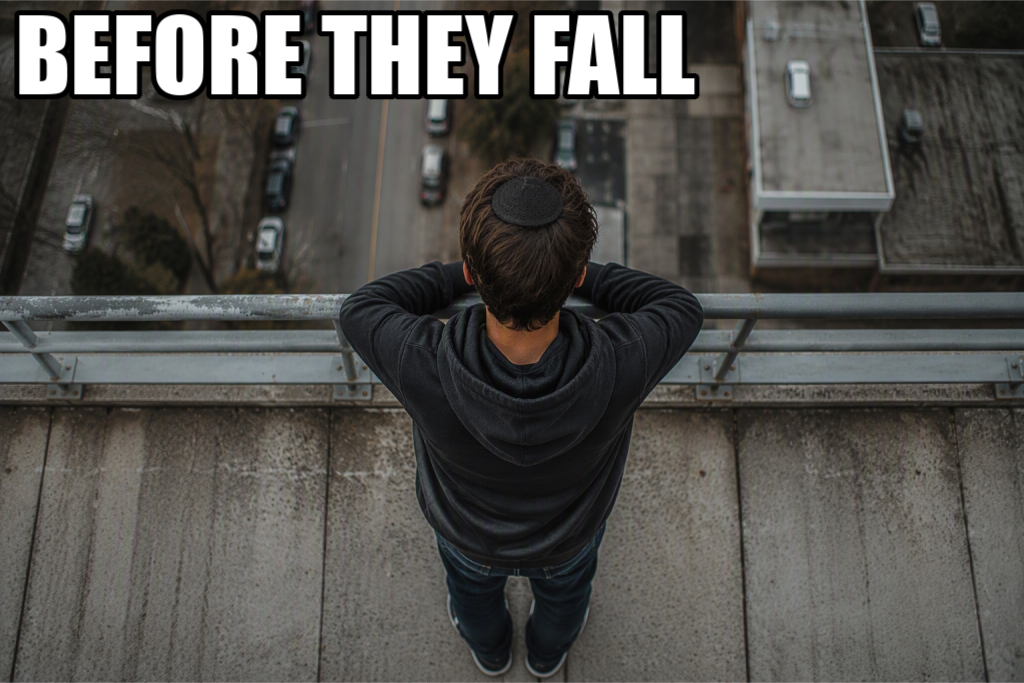
BEFORE THEY FALL
On January 10, 1860, at around five o’clock in the afternoon, something terrible happened in a place called Lawrence, Massachusetts.
The Pemberton Mill was a massive textile factory, one of the great industrial buildings of its era. Hundreds of workers—many of them young immigrant women—were inside operating hundreds of looms when, without any warning, part of the building gave way. And then the whole thing came down.
Floors collapsed onto floors. Brick walls folded inward. Machinery weighing thousands of pounds crashed through the building. Hundreds of workers were trapped beneath an enormous mountain of wooden beams, bricks, and twisted iron.
People rushed in from the surrounding streets to rescue them. And then, just to make things worse, several hours later an oil lamp was accidentally knocked over. The entire wreckage caught fire.
Imagine the horror. People who had survived the collapse were still trapped underneath, calling out for help, as the fire spread through the ruins.
To this day, the precise death toll remains uncertain—somewhere between 100 and 150 people were killed, and many more were badly injured. It remains one of the worst industrial disasters in American history.
The crazy thing is this: the Pemberton Mill did not collapse because an earthquake struck Massachusetts. Nor did it collapse because of a tornado. It collapsed because the building could not bear the load being placed on it.
Investigators found serious structural weaknesses in the facility.
The cast-iron columns supporting the floors were inadequate, and the mill had been packed with more and more heavy machinery as its owners tried to increase production. The building looked enormous and impressive. It was functioning, and it was profitable.
Until suddenly it wasn’t.
We have a mitzva in Parshat Ki Teitzei which deals with this exact issue (Deut. 22:8): כִּי תִבְנֶה בַּיִת חָדָשׁ וְעָשִׂיתָ מַעֲקֶה לְגַגֶּךָ וְלֹא תָשִׂים דָּמִים בְּבֵיתֶךָ – “When you build a new house, you shall make a guardrail for your roof, so that you do not place blood in your house.”
On the surface, the mitzvah is obvious. Flat roofs were used as living spaces in those days, and if your roof has no protective wall, someone could fall off. So the Torah says you need to build a maakeh—a guardrail—which will prevent people from falling off the roof.
But listen carefully to the language: וְלֹא תָשִׂים דָּמִים בְּבֵיתֶךָ – “Do not place blood in your house.”
It’s a strange phrase. You did not push anybody off the roof. You certainly did not want anybody to fall off your roof. And you may not even have been home when someone fell.
But the Torah says clearly: if you knowingly maintain a dangerous house, you cannot completely separate yourself from what happens there.
After all, you know gravity exists. You know people go onto the roof. You know what could happen if someone steps too close to the edge.
That’s why, if someone falls off, you can’t just shrug your shoulders and say: “They should have been more careful.”
In fact, the Sefer HaChinuch explains that the Torah is establishing a much broader principle here. The roof is simply an example. The Torah wants us to understand something really important: we have an obligation to remove foreseeable hazards from the places in which we live.
And the Sefer HaChinuch goes on to make a fascinating theological point. Believing in God does not mean pretending that the normal rules of the world do not operate. Fire burns. Heavy stones cause injuries. Someone who falls from a high roof may die.
God created a world governed by natural consequences, and He therefore commands us to take all necessary precautions against them.
In other words, the Torah introduces an extraordinarily modern idea: Foreseeable risk creates responsibility. And truthfully, I think there is a message here that goes far beyond physical safety.
Because every one of us is building a house. Not merely the house we sleep in every night. I’m talking about a Jewish house—a Jewish home.
And into that home we are bringing our children. We want them to emerge from our homes as committed Jews. We want them to love Torah and mitzvot. We want them to marry Jews and build Jewish families. We want them to feel an instinctive connection to the Jewish people and a profound love for Israel.
And then, if that does not happen, we have plenty of people to blame.
The schools. The universities. Social media. Hollywood. The rabbis. The political climate. Antisemitism. Bad influences.
Name your preferred villain, as long as you can say: “It’s not my fault!”
And sometimes those things really are to blame. There are powerful forces outside our homes, and some of them are profoundly hostile to the values we are trying to transmit.
But Parshat Ki Teitzei asks us an uncomfortable question: What kind of house did you build before they encountered those forces? Was there a guardrail?
Because none of this is a surprise. We know our children are going to grow up in a secular culture. We know they will meet intelligent people who challenge religious belief. We know they will encounter people for whom intermarriage is completely normal. We know they will hear Israel described in ways that are distorted, hostile, and sometimes openly antisemitic. We know that their phones will offer them an endless menu of ideas and values completely different from ours.
None of this is an earthquake. It is gravity. And you cannot build a roof without a railing and then blame gravity when somebody falls off. The question is not how to prevent our children from ever encountering the outside world. That is impossible.
A maakeh is not a prison wall. The Torah does not tell you to seal off the roof so nobody can ever go onto it. People are supposed to use the roof. They are supposed to walk around up there, enjoy it, experience the world.
But do you know what the Torah says? Make the roof safe enough that people can go up there without falling.
That is the approach we need to have to Jewish education. Our job is not to raise children who can remain Jewish only as long as nobody asks them a difficult question. Our job is to raise children whose Judaism can survive any question.
We need homes where children don’t just know what we do, but know why we do it.
Shabbos can never be just a list of things we cannot do. Shabbos has to be the most beautiful day of the week.
Keeping kosher must never be thought of merely as a burden. We must teach our children that it is a privilege.
Our Shabbat dinner table must contain conversation and fun, but also Torah, ideas, questions, stories, and meaningful discussions.
Our children need to see that mitzvot are not burdens inherited from previous generations. They are opportunities connecting us to thousands of years of Jewish life.
And Israel—Israel must be introduced to our children long before it is in trouble. Israel is the apple of our eye, not a problem that erupts whenever people attack us. This last point is particularly important. If the only time our children hear us talk passionately about Israel is when there is a war, a terror attack, an antisemitic protest, or some political crisis, then Israel slowly becomes associated in their minds with anxiety, controversy, and burdensome obligation.
Israel must also be joy.
Israel must be history.
Israel must be the beautiful Hebrew language.
Israel must be Jerusalem on a Friday afternoon. Israel must be soldiers coming home for Shabbat. Israel must be archaeological discoveries, extraordinary innovation, Jewish arguments, ridiculous Israeli bureaucracy, magnificent food—and the overwhelming miracle that after two thousand years the Jewish people came home.
Children shouldn’t just learn that Israel needs defending.
They must be taught to understand why Israel is worth loving.
And the same applies to Judaism itself. If we want strong Jews, we need strong Jewish homes. Homes with the best guardrails we could possibly build.
Homes capable of carrying weight, so that they don’t collapse like the Pemberton Mill the moment there is a little bit of stress.
The Pemberton Mill looked strong. It was huge. Hundreds of people came to work there every day. But underneath the impressive exterior, the structure was not strong enough for the load its owners had placed upon it.
And that is the question we have to ask ourselves:
Can the Jewish structure we are giving our children carry the load we already know is coming?
Have we given them enough knowledge? Enough experience? Enough pride? Enough answers?
Enough confidence to say: “I don’t know the answer to that question, but I know enough about Judaism not to abandon everything because somebody on TikTok made a clever thirty-second video”?
We need our children to have enough love of Israel that when they encounter somebody chanting something vicious on campus, their first thought is not: “Perhaps everything my parents told me was wrong.”
And above all, our children need enough love from us that Judaism itself feels like home.
I remember many years ago, we invited the actor Stephen Berkoff to our Friday night dinner with dozens of Jewish singles in London. He was raised in a secular Jewish home and had never really experienced Shabbos before.
At some point he got up to speak. Berkoff is a very dramatic, expressive man, and he said: “Being at Friday night dinner with Rabbi Dunner and his wife, and with all of you, I feel like I’m in a big warm bowl of chicken soup.”
I have never forgotten that.
Because whatever else we teach our children about Judaism, that is what home needs to feel like.
Although, just to be clear, none of this guarantees an outcome. Children are not machines. Parents are not engineers. Human beings have free will, and wonderful parents sometimes watch children make choices that break their hearts.
But the absence of guarantees does not remove responsibility.
That is exactly the point of maakeh in Parshat Ki Teitzei. A railing does not guarantee that nobody will ever get hurt. But you build it anyway.
The Torah does not ask whether an accident is certain. It asks whether the danger is foreseeable.
And the danger of Jewish attrition is foreseeable. We have watched it happen for generations. So we cannot simply shrug when another young Jew drifts away and say: “What can we do? That is the world today.”
The Torah says there is something you can do. Build better.
Strengthen the foundations. Put up the guardrails. Create a Jewish home robust enough to withstand the pressures you already know will come.
Because by the time someone is falling from the roof, it is very late to start building the railing.
My friends, our task is to build the kind of Jewish house our children will not only be safe inside—but one that is strong enough and beautiful enough that, wherever life takes them, our children will always know where home is.
And that home will always be a Jewish home.


(For the SoundCloud audio, scroll down) The Rosh Hashana machzor has 100’s of pages and the davening is really long. You already know about the shofar, the apple, the honey,... Read More