

A FEW WORDS ABOUT SPEECHES
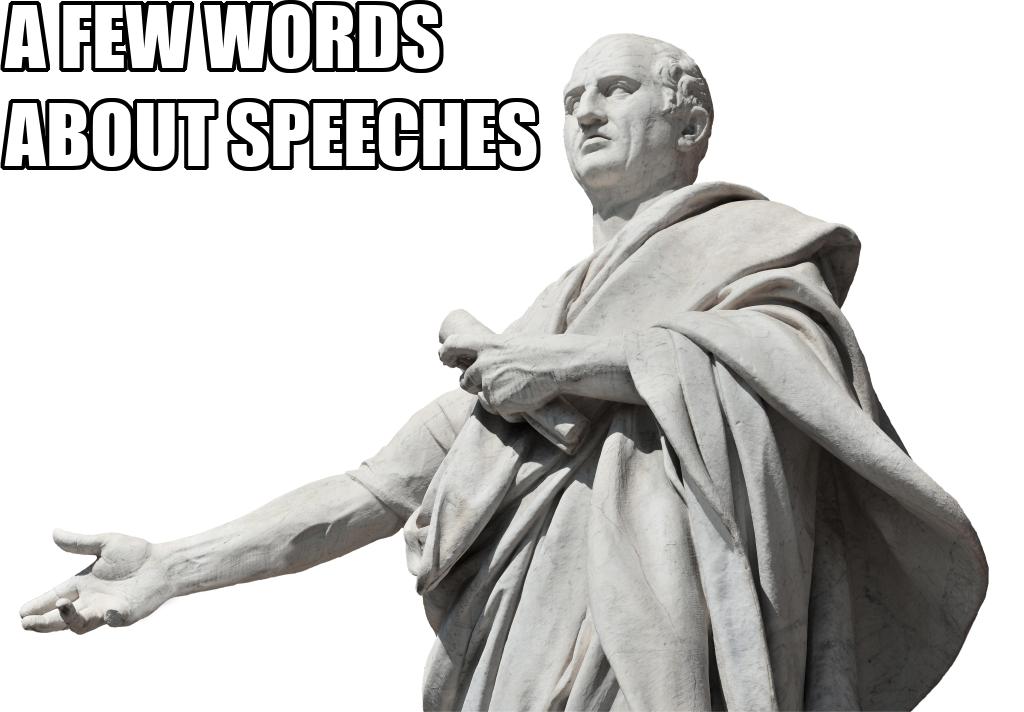
Winston Churchill, who knew a thing or two about public speaking, once observed: “A speech is like a love affair — any fool can start one, but to end it requires considerable skill.”
Another wit quipped that most speeches should come with a snooze button — which I take to mean that once a speech begins, many people see it as their cue to drift off. Personally, I judge my own efforts a success if I don’t hear any audible snoring.
The truth is, words are cheap. History is littered with speeches that achieved nothing more than extending the program by another twenty painful minutes. And yet — every so often — a speech doesn’t just fill time. It somehow bends time. It takes a moment that might otherwise have drifted by unnoticed and turns it into a hinge on which history quite literally swings.
Let me share a few examples.
The first comes from 324 BCE, from a man who was just 32 years old at the time: Alexander the Great. By then, Alexander had conquered most of the known world — which is impressive by any standard — but it had come at a cost.
His Macedonian soldiers, battle-hardened veterans who had marched with him for years, felt increasingly alienated. Alexander, now deep inside the Persian Empire, had gone thoroughly native. He had adopted Persian customs, promoted locals into senior positions, and married local women.
At a place called Opis — in what is today south-east of Baghdad, on the east bank of the Tigris River — the army finally snapped.
This wasn’t petty grumbling. It was open mutiny. And Alexander knew that if he lost the army, he would lose the empire.
What happened next is recorded by Arrian, the most important ancient historian of Alexander’s extraordinary life. Alexander rose before his troops and delivered a speech — an astonishing speech.
It was not conciliatory. He did not apologize. Instead, he reminded them who they had been before he led them: obscure soldiers from the fringes of the Greek world — and who they had become because of him: rulers of a vast empire.
Then he dropped the bombshell. If they no longer wanted him, he said, he would send them back to Macedonia and rule the empire with others. If necessary, with Persians. They were free to go.
The effect was immediate and electric. The soldiers broke down and wept. Weapons were cast aside. The mutiny collapsed without another word. One speech — and an entire empire held together.
My next example comes from three centuries later, from Rome. The year is 63 BCE. The Roman Republic is teetering on the brink — not because of foreign invasion, but because of rot from within.
A Roman aristocrat named Lucius Sergius Catilina is plotting a violent coup: assassinations, arson, chaos. Everyone suspects him. No one can quite prove it — and no one has the courage to challenge him openly.
No one, that is, except Cicero, the consul of Rome, who understands exactly what is at stake. If Catiline is not stopped, Rome will slide into civil war.
Cicero summons the Senate and opens with a line that has been drilled into the heads of Latin students for two thousand years: “Quo usque tandem abutere, Catilina, patientia nostra?” – “How long, Catiline, will you abuse our patience?”
It is a breathtakingly bold move. Cicero does not hint. He does not imply. He addresses Catiline directly, in public, and by sheer rhetorical force turns rumor and suspicion into certainty. Words do what swords have not yet done.
The result is immediate. Catiline storms out of the Senate and flees Rome that very night. Within weeks, the conspiracy collapses. The Roman Republic survives — for a few more years at least — until it finally succumbs to Julius Caesar in 49 BCE.
But on that day, Rome was saved not by legions on the battlefield, but by a rousing speech.
In the modern era, one speech stands out above almost all others: the address given by Abraham Lincoln at Gettysburg in 1863. The American Civil War was raging, and it felt unstoppable. The devastation was epic.
By that point, the war had already claimed hundreds of thousands of lives, and many in the Union were exhausted and ready to throw in the towel. The Battle of Gettysburg itself had just produced casualties on a scale that was almost unimaginable.
What is often forgotten is that Lincoln wasn’t even meant to be the main speaker. That honor belonged to Edward Everett, the most celebrated orator of his day, who delivered the keynote address — a meticulously crafted speech that lasted over two hours. Lincoln was invited merely to offer a few remarks at the dedication of the cemetery.
Two minutes later, he was finished. Just 272 words.
But instead of fire and brimstone, Lincoln did something far more powerful. He reframed the entire war. This, he said, was not merely a struggle over territory or rebellion, but a test of whether a nation “conceived in liberty” could endure.
“It is for us the living,” Lincoln declared, “to be dedicated here to the unfinished work” of those who had fallen.
The immediate reaction was surprisingly muted. The speech was barely reported in the newspapers, overshadowed by Everett’s oration. And yet, slowly and inexorably, Lincoln’s words took hold. The Gettysburg Address became the moral lens through which the war was understood.
After Gettysburg, the Union cause was no longer seen as just another military struggle bound to its moment in time. It became a moral struggle, one that cut to the very heart of what America stood for.
To this day, the Gettysburg Address is widely regarded as the manifesto of the American Republic — and across the world, as a distillation of what it means to defend Western democratic values.
My final example comes from exactly a century later, in 1963, and from a man standing on the steps of the Lincoln Memorial: Martin Luther King Jr.
America at the time was deeply fractured. Civil rights legislation was stalled in Congress. Violence simmered just beneath the surface. The March on Washington, which drew some 250,000 people, was intended to apply pressure — but expectations were modest. Another rally. Another protest. Another long sequence of speeches.
And the speeches, much like Edward Everett’s at Gettysburg, seemed to go on and on and on.
King was scheduled to speak last. He began by reading from prepared remarks — solid, careful, respectable. And then, partway through, he departed from his script.
What followed was pure rhetorical magic.
This was not an angry accusation directed at those who tolerated racism. It was something far more powerful: an invitation to imagine America differently.
“I have a dream,” King repeated again and again, painting a vision of a nation that would finally live up to its own ideals — a country where children would be judged not by the color of their skin, but by the content of their character.
The reaction was immediate and overwhelming. The speech was broadcast nationwide, and soon across the world. Public opinion shifted. Within a year, the Civil Rights Act was passed. Within two years, the Voting Rights Act followed.
One speech changed the tide — and suddenly, America found itself on a different path.
Alexander the Great held an empire together. Cicero saved the Roman Republic. Lincoln redefined what it meant to preserve the United States of America. And Martin Luther King Jr. awakened a nation’s conscience.
Different eras. Different audiences. Different styles. But the same underlying truth: Sometimes history doesn’t turn on armies, money, or brute power. Sometimes it turns because someone finds the right words, at the right moment — and dares to say them.
You might be wondering why I’m focusing on speeches today. I’ll tell you why. Because in Parshas Vayigash, we encounter what is arguably the first recorded speech in Jewish history.
Up until this point in the Torah, we have dialogue, conversation, exchanges. But here — for the first time — the Torah slows everything down and gives us a sustained, carefully constructed speech, introduced with just three words (Gen. 44:18): וַיִּגַּשׁ אֵלָיו יְהוּדָה — “And Yehuda stepped forward.”
There were no armies. And for a speech, there wasn’t really an audience either. Just one man stepping forward to speak to one other person — and in doing so, he changed the course of Jewish history.
Yehuda has no idea that the man standing before him is Yosef, his long-lost brother. He has no sense that this is a family drama waiting to be resolved. As far as Yehuda is concerned, this is a cold, foreign autocrat who holds absolute power over life and death. Which makes the speech all the more remarkable.
Because Yehuda understands something essential about great speeches: they are not about impressing an audience with rhetorical power — they are about changing the narrative for the audience so that the outcome changes. Yehuda needed to reframe reality for the one man who mattered.
Until that moment, the situation looked simple: Binyamin is guilty of theft; the law is clear; justice must be served.
But Yehuda shifts the paradigm. He doesn’t argue law. He doesn’t dispute facts — even though he knows those facts have somehow been manipulated. Instead, he changes the story.
He forces the viceroy to see the consequences of his decision — not on Binyamin, but on an old father who will not survive another loss.
He reframes the issue from a question of justice to a question of responsibility, from legal correctness to human cost.
And that is what great speeches do. They don’t add information; they change the framework through which information is understood.
Alexander reframed mutiny as ingratitude.
Cicero reframed rumor as certainty.
Lincoln reframed war as moral purpose.
King reframed protest as national conscience.
And Yehuda reframes punishment as destruction — and in doing so, he changes the outcome.
And then the Torah tells us something extraordinary (Gen. 45:1): וְלֹא יָכֹל יוֹסֵף לְהִתְאַפֵּק — “Yosef can no longer restrain himself.”
Because this is exactly what he has been waiting for all along: for the brothers to move from self-serving righteousness to genuine concern for the impact of their actions on others.
The paradigm has shifted — and it is Yehuda’s speech, so carefully constructed and so deeply human — that finally makes it happen.
And that may be the Torah’s quiet definition of a great speech. It’s not about brilliance. It’s certainly not about length.
It’s about speaking in a way that makes it impossible for the listener to go on seeing the world as they did before.
And perhaps that is the deeper lesson of Yehuda’s speech — and of every great speech worth listening to.
The role of a public speaker is not to overwhelm an audience with new information, or to dazzle them with clever turns of phrase. It is to take ideas people already know — or think they know — and help them see them differently.
And when that happens, something subtle but profound takes place. You don’t walk away merely informed. You walk away renewed. Refreshed. Rebooted. Standing in a new mental landscape — a shifted paradigm — one that allows you to move forward in a better frame of mind and toward better places.
That is what Yehuda achieves in Vayigash. And that is what the Torah quietly teaches us that a great speech — and great leadership — is really all about.

(For the SoundCloud audio, scroll down) Iran’s increasingly reckless attacks across the Middle East have reached a new level. This week, debris from an Iranian missile struck the Church of... Read More