

THE WORLD BEHIND THE DEAD SEA SCROLLS
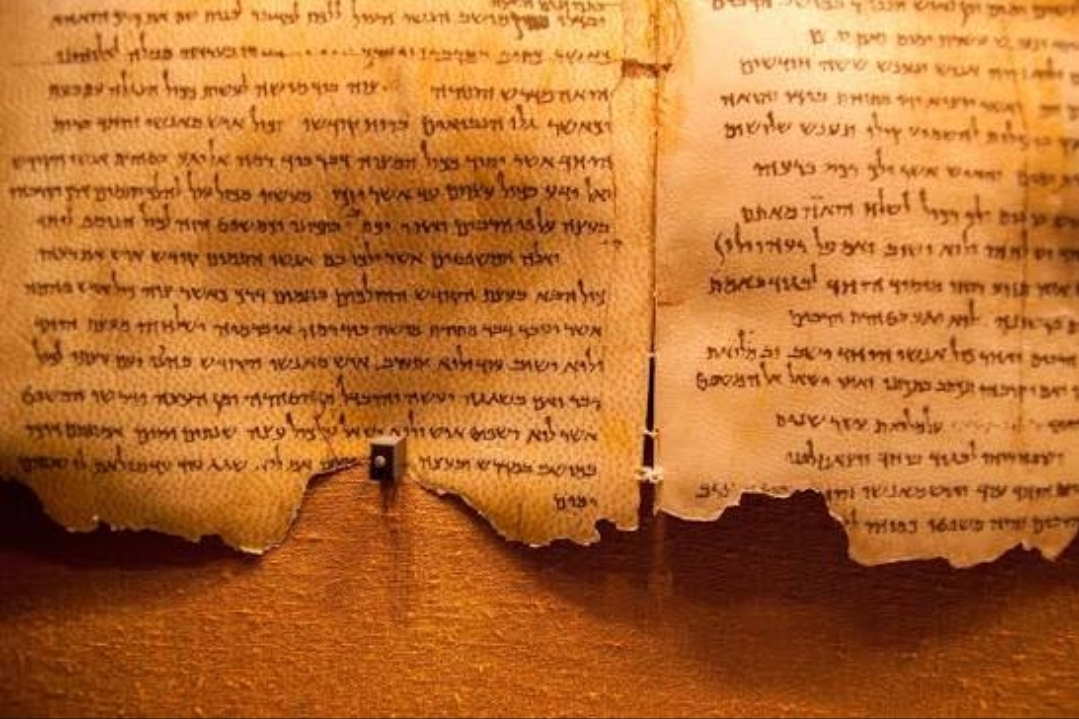
Few archaeological discoveries have so radically transformed our understanding of ancient Judaism as the accidental discovery of the Dead Sea Scrolls in the Judaean desert during the middle years of the twentieth century.
Before their discovery, historians attempting to reconstruct the religious landscape of the late Second Temple period were forced to rely on a relatively small and deeply problematic collection of literary sources. The writings of Josephus, the philosophical reflections of Philo of Alexandria, the New Testament, and later rabbinic traditions provided tantalizing glimpses into a vanished Jewish world — but only in fragments, and almost always through the lens of ideological or theological bias.
Then, in 1947, everything changed. According to the now-famous story, a young Bedouin shepherd searching for a stray goat wandered into the limestone cliffs overlooking the northwestern shore of the Dead Sea. Throwing a stone into one of the caves, he heard the sound of breaking pottery. Inside the cave, he discovered ancient jars containing leather scrolls wrapped in linen cloths — manuscripts that had lain undisturbed for nearly two thousand years.
What began as a chance discovery soon developed into one of the most important archaeological finds in modern history. Over the following decade, eleven caves near the ruins of Khirbet Qumran yielded thousands of manuscript fragments representing hundreds of ancient texts. (Dead Sea Scrolls – World History Encyclopedia, 2008)
The significance of the Scrolls was immediately apparent. Here were Hebrew and Aramaic manuscripts dating from the final centuries before the destruction of the Second Temple in Jerusalem in 70 CE — centuries that had previously remained frustratingly obscure.
Some of the texts were biblical manuscripts, far older than any previously known Hebrew Bible. Others were apocryphal works, liturgical compositions, biblical commentaries, legal texts, and sectarian writings describing the beliefs and practices of a previously unknown Jewish community living on the margins of Judaean society.
Suddenly, the late Second Temple period no longer seemed like a relatively simple world dominated by just two opposing groups — Pharisees and Sadducees — as generations of historians had assumed. Instead, the Scrolls revealed a fragmented and intensely contested religious landscape, populated by competing movements, rival interpretations of Torah, priestly disputes, apocalyptic expectations, and communities passionately convinced that they alone possessed the authentic truth of Judaism.
The discovery of the Dead Sea Scrolls did not merely add new information to existing historical knowledge. It also forced scholars to reconsider many assumptions that had long shaped the study of Judaism, Christianity, and the origins of Western religious thought. Questions once regarded as settled suddenly became uncertain again. Who exactly were the Pharisees? Who were their rivals, the Sadducees? Who were the mysterious Essenes described by Josephus and Philo, and were they connected to the sectarian community at Qumran?
More fundamentally, how unified — or how fractured — was Jewish society in the century before the destruction of the Temple? And where did this mysterious Dead Sea sect fit within the kaleidoscope of movements that characterized this tumultuous period of Jewish history?
The answers to these questions could only begin to emerge once the scrolls themselves had been deciphered and interpreted. But that process proved to be a story in its own right — one that stretched across decades and became entangled in scholarly rivalry, institutional secrecy, academic politics, and bitter controversy. Far from resolving every mystery, the Dead Sea Scrolls opened the door to an entirely new world of questions, many of which remain fiercely debated to this day.
For centuries, scholars had considered the religious world of late Second Temple Judaism to be relatively straightforward. Historians generally described Jewish society in Judaea during the final centuries before the destruction of the Temple as being dominated by two principal groups – the Pharisees and the Sadducees – and a minor group known as the Essenes. This framework was drawn primarily from the writings of the first-century Jewish historian Josephus, supplemented by occasional references in Philo, Pliny the Elder, the New Testament, and later rabbinic literature.
At first glance, the picture seemed reasonably clear. The Pharisees were portrayed as the popular religious teachers and legal interpreters whose ideas would eventually shape rabbinic Judaism. The Sadducees appeared as their aristocratic opponents — priestly traditionalists closely associated with the Temple establishment in Jerusalem. The Essenes, meanwhile, were depicted as an austere, separatist brotherhood living lives of ascetic discipline on the fringes of Jewish society.
Even before the discovery of the Dead Sea Scrolls, this neat categorization concealed serious problems. Almost everything historians thought they knew about these groups came from sources written by outsiders, critics, or people with an ideological agenda.
Josephus, invaluable though he remains, wrote under Roman patronage and tailored much of his work for a Greco-Roman audience. Philo viewed Jewish sects through the lens of his own Pharisaic background and his adopted Roman cultural persona.
The New Testament’s frequent clashes with the Pharisees inevitably shaped Christian perceptions of them for centuries afterward. Rabbinic literature, meanwhile, although it preserved information about the Sadducees, did so through the prism of theological bias and a history of rivalry and antipathy. Notably, rabbinic sources said nothing about the Essenes.
As a result, historians attempting to reconstruct the religious world of Judaea faced an unusual challenge. They possessed names, fragments, polemics, and passing descriptions of the Sadducees and (Editors, 2026) Essenes — but none of the internal literature of the groups themselves. It was rather like trying to reconstruct the political landscape of modern Europe using only hostile newspaper editorials and the memoirs of foreign diplomats.
The Dead Sea Scrolls changed that situation dramatically. For the first time, scholars encountered the surviving writings of a particular Jewish sectarian community speaking in its own voice. Here were not merely references to disputes, but the disputes themselves: arguments over biblical interpretation, ritual purity, Temple practice, priestly legitimacy, calendars, law, authority, and the meaning of covenant itself.
The Scrolls revealed not simply another Jewish sect, but an entire worldview shaped by conflict, disappointment, apocalyptic expectation, and fierce certainty in the community’s own divine mission. (Bolotnikov, 2005) But what remained tantalizingly unknown was the sect’s exact identity. Were they Pharisees? Were they Sadducees? Or were they Essenes? It is this that I shall try to reveal using the evidence of the scrolls themselves.
The Controversy of the Dead Sea Scrolls
Before attempting to understand the sectarian world revealed by the Dead Sea Scrolls, it is necessary to consider another issue — one that lies at the heart of all historical inquiry but is especially important in the study of ancient Judaism. That issue is historiography. Put simply, historiography is not merely the study of history itself, but the study of how history has been written, interpreted, and transmitted over time.
Historians do not approach the past as blank slates. Every generation inherits assumptions, prejudices, intellectual fashions, religious loyalties, and cultural perspectives that inevitably shape the way historical events are understood. The historian’s task is therefore not only to examine ancient evidence, but also to recognize how earlier scholars interpreted that evidence and why they reached the conclusions they did.
This is particularly relevant when dealing with the late Second Temple period, because for centuries all the available source material was both limited and deeply partisan. Unlike later periods of Jewish history, which produced vast quantities of rabbinic and community literature as well as external documentary evidence, the final centuries before the destruction of the Second Temple survive only in fragments. Historians have therefore been forced to reconstruct an extraordinarily complex religious and political world using a relatively small collection of texts, many of them incomplete, partisan, or written long after the events they describe.
The problem is compounded by the fact that almost all the major sources were shaped by powerful ideological agendas. Josephus wrote partly to justify himself and explain Judaism to Roman readers following the catastrophic Jewish revolt against Rome. Early Christian writers often portrayed Jewish sects through the prism of theological conflict. Rabbinic literature preserved the perspectives of the Pharisaic-rabbinic tradition that ultimately survived the destruction of the Temple, while many rival movements disappeared almost entirely from Jewish memory.
In each case, history was not simply recorded — it was interpreted, defended, reshaped, and sometimes consciously sanitized. As a result, modern scholarship on the Second Temple period has often reflected as much about the scholars studying the material as it does about the ancient world itself.
Nineteenth-century Christian scholars — particularly within Protestant scholarship — often idealized the Essenes as spiritual forerunners of Christianity while portraying the Pharisees in harshly legalistic terms, an attitude inherited in part from centuries of Christian polemic. Jewish scholars, reacting against those portrayals, frequently sought to rehabilitate the Pharisees as the authentic and dynamic representatives of normative Judaism — the religious world from which early Christianity itself emerged. (Pharisees, Sadducees & Essenes, n.d.)
But the twentieth-century discoveries at Qumran profoundly complicated the picture, forcing historians of every background and persuasion to reconsider assumptions that had once seemed firmly established.
As a result, the history of scholarship surrounding the Dead Sea Scrolls became almost as controversial as the Scrolls themselves. Arguments over the identity of the Qumran community, the origins of Christianity, the authority of rabbinic tradition, and the nature of ancient Judaism quickly moved beyond purely academic debate. Questions of religion, ideology, nationalism, and even institutional control became deeply intertwined with the interpretation of the texts.
Understanding this historiographical background is therefore essential, because the study of the Dead Sea Scrolls has never been merely an exercise in archaeology or textual analysis. It is also the story of how modern scholars, theologians, and historians have struggled to reconstruct a lost Jewish world whose rediscovery challenged long-established narratives about Judaism and the origins of Western religion.
The Role of Josephus
No figure looms larger in any attempt to reconstruct the history of the late Second Temple period than Flavius Josephus. Quite simply, without Josephus, our knowledge of the political, religious, and social world of first-century Judaea would be immeasurably poorer. For all his biases, contradictions, and self-serving tendencies, he remains the single most important literary source for understanding the sectarian landscape into which the Dead Sea Scrolls emerged.
Born Yosef ben Matityahu into a priestly family in Jerusalem in the first century CE, Josephus claimed close familiarity with the major Jewish sects of his day, including the Pharisees, Sadducees, and Essenes. In his autobiographical writings, he presents himself as an intellectually curious young man who explored competing movements within Judaism before eventually aligning with the Pharisees. Yet the trajectory of his life would prove anything but straightforward.
During the Great Jewish Revolt against Rome, Josephus initially served as a Jewish military commander in Galilee. Following the collapse of Jewish resistance there, he surrendered to the Romans under controversial circumstances and subsequently entered the patronage of the Flavian imperial family, adopting the name “Flavius Josephus” in honor of his new Roman benefactors.
To many Jews, both in his own lifetime and afterward, Josephus was viewed as a turncoat — a man who abandoned the national struggle and accommodated himself to Rome while his people suffered catastrophe.
And yet Josephus was never merely a Roman propagandist. Despite his political opportunism and instinct for self-preservation, he remained deeply invested in defending Judaism before a Greco-Roman audience that often regarded Jews with suspicion or contempt. Much of his historical writing can be read as an extended apologetic project: an attempt to present Jewish tradition as ancient, rational, ethical, and philosophically respectable.
In this effort, Josephus frequently portrayed the Pharisees in relatively favorable terms, emphasizing their popularity and wisdom while presenting Judaism itself as a sophisticated and venerable civilization.
This dual identity — part Jewish insider, part Roman client intellectual — makes Josephus both indispensable and problematic. He preserves invaluable information about the sectarian movements of late Second Temple Judaism, but he does so through the eyes of a man navigating multiple loyalties, personal ambitions, political pressures, and theological sensitivities.
His descriptions of the Pharisees, Sadducees, and Essenes remain foundational to modern scholarship, yet they can never be accepted uncritically. Josephus was not simply recording history. Like all historians, he was shaping a narrative — one influenced as much by the world in which he wrote as by the world he sought to describe.
The Mishnah as a Historical Source
Alongside Josephus, another crucial — though very different — source for understanding the sectarian tensions of the late Second Temple period is the Mishnah. Unlike Josephus, the Mishnah was never intended to function as a historical chronicle. Redacted around the beginning of the third century CE by Rabbi Yehudah HaNasi, its primary purpose was legal rather than historical: to preserve and organize the oral traditions, debates, and rulings of the rabbinic tradition that emerged from the Pharisaic world after the destruction of the Temple.
And yet history constantly surfaces beneath its legal discussions. Again and again, the Mishnah preserves halakhic disputes, procedural safeguards, and institutional anxieties that make little sense unless understood against the backdrop of intense sectarian conflict during the final generations of the Second Temple era. And nowhere is this more apparent than in the Mishnah’s lengthy discussions concerning the determination of the calendar and the sanctification of the new moon.
At first glance, the tractate of Rosh Hashanah appears concerned merely with technical legal procedure: how witnesses testified to sightings of the new moon, how their testimony was examined, and how news of the declaration of the new month was transmitted throughout the land of Israel and beyond.
But beneath these detailed legal discussions lies an unmistakable atmosphere of conflict and distrust. The Mishnah describes witnesses being rigorously cross-examined before Rabban Gamliel lest false testimony be accepted and corrupt the calendar. It recounts how signal fires lit on mountaintops to communicate the beginning of the month could no longer be relied upon because of deliberate interference by the Boethusians.
This is not merely halakhic administration. It is the description of a system under siege. The recurring appearance of the Boethusians in these passages raises profound historical questions. Later rabbinic literature frequently associates them with the Sadducees, and many scholars have regarded the two groups as closely related or even synonymous.
Yet the portrait that emerges from the Mishnah does not fit comfortably with Josephus’s image of the Sadducees. Josephus largely portrays the Sadducees as an aristocratic, priestly, and somewhat aloof elite associated with the Temple hierarchy in Jerusalem — wealthy conservatives concerned with power, status, and political influence.
But the sectarians described in the Mishnah seem animated by something far more passionate and ideological. They appear deeply invested in questions of ritual timing, calendrical calculation, and legal interpretation. They are not indifferent aristocrats but determined religious opponents willing to disrupt public institutions to undermine Pharisaic authority.
Why would Hellenized priestly elites care so intensely about the precise determination of the new moon? Why would they risk public disorder over the calculation of festivals and sacred days?
These tensions would acquire entirely new significance after the discovery of the Dead Sea Scrolls. The Qumran texts revealed a sectarian community obsessed with calendars, sacred times, priestly legitimacy, and the proper ordering of religious life. Suddenly, the rabbinic accounts of disputes over the calendar no longer appeared to be marginal technical arguments. They seemed instead to reflect a much wider and deeper struggle over religious authority and the very definition of authentic Judaism.
The Dead Sea Scrolls Saga
The story of the Dead Sea Scrolls did not end with their discovery. In many ways, it was only beginning. What followed was one of the strangest and most controversial episodes in modern academic history — a saga involving scholarly rivalry, institutional secrecy, personal ambition, theological sensitivity, and decades of frustration. The history of Dead Sea Scroll research became so tangled and contentious that it eventually developed into a subject worthy of study in its own right.
Part of the problem stemmed from the political upheaval surrounding the discovery itself. The Scrolls were uncovered during the final years of the British Mandate in Palestine and the turbulent birth of the State of Israel in 1948. As a result, the manuscripts quickly became divided between competing jurisdictions. Those scrolls that came into Israeli possession were generally published relatively quickly and made available to scholars. But many of the most fragmentary and historically significant manuscripts — including texts central to understanding the sectarian movement itself — remained under Jordanian control in East Jerusalem.
These texts, numbering in the hundreds and often surviving only in thousands of tiny fragments, were entrusted to a small international team of scholars working primarily at the Rockefeller Museum. The task facing them was undeniably immense. The fragments required painstaking reconstruction, decipherment, translation, and interpretation.
Nevertheless, criticism steadily mounted as decade after decade passed with surprisingly little publication. By the late twentieth century, many scholars had become openly exasperated by the glacial pace of official Dead Sea Scroll research.
Even relatively cautious critics questioned how such an important body of material could remain inaccessible for so long. The distinguished Scrolls scholar Geza Vermes observed with characteristic bluntness that “it should have been evident to anyone with a modicum of good sense that a group of seven editors was insufficient to perform such an enormous task on any level.”
Others were far harsher. Lawrence Schiffman, one of the leading Jewish scholars of the Scrolls, accused the research establishment of fostering a culture of secrecy, exclusivity, and academic gatekeeping that effectively prevented wider scholarly engagement with the material for decades.
By the 1980s, frustration had become a full-scale academic rebellion. Younger scholars increasingly objected not only to the delayed publication of the texts but also to what they regarded as entrenched interpretive assumptions dominating the field. Some argued that the small circle of official editors had become overly committed to particular theories about the identity of the Qumran sect and its relationship to early Christianity.
Because only a limited selection of texts had been widely available — mostly biblical manuscripts and a relatively narrow range of sectarian writings — scholars were often forced to construct large historical theories on the basis of incomplete evidence.
The situation changed dramatically in 1991, when previously restricted photographs and materials were finally released into the public domain. The effect on the field was immediate and transformative. It was almost as though the Scrolls had been discovered for a second time.
Suddenly, scholars around the world gained access to the broader textual universe of Qumran.
New interpretations proliferated. Longstanding assumptions were challenged. The publication of key texts revolutionized scholarly understanding of the sect’s legal disputes and ideological orientation. What had once appeared to be an isolated ascetic community now seemed deeply connected to the wider sectarian and priestly conflicts consuming Jewish society during the late Second Temple period.
The post-1991 era, therefore, marked a decisive turning point in Dead Sea Scroll scholarship. Many theories that had dominated earlier decades came under intense scrutiny, while entirely new models emerged to explain the origins, beliefs, and historical role of the Qumran community. Far from settling the debate, the full release of the Scrolls opened an entirely new chapter in the effort to reconstruct the fractured religious world that existed in Judaea on the eve of destruction.
Among the more controversial figures to emerge during this turbulent period was the American scholar Robert Eisenman, whose highly provocative theories helped turn Dead Sea Scroll research into an international public controversy during the 1980s and early 1990s. Eisenman argued that the official scholarly team had not merely been slow in publishing the Scrolls, but had actively suppressed materials because of their potentially explosive implications for the origins of Christianity and the history of early Judaism.
His most influential and controversial work, The Dead Sea Scrolls Uncovered — co-authored with Michael Wise and published in 1992 — appeared at precisely the moment when frustration with the Scrolls establishment was reaching its peak. The book presented previously inaccessible texts alongside dramatic claims that the Scrolls revealed a far more radical and politically charged Jewish movement than mainstream scholars had acknowledged.
Eisenman proposed bold, highly speculative identifications between figures in the Scrolls and personalities associated with early Christianity, arguing that the Qumran sect was deeply intertwined with the revolutionary currents that eventually led to the Jewish revolt against Rome.
Many of Eisenman’s conclusions were received with considerable skepticism by specialists in the field. His reconstructions were frequently criticized as methodologically weak, overly sensational, and dependent upon tenuous historical connections. Over time, most of his major historical theories were either heavily qualified or rejected outright by mainstream scholarship. Nevertheless, dismissing Eisenman entirely would overlook the important role he played in transforming the field.
For all its excesses, The Dead Sea Scrolls Uncovered helped break the monopoly of the small circle of official editors and brought public attention to the extraordinary delays and secrecy surrounding the unpublished manuscripts. Eisenman succeeded in popularizing what had previously been an obscure academic dispute, generating pressure for broader access to the texts and greater transparency within Dead Sea Scroll scholarship.
In that sense, although many of his theories failed to withstand critical scrutiny, his intervention helped open the floodgates that ultimately led to the wider release of the Scrolls in the early 1990s.
The result was a profound democratization of the field. What had once been controlled by a small, highly insulated scholarly elite suddenly became accessible to historians, theologians, philologists, and independent researchers worldwide. The study of the Dead Sea Scrolls will never again be confined to a closed academic circle.
The MMT Scroll
Among all the discoveries, debates, and controversies surrounding the Dead Sea Scrolls, one document proved more revolutionary than almost any other: the text known as Miqsat Ma‘aseh HaTorah, usually referred to simply as MMT.
For decades, scholars attempting to identify the Qumran sect were forced to rely primarily on community rules, biblical commentaries, apocalyptic writings, and polemical literature. Although these texts revealed much about the sect’s worldview, discipline, and self-perception, they did not clearly explain where the group fit within the wider ideological and religious struggles of late Second Temple Judaism. The sectarians appeared isolated, mysterious, and difficult to classify. Were they Essenes? A splinter priestly movement? Proto-Christians? Radical separatists? Or something else entirely?
MMT changed the conversation completely. Published officially in 1994 after years of anticipation, the document was unlike most previously known sectarian texts from Qumran. Rather than mystical visions or apocalyptic prophecies, MMT was essentially a legal and theological manifesto.
Structured partly as a formal communication addressed to an opposing authority, it outlined a series of specific halakhic disputes concerning Temple practice, ritual purity, sacrificial procedure, calendrical issues, and questions of biblical interpretation. In doing so, it opened an unprecedented window into the concrete religious disagreements that divided Jewish sects during the late Second Temple period.
For the first time since 1947, scholars could begin to identify the sectarians not merely by their rhetoric or communal lifestyle, but by their legal positions.
The implications were enormous. Many of the legal rulings reflected in MMT appeared strikingly similar to positions historically associated with the Sadducees and priestly aristocracy in early rabbinic literature. At the same time, the text displayed precisely the kind of sectarian rigidity and separatism long associated with the Qumran community.
Suddenly, categories that had previously seemed distinct began to overlap. The simplistic picture of wealthy, politically detached Sadducees on one side and isolated desert ascetics on the other no longer seemed sustainable. MMT suggested that the sectarian world of late Second Temple Judaism was far more fluid, interconnected, and ideologically charged than scholars had previously imagined.
The disputes highlighted in MMT were not abstract theological arguments. They concerned the practical organization of Jewish religious life itself: how purity was maintained, how the Temple should function, how Scripture should be interpreted, and who possessed legitimate authority to determine religious law. In many respects, MMT became the missing piece of the puzzle.
It is therefore this document that will stand at the center of the present study. More than any other single text discovered at Qumran, MMT provides the clearest insight into who the Dead Sea sectarians were, what they represented, and how they understood themselves in relation to the wider Jewish world around them.
Through MMT, the sectarian conflicts of the late Second Temple period cease to be distant and abstract historical categories. They become living ideological struggles between rival Jewish movements competing to define the authentic meanings of Torah, the Temple, covenant, and religious authority during one of the most turbulent periods of Jewish history.
The Traditional View: Pharisees, Sadducees, and the Origins of Sectarianism
The final centuries of the Second Temple period were among the most turbulent and intellectually dynamic in all of Jewish history. Judaea during this era was not a religious monolith but a society alive with competing interpretations of Torah, fierce ideological disputes, political upheaval, and growing sectarian fragmentation. Beneath the outward unity of Temple worship lay deep disagreements over authority, law, purity, priesthood, and the very meaning of Judaism itself.
The Jews of this period were, for the most part, descendants of those who had returned from the Babylonian exile under the leadership of Ezra and Nehemiah during the Persian period. Following the destruction of Solomon’s Temple by Nebuchadnezzar in 586 BCE, the exile to Babylon had represented a theological and national catastrophe.
The return to Judaea under Persian sponsorship, beginning in the late sixth century BCE, was understood by its protagonists not merely as political restoration but as religious rebirth. The rebuilding of the Temple — completed around 515 BCE — restored the spiritual center of Jewish life and re-established Jerusalem as the focal point of Jewish identity.
For centuries afterward, the Temple dominated Jewish religious consciousness. Sacrifice, pilgrimage, priesthood, ritual purity, and sacred time all revolved around its rhythms and institutions. Unlike later forms of Judaism centered on synagogue, study, and rabbinic discourse, early Second Temple Judaism remained profoundly Temple-oriented. To worship God properly meant, above all else, to maintain the sacrificial order established in Jerusalem.
Political leadership during much of this period rested largely in the hands of the priestly aristocracy, especially descendants of the ancient Zadokite priesthood. These elites not only administered the Temple and its rituals but also served as political intermediaries between Judaea and the great empires that successively dominated the region — Persia, the Hellenistic kingdoms, and, eventually, Rome. Stability depended upon their ability to maintain religious continuity while simultaneously navigating dangerous political realities.
Precisely how ordinary Jews understood and practiced their religion during these centuries remains difficult to reconstruct with certainty. The surviving evidence is fragmentary and often filtered through later ideological lenses. Yet it seems clear that the Temple and its sacrificial system formed the central axis of Jewish religious life. This explains why the return from exile and the rebuilding of the Temple occupied such a powerful place in Jewish memory and imagination. Without the Temple, Judaism itself seemed incomplete.
The Pharisees and the Sadducees
And yet by the second century BCE, the apparent stability of this system had begun to fracture.
Long before the discovery of the Dead Sea Scrolls, historians had sought to explain the origins of the major Jewish sects that emerged during the late Second Temple period, particularly the Pharisees and the Sadducees. Two broad explanatory models came to dominate traditional scholarship.
The first focused on the growing tension between written scripture and religious interpretation. According to this view, the emergence of sectarianism was closely connected to the gradual closing of the biblical canon and the question of religious authority that followed. Once the canon of sacred scripture had effectively been fixed, a profound dispute emerged concerning how Jewish law was to develop going forward.
According to this reconstruction, the Sadducees insisted that only laws explicitly rooted in the written Torah had binding authority. They rejected the expanding body of oral traditions, interpretive rulings, and legal innovations championed by the Pharisees.
The Pharisees, by contrast, argued that alongside the written Torah there existed an equally ancient oral tradition — later known as the Torah Shebe’al Peh, the Oral Law — which had been transmitted through generations and provided the necessary framework for interpreting and applying biblical law to contemporary life.
This disagreement was not merely technical. It represented fundamentally different visions of Judaism itself. The Pharisees believed that the Torah was a living system requiring interpretation, adaptation, and ongoing legal development. Through methods of exegesis and legal reasoning, they sought to apply ancient laws to new realities and changing social circumstances. But the Sadducees regarded such innovations with deep suspicion. To them, the multiplication of oral traditions threatened to undermine the fixed authority of divine revelation itself.
Much of this traditional picture derives from two principal sources: the writings of Josephus and the rabbinic literature of the Mishnah and Talmud. But it must be noted that both sources emerged from Pharisaic or post-Pharisaic circles and therefore present the conflict through a distinctly partisan lens.
Rabbinic literature consistently portrays the Pharisees as guardians of authentic tradition, while the Sadducees are often depicted as rigid literalists incapable of responding intelligently to practical religious life. Josephus presents a broadly similar picture, describing the Pharisees as custodians of ancestral traditions handed down through generations, traditions rejected by the Sadducees because they were not explicitly written in the Torah.
Yet even Josephus’ account raises important questions. If the Sadducees represented only a narrow priestly elite while the Pharisees enjoyed widespread popular support, why did the conflict between them become so intense and enduring? And why do rabbinic sources portray these disputes with such extraordinary passion and anxiety?
Complicating matters further was the influence of Christian scholarship. For centuries, the dominant Western understanding of the Pharisees derived more from the New Testament than from Jewish sources. In the Gospels, the Pharisees frequently appear as legalistic opponents of Jesus — rigid, hypocritical, obsessed with ritual detail, and spiritually hollow. This portrayal profoundly shaped Christian attitudes toward Judaism for nearly two millennia.
Within this framework, the Pharisees came to symbolize religious formalism at its worst: a system of endless legal technicalities imposed upon ordinary believers by self-righteous religious authorities. Their insistence upon the authority of pedantic oral law and ridiculously detailed legal interpretation was viewed by Christian scholars as evidence of spiritual decline rather than religious creativity.
The Sadducees, despite their conservatism and aristocratic aloofness, sometimes emerged more favorably from this comparison. Because they rejected much of the oral tradition championed by the Pharisees and adhered more closely to the plain meaning of scripture, Christian scholars regarded them as theologically purer, even if ultimately politically and religiously unsuccessful.
Yet, if one is to be objective, neither portrait is entirely satisfactory. The Pharisees are not easily dismissed as narrow legalists, given that their movement ultimately gave birth to rabbinic Judaism — one of the most intellectually sophisticated and enduring religious traditions in history. Nor did the Sadducees fit neatly into the stereotype of detached aristocratic conservatives uninterested in broader religious questions. As rabbinic literature repeatedly demonstrates, disputes between the groups were often centered on matters of intense religious significance: purity, Temple ritual, sacrificial practice, and the calendar.
Indeed, many of the contradictions embedded within the traditional picture should have raised suspicions long before the discovery of the Dead Sea Scrolls. Historians were attempting to reconstruct an extraordinarily complicated religious world using sources shaped by theological polemic, ideological rivalry, and centuries of accumulated prejudice.
By the late nineteenth and early twentieth centuries, some scholars had already begun to recognize the inadequacy of older models and to produce more nuanced interpretations of Jewish sectarianism. But without new evidence, progress remained limited. Scholars were still trying to reconstruct a lost world using fragments filtered through the biases of its survivors. The discovery of the Dead Sea Scrolls would change that forever.
Essenes: The Third Sect
If the Pharisees and Sadducees dominated the familiar map of late Second Temple Judaism, the Essenes occupied its margins — mysterious, austere, and, for centuries, tantalizingly difficult to place. Unlike the Pharisees and Sadducees, the Essenes are not mentioned by name in the New Testament or in rabbinic literature. They appear instead in Greek and Roman sources — above all Josephus, Philo, and Pliny the Elder — who describe them as a distinct Jewish brotherhood marked by discipline, simplicity, purity, communal property, and withdrawal from ordinary society.
Josephus gives the fullest account, portraying them as a sect stricter than the Pharisees and Sadducees, devoted to self-control, contemptuous of luxury, and deeply committed to piety. Philo similarly presents them as models of virtue and simplicity, while Pliny famously locates an Essene settlement on the western shore of the Dead Sea, somewhere above Ein Gedi.
The picture that emerges from these sources is striking. The Essenes rejected personal wealth. Property was held in common. Meals were eaten communally and with ritual seriousness. Initiation into the group was gradual and demanding. Oaths were generally avoided, except for the solemn oath of admission. Ritual purity played a central role in daily life, with frequent immersion and careful separation from those considered less pure.
Many Essenes appear to have avoided marriage, although Josephus also refers to another group of Essenes who did marry. They rejected slavery, emphasized equality within the group, and cultivated a disciplined life that seemed, to ancient observers, almost monastic.
For generations, this portrait fascinated scholars. The Essenes appeared to be the “third sect” of ancient Judaism — neither Pharisee nor Sadducee, but something more otherworldly. To some Christian writers, they seemed almost proto-Christian: celibate, communal, ascetic, and detached from the Temple establishment. To Jewish historians, however, they often appeared as a radical extension of Pharisaic piety — Jews so committed to purity and holiness that they withdrew from ordinary society in order to live out the Torah in its most demanding form.
Before the discovery of the Dead Sea Scrolls, scholars possessed almost no internal literature from the Essene world itself. Apart from the Damascus Document — an ancient sectarian text preserved in a medieval manuscript discovered in the Cairo Genizah and published by Solomon Schechter at the end of the nineteenth century, whose contents corresponded strikingly with aspects of what was known about the Essenes — the movement was understood almost entirely through outsiders. Historians were therefore attempting to reconstruct an entire religious community from descriptions written by observers who admired, misunderstood, idealized, or used them for their own literary purposes.
Heinrich Graetz, writing in the nineteenth century, saw the Essenes as extreme spiritual descendants of the Hasideans of the Maccabean period. In his view, they and the Pharisees had sprung from a common root, but the Essenes had pushed Pharisaic piety into the realm of radical asceticism. They were, for Graetz, almost like biblical Nazirites — Jews pursuing the highest level of priestly sanctity outside the formal priesthood. Their separation from society was driven by the desire for purity, holiness, and perhaps even prophetic inspiration.
But Graetz, showing his characteristic antipathy to pietism, was not entirely sympathetic. He regarded the Essenes’ asceticism as excessive and unhealthy, a distorted form of piety that combined genuine religious aspiration with superstition and withdrawal from real life. This ambivalence became a recurring feature of modern scholarship: the Essenes were admired for their discipline, but often treated as obscurantist religious extremists.
Kaufmann Kohler went further in linking the Essenes with Pharisaic circles. He associated them with the ḥaverim — elite Pharisaic groups concerned with purity and strict religious observance — and argued that many Essene practices were not alien to Pharisaism. Their concern for purity, avoidance of casual use of God’s name, and disciplined religious lifestyle all had parallels in rabbinic tradition.
Robert Travers Herford offered a similar but more measured interpretation. For him, Essenism represented “the logical development of Pharisaism” — not identical with mainstream Pharisaism, but emerging from the same religious impulse. If the Pharisees sought to bring holiness into ordinary Jewish life, the Essenes solved the problem differently: they withdrew from ordinary life altogether. They became, in effect, the separatists of separation — Jews who believed that the only way to live the Torah fully was to create a purified community apart from the corruption of society.
This older historiographical consensus is important. Before Qumran, most scholars assumed that the Essenes were closer to the Pharisees than to the Sadducees. Josephus, himself sympathetic to the Pharisees, spoke warmly of them. Their piety, Sabbath observance, purity concerns, and apparent devotion to ancestral tradition all seemed to place them on the Pharisaic side of the Jewish spectrum.
The Sadducees, by contrast, were imagined as aristocratic, priestly, Temple-based, and politically entangled — almost the opposite of poor, ascetic, apolitical Essenes.
And so, before 1947, the Essenes were usually understood as a peaceful, apolitical, pietistic movement: strict, ascetic, communitarian, perhaps eccentric, but fundamentally an extreme branch of Pharisaic religiosity.
The discovery of the Dead Sea Scrolls would overturn that neat picture. Once the sectarian texts from Qumran began to emerge, the Essenes no longer looked merely like gentle ascetics who had retreated from the world. They appeared as a movement consumed by legal dispute, priestly legitimacy, Temple purity, calendrical conflict, and apocalyptic expectation. In other words, the very issues that had once seemed to belong to the world of Sadducees, priests, and Temple politics suddenly stood at the center of Essene identity.
That was the beginning of a new problem — and a new historiography.
Resurrection, the Afterlife, and Divine Providence
The sectarian divisions of the late Second Temple period were not confined to matters of law, purity, or Temple ritual. Beneath the legal disputes lay even deeper disagreements concerning the most fundamental religious questions imaginable: Does God intervene in human affairs? Do human beings possess genuine free will? Is there life after death? Will the dead one day rise again? And how are justice and reward ultimately administered in the universe?
These questions were not abstract theological exercises. They touched the very heart of Jewish religious consciousness during an age marked by foreign domination, political violence, martyrdom, corruption, and national crisis. If the righteous suffered while the wicked prospered, where was divine justice to be found? If faithful Jews died at the hands of tyrants, would God reward them beyond the grave?
Such questions became increasingly urgent during the Hasmonaean and Roman periods, and the various Jewish sects developed sharply different responses.
Josephus, despite his tendency to translate Jewish ideas into Greek philosophical terminology familiar to his Roman audience, provides a valuable overview of these sectarian differences. According to him, the Pharisees occupied a kind of theological middle ground between the deterministic worldview of the Essenes and the radical human autonomy of the Sadducees.
The Pharisees believed in both divine providence and human moral responsibility. Josephus writes that they held “that some actions, but not all, are the work of fate, and some are in our own power.” In other words, God’s providence governed the world, yet human beings retained genuine freedom to choose between good and evil. This delicate balance between divine foreknowledge and human responsibility would later become a central theme of rabbinic Judaism.
The Pharisees also believed firmly in the immortality of the soul and in posthumous reward and punishment. Josephus describes their belief that “every soul is incorruptible,” and that the righteous would receive reward after death, while the wicked would face punishment. Although Josephus expresses these concepts in language strongly influenced by Greek philosophy, the underlying ideas are recognizably Jewish: divine justice extends beyond earthly existence, and moral choices carry eternal consequences.
This belief system would eventually become one of the defining foundations of rabbinic Judaism. The Pharisaic attempt to balance divine providence with human moral responsibility found classic expression in the famous maxim attributed to Rabbi Akiva in Pirkei Avot: הַכֹּל צָפוּי וְהָרְשׁוּת נְתוּנָה — “All is foreseen, yet freedom is given” (Avot 3:15). In a single sentence, the rabbis captured the delicate equilibrium between God’s omniscience and humanity’s freedom of choice, a tension that would remain central to Jewish religious thought for centuries. God knows, but man chooses.
The Sadducees took a dramatically different position. According to both Josephus and the New Testament, they denied the doctrines of resurrection and the afterlife altogether. The Book of Acts states bluntly: “The Sadducees say that there is no resurrection, neither angel, nor spirit.” (Acts 23:8) Similarly, the Gospel of Matthew introduces the Sadducees as those “which say that there is no resurrection.” (Matthew 22:23)
Josephus confirms this picture, describing the Sadducees as rejecting fate entirely and insisting that human beings alone determine their actions: “They say that men are free to choose between good and evil, and each individual must choose which line he will follow.”
For the Sadducees, religion appears to have been grounded almost entirely in the tangible realities of this world rather than in supernatural expectation. Divine reward and punishment were not deferred to some future existence; they were embedded within life itself. This helps explain why later Jewish and Christian sources often portrayed the Sadducees as austere rationalists, suspicious of speculation about angels, resurrection, or mystical afterlife doctrines.
Some scholars attributed this outlook to the Sadducees’ alleged rejection of the Oral Law and, perhaps, of parts of the broader biblical canon beyond the Torah itself. Others argued that their worldview reflected the mentality of a wealthy priestly aristocracy deeply rooted in the political and material realities of Temple life. Whatever the explanation, the Sadducean position stood in sharp contrast to the increasingly developed doctrines of resurrection and divine judgment emerging within broader Jewish thought during this period.
The Essenes occupied the opposite end of the spectrum. If the Sadducees emphasized human autonomy, the Essenes stressed divine sovereignty and providence to an extraordinary degree. Josephus writes that the Essenes believed that “fate governs all things, and nothing befalls man but what is according to its determination” (Antiquities 13.5.9 §172). Elsewhere, he describes them as people who regarded earthly life as part of a larger divinely ordered cosmic reality, believing that the soul was immortal and that human existence unfolded according to heavenly decree. Some earlier scholars interpreted this as meaning that the Essenes denied free will almost entirely, embracing a rigid doctrine of predestination.
At first glance, this would appear to place the Essenes far closer to the Pharisees than to the Sadducees. Like the Pharisees, the Essenes accepted the immortality of the soul, divine providence, angels, and a system of heavenly reward and punishment — doctrines explicitly rejected by the Sadducees according to both Josephus and the New Testament. The Essenes may have pushed these beliefs to far greater extremes, but they nevertheless inhabited the same broad spiritual universe as the Pharisees. This resemblance led many earlier scholars to conclude that Essenism was essentially an ascetic or radicalized form of Pharisaism.
Yet this may overstate the matter. The German historian Emil Schürer and others argued more convincingly that Josephus was not describing strict philosophical fatalism, but rather the Essenes’ overwhelming belief in divine providence and cosmic order. The Essenes did not necessarily deny moral responsibility; rather, they saw human history as unfolding according to a divinely ordained plan governed by God’s will.
Schürer summarized the theological distinctions between the sects most elegantly. In his view, the Sadducees placed primary emphasis on human autonomy and responsibility, while the Essenes stressed the overwhelming power of providence and destiny. The Pharisees, by contrast, attempted to preserve both principles simultaneously: “The Pharisees… adhered to both lines of thought with equal determination: to Divine omnipotence and providence, and to human freedom and responsibility.”
This outlook fits remarkably well with the worldview later revealed in the Dead Sea Scrolls. The Qumran texts are saturated with the language of predestination, divine election, cosmic struggle, and apocalyptic destiny. Humanity is divided between the “sons of light” and the “sons of darkness,” with history moving inexorably toward an ordained final judgment.
Like the Pharisees, the Essenes strongly affirmed the immortality of the soul and the doctrine of divine retribution after death. As Josephus remarks, they believed “the rewards of righteousness are to be earnestly striven for,” and describe their conviction that the soul survives bodily death. In some accounts, Essene teachings about the afterlife appear even more elaborate and spiritually charged than those of the Pharisees.
What emerges from this survey is a striking theological spectrum within late Second Temple Judaism. The Sadducees emphasized human freedom, earthly religion, and skepticism toward supernatural doctrines. The Essenes stressed providence, divine destiny, cosmic struggle, and future judgment. The Pharisees attempted to hold both worlds together — affirming divine oversight while preserving human moral agency.
Long before the discovery of the Dead Sea Scrolls, historians saw these differences as the key markers of sectarian identity. But the Scrolls would later demonstrate that such beliefs were not merely abstract theology. They shaped communal structure, legal interpretation, purity practice, political outlook, and attitudes toward the Temple itself. Theology and sectarianism were inseparable. Behind every legal dispute stood an entire vision of God, humanity, history, and redemption.
Yet despite these theological overlaps with the Pharisees, the Essenes were still widely regarded by ancient writers and modern scholars alike as a distinct “third sect” within Judaism. Their radical communalism, strict purity regime, apocalyptic worldview, celibate tendencies, and withdrawal from ordinary society marked them out as something far more extreme than a merely rigorous Pharisaic fellowship.
Whatever doctrinal similarities may have existed between Pharisees and Essenes, the Essenes appeared to embody a far more separatist and sectarian vision of Jewish life — one rooted in the conviction that the broader religious establishment, and perhaps the Temple itself, had become irredeemably corrupt.
Qumran, the Scrolls, and the Dead Sea Sect
The discovery of the Dead Sea Scrolls in the caves surrounding Qumran transformed the study of late Second Temple Judaism more dramatically than perhaps any other archaeological discovery of the twentieth century.
Until 1947, historians attempting to reconstruct the religious world of Judaea in the centuries before the destruction of the Temple worked largely in the dark. The surviving evidence consisted primarily of external descriptions — Josephus, Philo, Pliny, the New Testament, and later rabbinic literature — all valuable, but all written by observers with their own ideological agendas and historical limitations.
For the first time, the Scrolls offered scholars something entirely different: the internal literature of a Jewish sectarian movement speaking in its own voice. This cannot be overstated. Before the discovery at Qumran, virtually no substantial sectarian writings from the period had survived, apart from the Damascus Document preserved in the Cairo Genizah and published by Solomon Schechter at the end of the nineteenth century.
That remarkable text hinted at the existence of a highly organized Jewish sect with its own legal interpretations, disciplinary codes, and covenantal ideology. But isolated fragments were not enough to reconstruct an entire movement. Qumran changed everything.
Suddenly, scholars found themselves confronted with an entire sectarian library: biblical manuscripts, liturgical texts, apocalyptic writings, legal compilations, communal regulations, calendrical treatises, biblical commentaries, hymns, blessings, war manuals, and theological reflections. Collectively, these texts revealed the existence of a highly disciplined religious community convinced that it alone represented the true remnant of Israel.
Among the most important texts discovered was the Serekh haYahad — usually translated as The Rule of the Community or The Manual of Discipline. More than any other single document, it provides an extraordinary window into the internal life, structure, values, and aspirations of the Qumran sect. Reading it today is rather like uncovering the constitution and rulebook of a secretive religious order, or cult.
The first striking feature of the sect was its intense exclusivity. Membership was not automatic, even for Jews already committed to Torah observance. Entrance into the community required a lengthy, demanding initiation process intended to test the candidate’s intellectual and spiritual suitability.
Before admission could even begin, the initiate was required to swear a solemn covenantal oath: “To return with all his heart and soul to every commandment of the Law of Moses…”
This was not a mere declaration of belief. It was an act of total ideological submission. The initiate pledged himself not simply to the Torah, but to the sect’s own interpretation of the Torah as revealed through the “sons of Zadok,” the priestly leaders of the community.
The candidate was then examined by the sect’s overseers, who assessed both his understanding and his conduct. If deemed suitable, he would begin a lengthy probationary period involving instruction in the sect’s laws and customs. Yet even this was no guarantee of acceptance. Membership required approval by the community itself, which voted collectively on whether the initiate was worthy to continue.
What emerges from these texts is a community obsessed with purity — not just ritual purity, but ideological purity as well.
The probationary process could last years. During the first stage, the novice remained excluded from the community’s sacred meals and could not participate fully in communal ownership. Even his property, once surrendered, remained quarantined from the sect’s collective resources until he had proven himself completely trustworthy.
Only after further examination and approval could he become a full member, entitled to participate fully in the life of the covenant. This was no loose religious fellowship. It was an intensely regulated society governed by hierarchy, discipline, and communal oversight.
The sect’s internal structure reflected this same rigidity. Priests occupied positions of clear superiority, especially the mysterious “sons of Zadok,” who appear throughout the Scrolls as the authoritative guardians of true covenantal teaching.
Beneath them stood Levites, elders, instructors, and overseers, each with defined responsibilities within the communal order. Rank and precedence mattered deeply. Even seating arrangements and speaking order appear to have reflected carefully maintained hierarchies.
The atmosphere revealed by these texts is strikingly unlike the earlier romantic image of the Essenes inherited from nineteenth-century scholarship. These were hardly gentle ascetics meditating peacefully in the desert. They were inflexible ideologues who saw themselves as a righteous remnant living in covenantal opposition to a corrupt world.
The community’s disciplinary regulations are particularly revealing. The Rule of the Community contains detailed lists of infractions and punishments, ranging from temporary reductions in food rations to expulsion from communal life altogether. Speaking disrespectfully to another member, interrupting a superior, criticizing sectarian teachings, laughing inappropriately, or displaying insufficient humility could all result in sanctions. The level of control exercised over communal life was extraordinary.
This rigidity extended into every aspect of daily existence — food, purity, speech, work, property, worship, and even bodily functions. The sectarians lived according to an all-encompassing religious system designed to create a purified community separated from what they regarded as the defilement and corruption of mainstream Jewish society.
And yet the Scrolls also reveal something else: this was not simply an isolated desert monastery cut off from the outside world. The evidence increasingly suggests a broader movement with networks extending into towns and cities throughout Judaea. The Damascus Document and related texts refer repeatedly to sectarian communities living outside Qumran and engaging with ordinary society under carefully regulated conditions.
Qumran itself may therefore have functioned not as the entirety of the movement, but as its ideological and spiritual center — a kind of sectarian headquarters populated by the movement’s strictest and most devoted adherents.
The Qumran Sect Calendar
One of the most revealing aspects of the Qumran community was its relationship to time itself.
The sect’s calendar lay at the very heart of its religious identity and represented one of the clearest points of conflict between the community and the religious establishment in Jerusalem.
Unlike the lunar calendar used by the Temple authorities and later adopted by rabbinic Judaism, the Qumran sect followed a strictly solar calendar consisting of 364 days divided into four equal seasons. Festivals, therefore, always fell on the same day of the week each year, creating a perfectly ordered liturgical cycle that the sectarians regarded as divinely ordained.
To be clear, this was far more than a technical disagreement about dates. In the ancient world, control of the calendar meant control of sacred time itself. Whoever determined the calendar determined when festivals would be observed, when sacrifices would be offered, and when the nation would assemble before God. A dispute over the calendar was therefore a dispute over religious authority, priestly legitimacy, and the correct interpretation of Torah.
The sectarians believed that the Jerusalem priesthood had corrupted the proper ordering of sacred time. From their perspective, the Temple authorities were celebrating festivals on the wrong days, offering sacrifices at improper times, and thereby defiling the covenant itself. This explains the extraordinary passion with which calendrical issues appear throughout the Scrolls. What might seem to modern readers like arcane technical disputes were, for the sectarians, matters of cosmic significance.
The same obsession with purity and order governed every aspect of communal life. The Scrolls reveal a community intensely concerned with ritual purity, perhaps to a degree unmatched anywhere else in ancient Judaism. Immersion rituals were performed regularly before Sabbaths, festivals, communal meals, and other sacred occasions.
Purity regulations extended into areas touching bodily functions, sexual conduct, skin disease, contact with corpses, and the preparation of food and drink. Archaeological excavations at Qumran uncovered an unusually large number of ritual baths (mikva’ot), reinforcing the impression that purification rites dominated daily life. (Schiffman, 2024, pp. 37-59)
The sectarians also observed practices familiar from later rabbinic Judaism, including the wearing of tefillin and the placing of mezuzot on doorposts. Yet their interpretation and application of religious law were often stricter and more uncompromising than anything preserved in later rabbinic sources.
The Sabbath, in particular, was regulated with remarkable severity. Sectarian texts prohibit carrying objects outside one’s immediate domain, rescuing animals from pits, and engaging in activities that might remotely resemble work. Some texts even limit the manner in which assistance could be given to human beings in distress on the Sabbath. The cumulative impression is of a community attempting to construct an existence governed entirely by sacred law, with virtually no distinction between religious and ordinary life.
This sharply distinguished the sectarians from the Pharisaic-rabbinic tradition developing in Jerusalem and beyond. The Pharisees certainly enacted extensive Sabbath regulations of their own, but they also adhered to and developed legal mechanisms to sustain communal life within ordinary society. The Qumran sect, by contrast, pursued an uncompromising ideal of ritual perfection that left little room for accommodation with the realities of everyday life.
The Sons of Zadok
The Qumran sect operated through an elaborate system of authority, hierarchy, and discipline. Priests occupied positions of honor and leadership, especially the “sons of Zadok,” whom the sect regarded as the legitimate heirs of the ancient priestly covenant. Their authority appears to have rested not merely on genealogy but on the belief that they alone preserved the authentic interpretation of divine law.
One text, The Rule of Benedictions, contains a remarkable blessing directed toward these Zadokite priests: “[God] chose [them] to strengthen His covenant eternally… to examine all His laws in the midst of His people and to instruct them…”
This language is enormously significant. The sect did not view itself as just another Jewish movement among many. It was believed that divine authority had passed from the Jerusalem establishment to the priestly leadership of the covenant community.
In this sense, the Qumran sect was profoundly separatist, but also profoundly political — not in the conventional sense of armies and governments, but in the deeper religious sense of claiming legitimacy against the ruling order of Judaea itself.
This is where the discovery of the Scrolls fundamentally altered older scholarly perceptions of the Essenes. The traditional image — inherited from Josephus and developed by nineteenth-century historians — portrayed the Essenes as peaceful, mystical ascetics who had withdrawn from society in pursuit of holiness. But the sectarian texts from Qumran reveal something much sharper and more militant.
The community was consumed by questions of authority, legitimacy, purity, covenant, priesthood, and divine judgment. Its members saw themselves as the righteous remnant of Israel living in the final age before an apocalyptic confrontation between the forces of light and darkness. Their withdrawal from society was not because they were interested in spiritual retreat; it was ideological separation from a religious establishment they regarded as corrupt beyond redemption.
And perhaps most importantly, the Scrolls revealed that the sect’s disputes were not centered on mystical speculation or ascetic practice, but on concrete legal disagreements over the interpretation of the Torah itself. The key to understanding the sect would therefore not ultimately be found in its apocalyptic language or communal lifestyle, but in its halakhic positions — the precise legal disagreements that separated it from its rivals.
It was this realization that made MMT’s publication so revolutionary.
Who Were the Dead Sea Sectarians?
Almost from the moment the first scrolls were deciphered, scholars began asking the obvious question: who exactly were the people who produced them? The texts emerging from the caves at Qumran revealed a highly organized Jewish sect possessing its own leadership structure, communal rules, theological outlook, legal system, calendar, and apocalyptic worldview.
But nowhere in the scrolls did the sect identify itself using any familiar name known from the classical sources. The terms “Essene,” “Pharisee,” and “Sadducee” never appear in the sectarian manuscripts themselves. Instead, the community referred to itself using phrases such as haYahad (“the Community”), “the sons of light,” “the men of the covenant,” and most intriguingly, “the sons of Zadok.” This ambiguity immediately created one of the great historical controversies surrounding the Scrolls.
The earliest generation of scholars working on the manuscripts quickly reached a consensus that the sectarians represented a movement distinct from both the Pharisees and the Sadducees. In 1949, the Israeli archaeologist and scholar Eleazar Lipa Sukenik published a groundbreaking argument identifying the Qumran sect with the Essenes described by Josephus, Philo, and Pliny. His theory rapidly gained widespread acceptance and would dominate Dead Sea Scroll scholarship for decades. (Eleazar Sukenik, 2024)
At first glance, the identification seemed compelling. The similarities between the Essenes of the classical sources and the community described in the Scrolls were too numerous to ignore. Josephus describes the Essenes as a communal brotherhood whose members surrendered their personal wealth upon joining the order. The Rule of the Community describes precisely such a process, requiring initiates to transfer their property into the communal treasury after completing probationary periods.
Josephus describes a lengthy initiation process involving examinations and graded admissions. The Qumran texts preserve an almost identical system. And the parallels continued elsewhere. Both groups practiced communal meals governed by priestly blessing and ritual purity. Both rejected casual oath-taking and treated blasphemy with extraordinary severity. Both stressed ritual immersion and purity regulations. Both appear to have maintained networks of settlements extending beyond a single isolated community.
Josephus writes that the Essenes “possess no one city but everywhere have large colonies,” while the Damascus Document and related texts strongly imply the existence of affiliated sectarian communities throughout Judaea.
Even the geographical evidence appeared persuasive. Pliny the Elder famously located an Essene settlement on the western shores of the Dead Sea, somewhere between Jericho and Ein Gedi — almost exactly where Khirbet Qumran was situated. Archaeology, chronology, literary description, and sectarian practice all seemed to align. To many scholars, the case appeared settled.
And yet serious problems remained. The first difficulty concerned the sect’s own self-understanding. Throughout the Scrolls, the community repeatedly refers to its leadership — and perhaps to itself more broadly — using explicitly Zadokite language. The “sons of Zadok” are presented as the authoritative interpreters of divine law and the legitimate heirs of the priestly covenant.
This terminology immediately raised troubling questions for the standard Essene hypothesis. Why would a supposedly Essene movement define itself in priestly Zadokite terms so strongly associated with the Sadducees?
The issue became even more complicated when scholars compared the sect’s legal outlook with rabbinic descriptions of Sadducean disputes. Again and again, the sectarian texts appeared deeply preoccupied with the same kinds of issues associated in the Mishnah with Sadducean-Pharisaic controversy: purity laws, Temple ritual, sacrificial procedure, calendrical calculation, and priestly legitimacy. This did not fit comfortably with the traditional portrait inherited from Josephus.
Josephus portrays the Sadducees largely as aristocratic, politically entangled, and heavily Hellenized members of the Jerusalem elite. They appear worldly rather than ascetic, pragmatic rather than separatist. Nothing in Josephus suggests that the Sadducees withdrew into the desert to establish highly disciplined covenantal communities obsessed with purity and apocalyptic expectation.
Nor does Josephus present them as passionate religious ideologues locked in existential legal conflict with rival Jewish groups. If anything, his Sadducees often seem detached from precisely the kinds of sectarian fervor saturating the Qumran texts.
This contradiction created enormous tension within early Dead Sea Scroll scholarship. Some scholars attempted to resolve the problem by minimizing the seriousness of Sadducean legal disputes preserved in rabbinic literature. Emil Schürer argued that at least some of the Sadducean disputes preserved in the Mishnah were not genuine legal controversies, but rather aristocratic mockery directed at Pharisaic legal reasoning. Referring to debates over ritual purity, he suggested that the Sadducees “wished to ridicule the peculiarities of the Pharisees.” (Brand, 2025)
Others, such as Hanoch Albeck, portrayed the Sadducees as wealthy, Hellenized elites who outwardly disputed Pharisaic oral law while inwardly showing little serious commitment to the written Torah itself.
But such explanations increasingly seemed inadequate once the sectarian texts were studied more closely. The Qumran community – the self-declared “Sons of Zadok” – was clearly not indifferent to halakhic detail. On the contrary, it was consumed by it. The Scrolls reveal a movement passionately engaged with legal interpretation and intensely concerned with the proper observance of Torah. Their disputes with opponents were not casual intellectual disagreements or aristocratic sarcasm. They were matters of covenantal truth and religious legitimacy.
Nor could the sect easily be identified with the Pharisees, as many scholars would have preferred. The sectarian calendar alone made this nearly impossible. The Qumran community followed a solar calendar fundamentally incompatible with the lunar calendar used by the Jerusalem Temple and later rabbinic Judaism.
This was not a minor divergence but a total rejection of the Temple’s sacred timetable. Since the Pharisees themselves operated within the Temple’s calendrical framework, the sectarians could hardly be regarded simply as an extreme branch of Pharisaism.
Moreover, the sectarian literature is relentlessly polemical toward rival interpreters of Torah. The community saw itself not as one school among many, but as the sole guardian of authentic covenantal truth. The Jerusalem establishment — whether they meant Pharisaic, Sadducean, or Hasmonaean — was portrayed as corrupt, impure, and fundamentally illegitimate.
Central to this conflict was the mysterious figure known throughout the Scrolls as the “Teacher of Righteousness.” Although his precise identity remains uncertain, many scholars have concluded that he was likely a Zadokite priest, displaced or persecuted during the Hasmonaean period by a rival figure known as the “Wicked Priest.” Some identified the Wicked Priest with a Hasmonaean ruler who had combined kingship and high priesthood in ways the sect regarded as illegitimate and sacrilegious.
If true, this would place the origins of the sect not merely in abstract theological disagreement, but in an explosive priestly and political crisis at the heart of Judaean society itself.
By the late twentieth century, scholars increasingly recognized that the neat categories inherited from earlier historiography were beginning to collapse. The sectarians looked like Essenes in their lifestyle and communal organization. They looked Sadducean in aspects of their legal reasoning and priestly identity. They looked Pharisaic in their obsession with religious observance and covenantal discipline. Yet they also seemed unlike all three of them.
The deeper scholars penetrated into the Scrolls, the more elusive the sect’s identity became.
And then came MMT.
MMT and Its Aftermath
The decisive breakthrough came with a text known by the deliberately understated title Miqsat Ma‘aseh HaTorah — “Some of the Works of the Torah” — usually abbreviated simply as MMT.
At first glance, MMT does not sound like the sort of document that could transform the study of ancient Judaism. It is not a grand apocalypse, not a mystical vision, not a dramatic account of war, persecution, or messianic expectation. It consists of fragments from six manuscripts, preserving roughly 130 lines of text. Compared with the massive Temple Scroll, with its thousand lines, MMT seems modest.
But appearances can be misleading. MMT turned out to be one of the most important documents ever discovered at Qumran, because it did something no other scroll had done with such clarity: it connected the sectarian world of Qumran to the halakhic disputes preserved in rabbinic literature.
The document is divided into three main sections. The first section contains a calendar, confirming that the sect used a solar calendar rather than the lunar calendar used by the Jerusalem Temple and later by rabbinic Judaism. This was not merely theoretical. MMT sets out the calendar in legal terms, showing how sacred time was to be observed in practice.
The second section is the heart of the document. It presents a series of legal rulings — sharply formulated, polemical, and clearly directed against opponents. These rulings concern precisely the issues that mattered most in Second Temple Judaism: Temple purity, sacrifice, priestly procedure, ritual contamination, forbidden mixtures, and the boundaries between purity and impurity.
The third section appears to frame the document as a letter. It is addressed to an unnamed authority — a “you” — and speaks of disagreement between “us” and “them.” This gives MMT its extraordinary force. It is not just a law code. It is a manifesto. Someone is trying to persuade someone powerful that the sect’s interpretation of Torah is correct — and that its opponents have corrupted the law.
The importance of MMT was obvious from the number of copies found at Qumran. Six manuscripts were discovered in Cave 4, dating back over a century. At Qumran, multiple copies usually indicate that a text held real authority within the community. Whatever its precise origin, MMT was not peripheral. It mattered deeply.
And then came the revelation. Elisha Qimron, one of the editors of the official publication, together with scholars such as Yaakov Sussmann and Lawrence Schiffman, noticed something astonishing: the legal positions taken by MMT corresponded not to the Pharisees, but to the Sadducees/Boethusians as described in rabbinic literature. Meanwhile, the positions opposed by MMT corresponded exactly to the rabbinic-Pharisaic view as recorded in the Mishnah.
This discovery was explosive. For decades, scholars had struggled to identify the Dead Sea sectarians. Were they Essenes? Were they extreme Pharisees? Were they something else altogether? MMT suddenly suggested a startling answer: in halakhic terms, the sectarians stood much closer to the Sadducees than anyone had expected.
Qimron himself recognized the shock of the conclusion. He wrote that scholars seemed to be drawn to the “paradoxical conclusion” that the authors of MMT were, in the terminology of rabbinic literature, Sadducees — even though MMT appeared to be an ancestral document of the Qumran sect.
The paradox lay in the word “Sadducee” itself. For centuries, the Sadducees had been imagined largely through Josephus: aristocratic, priestly, wealthy, politically compromised, and often Hellenized. But MMT forced scholars to reconsider that category. Perhaps “Sadducee” did not always refer to one single social group. In some contexts, it may have referred to the Jerusalem aristocracy. In others, it may have referred to a conservative priestly movement fiercely opposed to Pharisaic legal interpretation.
That distinction changed everything. It explained why the Qumran sect called its leaders “the sons of Zadok.” The phrase was not symbolic ornament. It was a claim of identity and legitimacy. These sectarians believed themselves to be the true heirs of the ancient Zadokite priesthood — displaced, betrayed, and forced into opposition by the religious and political developments of the Hasmonaean age.
Schiffman put the point sharply: the earliest members of the Dead Sea sect were likely Sadducees who refused to accept the post-Maccabean settlement. When the Hasmonaeans replaced the older Zadokite high priesthood with their own priestly dynasty, the displaced Zadokites did not simply disappear. Some accommodated themselves to the new order. Others, perhaps, became the sectarians of Qumran. (Lim & Collins, 2010)
In that light, the Qumran retreat into the wilderness was not an escape from Judaism. It was a protest against what they regarded as the corruption of Judaism at its very center — the Jerusalem Temple.
MMT also helps explain the intensity of the sect’s polemic. These were not dreamy ascetics who had abandoned the world because they disliked urban life. They were priestly legal conservatives convinced that the Temple had been defiled by false interpretation, illegitimate authority, and improper practice. Their separation was not a spiritual project. It was a halakhic, political, and priestly protest movement.
The most powerful evidence comes from the legal parallels between MMT and the Mishnah.
One example concerns the red heifer ritual. The Mishnah records that the sages deliberately rendered the priest who was to burn the red heifer impure, specifically “on account of the Sadducees,” so that the Sadducees could not insist that only one whose sun had set after immersion was fit to perform the rite. MMT preserves precisely the opposite position: those involved in the preparation of the red heifer become pure only at sunset. This is not a vague resemblance; it is a direct halakhic confrontation.
Another example concerns the law of a stream of liquid poured from a pure vessel into an impure one. The Mishnah reports that the Sadducees protested against the Pharisees for declaring such a stream pure and non-connective. MMT takes the Sadducean side, stating that the stream is not pure because the liquid above and below should be regarded as a single connected substance.
This was the moment when old assumptions collapsed. Earlier scholars had often treated these rabbinic stories as caricatures or polemical mockery — Sadducees ridiculing Pharisaic legal technicalities without any serious legal system of their own. MMT proved otherwise. The disputes were real. The Sadducean positions were coherent. And the Qumran sect preserved them.
The implications were enormous. The Mishnah was not simply remembering shadowy aristocrats who had vanished after the destruction of the Temple. It was preserving the memory of fierce halakhic battles against opponents who took Torah, purity, Temple service, and priestly legitimacy with deadly seriousness. MMT did more than identify the Qumran sect. It redrew the entire map of late Second Temple sectarianism.
The old picture had been too simple: Pharisees as legal innovators, Sadducees as aristocratic conservatives, Essenes as apolitical ascetics. MMT revealed a more complex world. The sectarians of Qumran were Essene in communal organization, Sadducean in legal tradition, priestly in self-understanding, and apocalyptic in theology. They did not fit neatly into any one inherited category because the inherited categories themselves were too blunt.
And that is why MMT was so revolutionary. It showed that the Dead Sea sect was not a curiosity at the edge of Jewish history. It stood at the center of the great struggle over Torah, Temple, purity, authority, and sacred time. The people who preserved these scrolls were not merely hiding in the desert. They were contesting the future of Judaism.
The Tripartite Division in the Light of MMT
With the publication of MMT, the entire landscape of late Second Temple historiography began to shift. For generations, scholars had relied primarily on Josephus when attempting to understand the division of Judaism into Pharisees, Sadducees, and Essenes.
Josephus presented these sects largely in theological and philosophical terms. The Pharisees occupied a middle ground between free will and fate; the Sadducees rejected resurrection and divine providence; the Essenes embraced an almost overwhelming belief in destiny, purity, and cosmic order. To educated Greco-Roman readers, these categories would have sounded familiar — less like rival Jewish legal movements and more like competing philosophical schools.
But MMT revealed something very different. The fault-lines dividing Jewish sectarianism were not primarily abstract theological doctrines. They were practical, legal, and ritual. The arguments that fractured Jewish society during the late Second Temple period revolved around halakha: purity law, sacrificial procedure, priestly legitimacy, calendrical calculation, and the daily application of Torah.
This discovery solved one of the great puzzles that had confronted historians since the Scrolls first appeared. Why would a Jewish sect withdraw almost entirely from society? Why retreat into the wilderness? Why not simply remain within the broader Jewish community while privately observing stricter religious standards?
The answer becomes clear once one understands the sect’s own worldview. For the Qumran sectarians, their legal rulings were not merely a means of achieving heightened personal piety. They believed that the religious establishment in Jerusalem had fundamentally corrupted the covenant itself. If the Temple calendar was wrong, then the festivals were being observed on the wrong days. If the priesthood were impure, then the sacrifices offered in Jerusalem would be invalid. If food prepared according to Pharisaic standards was ritually contaminated, then participation in ordinary Jewish society itself became spiritually dangerous.
The sect’s separation from wider society was therefore not ideological theatre or spiritual eccentricity. It was the logical consequence of its halakhic conclusions. In this respect, MMT provides something unprecedented: the sect’s own explanation for why it separated from the rest of Israel.
This becomes even clearer when contrasted with internal Pharisaic disputes preserved in rabbinic literature. The Mishnah records fierce disagreements between the schools of Hillel and Shammai, often involving significant practical consequences. Yet despite these disputes, the followers of one school continued to marry into the families of the other.
The Mishnah explicitly states that Beit Shammai and Beit Hillel did not refrain from intermarriage despite their legal disagreements. Likewise, the Tosefta explains that even when one school regarded food as impure and the other as pure, social and communal interaction continued. In other words, Pharisaic Judaism possessed mechanisms for sustaining communal unity despite legal disagreement.
The Qumran sect rejected that possibility entirely. The authors of MMT make clear that they could not accept majority rulings that contradicted their belief in the correct interpretation of Torah. For them, compromise itself constituted defilement. If the wider Jewish population followed impure standards, then participation in ordinary society endangered the covenant community’s holiness.
This insight fundamentally changes the meaning of the Essene withdrawal into the desert.
The sectarians did not separate because they were spiritual ascetics dissatisfied with urban life. Nor did they retreat because of abstract theological speculation. They withdrew because they concluded that the halakhic conditions prevailing in Jerusalem made normal Jewish communal existence impossible.
Seen in this light, the traditional tripartite division begins to look very different. The Pharisees emerge as the dominant legislative movement — flexible, adaptive, and capable of maintaining national cohesion despite disagreement. The Sadducees, or at least one branch of them, emerge as priestly legal conservatives unwilling to accept Pharisaic innovation or compromise.
The Essenes, meanwhile, appear not as an entirely separate theological movement, but as separatist Sadducees — Zadokite purists who withdrew from society because they regarded the Temple establishment and broader Jewish society as irredeemably compromised.
Which helps resolve one of the great puzzles of the sources: why the Mishnah never mentions Essenes at all. From the rabbinic perspective, the distinction may have been unnecessary. Whether a Zadokite priest remained in Jerusalem as part of the aristocratic establishment or withdrew into sectarian isolation, he still belonged to the broader category of Sadducee. The rabbis were interested primarily in legal opposition to Pharisaic interpretation, not in sociological nuances within anti-Pharisaic movements.
Josephus, however, had different concerns. Writing for a Greco-Roman audience, Josephus sought to describe visible social divisions within Jewish society. To him, the separatist ascetics living near the Dead Sea represented a distinct and noteworthy phenomenon deserving independent treatment. Hence, his extensive descriptions of the Essenes as a separate sect, even if in legal terms they may have represented a radical Zadokite-Sadducean movement.
In this sense, MMT does not destroy the older sources. It reconciles them. Josephus was describing social appearance and communal behavior. The Mishnah was preserving legal controversy. MMT provides the missing bridge between the two.
The Qumran Sect and Early Christianity
The implications of MMT extend beyond Judaism itself. One of the most striking features of both the Qumran Scrolls and parts of the New Testament is their fierce anti-Pharisaic rhetoric. The polemical language directed against Pharisaic opponents in Matthew’s Gospel often sounds remarkably similar in tone to the denunciations found in Qumran sectarian literature. Both portray their opponents as corrupt interpreters of Torah, hypocritical leaders, or guides leading Israel astray.
This similarity led some early scholars to speculate about direct connections between the Qumran community and early Christianity. But such theories remain highly controversial, and the differences are at least as significant as the similarities. The Qumran sect was rigidly isolationist, viewing contact with outsiders as a source of impurity. Early Christianity, by contrast, actively sought engagement with broader society and rapidly expanded beyond Jewish communal boundaries altogether.
Nevertheless, the parallels remain historically important. Both movements emerged within a Jewish world dominated by Pharisaic influence. Both defined themselves, at least in part, through opposition to Pharisaic authority. Both employed apocalyptic language, covenantal self-understanding, and sharp internal polemic. The similarities do not prove identity or direct dependence, but they do reveal that early Christianity and the Qumran movement inhabited the same turbulent religious universe.
The publication of MMT, therefore, marked far more than the release of another Dead Sea Scroll fragment. It forced historians to rethink the entire structure of Jewish sectarianism in the late Second Temple period. The simplistic categories inherited from earlier scholarship — Pharisees as legalists, Sadducees as aristocrats, Essenes as mystics — could no longer survive unchanged. The reality was more fluid, more fractured, and far more intellectually serious than previously imagined.
Above all, MMT revealed that the great struggles of this period were fundamentally struggles over authority: who possessed the right to interpret Torah, regulate purity, control sacred time, and define authentic Judaism itself. The caves of Qumran had preserved not merely ancient manuscripts, but the voice of one side in a civil war over the future of Judaism.
Toward a New Understanding of Second Temple Judaism
In the decades since the publication of MMT, scholarship on the Dead Sea Scrolls has continued to evolve, but the essential revolution it initiated has endured. Few serious scholars today would return to the older, simplistic portraits of the sects inherited from nineteenth-century historiography.
The older model portrayed the Pharisees, Sadducees, and Essenes primarily as competing theological schools distinguished by abstract beliefs concerning fate, resurrection, or the afterlife. But the cumulative evidence of the Scrolls — and especially of MMT — has demonstrated that the deepest divisions within late Second Temple Judaism were fundamentally disputes over halakha, priestly legitimacy, purity, Temple practice, and the interpretation of Torah itself.
Lawrence Schiffman was among the first scholars to state this explicitly. In a series of studies following the release of MMT, he argued that the Qumran movement could no longer be understood simply as an isolated Essene monastic order. Rather, the movement emerged from priestly circles closely aligned with Sadducean legal traditions and Zadokite claims to authority. (Schiffman, n.d.)
Schiffman concluded that the Scrolls revealed not a marginal sect detached from mainstream Judaism, but one of the principal combatants in the struggle over the religious direction of Judaea.
Subsequent scholarship has refined rather than overturned this picture. John J. Collins, James VanderKam, Philip Alexander, and others have increasingly emphasized that the Qumran movement was not confined to a single isolated settlement near the Dead Sea, but formed part of a wider sectarian network extending throughout Judaea. Qumran itself is now often understood less as an isolated monastery and more as the ideological and priestly center of a broader covenant movement.
At the same time, the Scrolls have also reshaped scholarly understanding of the Pharisees. Earlier generations of historians often treated rabbinic traditions concerning the Pharisees with deep suspicion, regarding them as late retrojections by post-Temple rabbis attempting to create artificial continuity with the past.
The Qumran texts, however, repeatedly confirm the existence of Pharisaic legal positions as early as the Hasmonaean era. Ironically, the sectarian attacks preserved in the Scrolls have become some of the strongest evidence for the historical reliability of core Pharisaic-rabbinic traditions.
The result has been a profound shift in the study of ancient Judaism. The Judaism of the late Second Temple period cannot be understood as a stable religious system fractured only by minor sectarian deviations. Instead, it increasingly appears as a dynamic, internally contested civilization engaged in fierce debates over law, purity, priesthood, revelation, and authority. The Scrolls revealed not merely the existence of forgotten texts, but also the intensity of a struggle over who had the right to define authentic Judaism.
In that sense, the discovery of the Dead Sea Scrolls did more than illuminate a lost sect living beside the Dead Sea. It fundamentally transformed our understanding of how Judaism evolved in the centuries before the destruction of the Temple, and how the competing visions of Pharisees, Sadducees, Essenes, priests, apocalyptists, and early Christians emerged from a single turbulent religious world.
References
(2008). Dead Sea Scrolls – World History Encyclopedia. https://www.worldhistory.org/Dead_Sea_Scrolls/
Editors, E. B. (2026). Sadducee. Encyclopaedia Britannica. https://www.britannica.com/topic/Sadducee
Bolotnikov, A. (2005). The Theme of Apocalyptic War in the Dead Sea Scrolls. Andrews University Seminary Studies 43(2). https://doi.org/10.1080/0000000000000000
(n.d.). Pharisees, Sadducees and Essenes. Jewish Virtual Library. https://jewishvirtuallibrary.org/jsource/History/sadducees_pharisees_essenes.html
Schiffman, L. H. (2024). Purity and Purification in the Dead Sea Scrolls and the Miqva’ot of Qumran: The Convergence of Text and Archaeology. The Dead Sea Scrolls, pp. 37-59. https://doi.org/10.1007/978-3-031-53177-4_4
(2024). Eleazar Sukenik. Wikipedia. https://en.wikipedia.org/wiki/Eleazar_Sukenik
Brand, E. (2025). Disputes Between Pharisees and Sadducees: Scripture, Impurity, and Legal Reasoning (Mishnah Yadayim 4:6-8). www.ezrabrand.com/p/disputes-between-pharisees-and-sadducees.
Lim, T. H. & Collins, J. J. (2010). The Oxford Handbook of the Dead Sea Scrolls. Oxford University Press. https://www.oxfordhandbooks.com/view/10.1093/oxfordhb/9780199207237.001.0001/oxfordhb-9780199207237
Schiffman, L. (n.d.). Tracking The Law in The Mishnah and in a Qumran Text. Biblical Archaeology Society Library. https://library.biblicalarchaeology.org/sidebar/tracking-the-law-in-the-mishnah-and-in-a-qumran-text/

(For the SoundCloud audio, scroll down) Yom Kippur can feel like a day to endure: fasting, confession, white garments, and hours in shul. But beneath the solemnity lies one of... Read More