

THE DEFINITION OF MADNESS
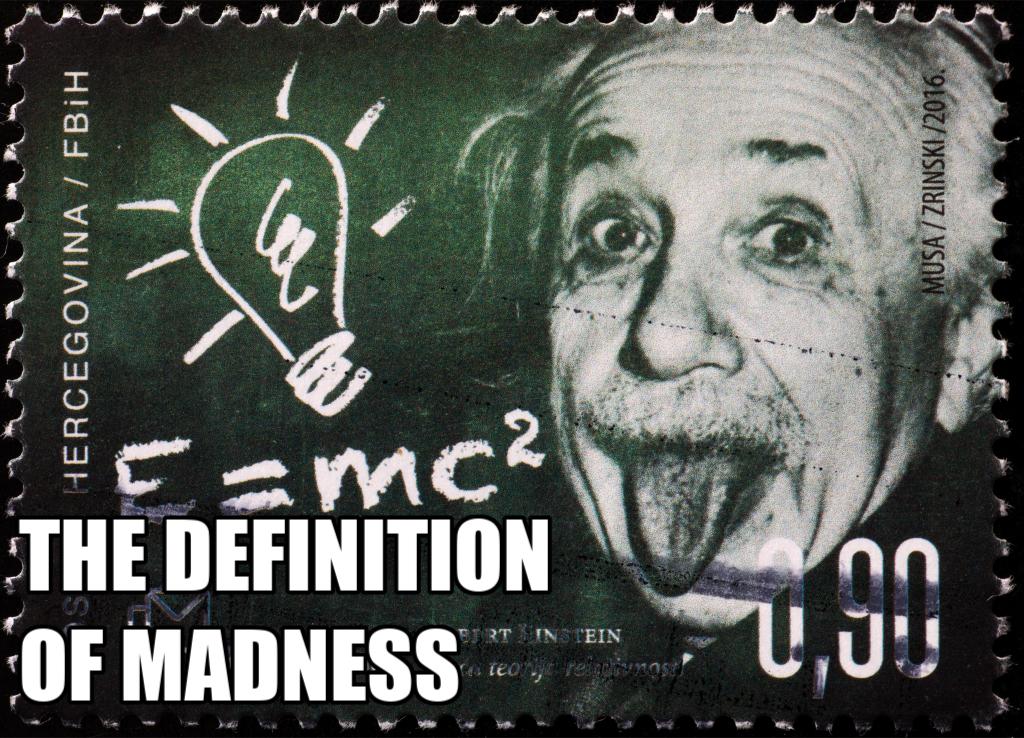
There’s a famous quote often attributed to Albert Einstein, although he probably never said it: “Madness is doing the same thing over and over again – and expecting different results.”
The reason this quote is so popular, whether or not Einstein said it, is because it captures something deeply human, and deeply familiar. We all know what it looks like when people and institutions – intelligent people, established institutions – keep repeating a failing strategy, convinced that if they just hold out long enough, reality will eventually cooperate. Like gamblers at a roulette table, they think that one more spin of the wheel, and they will win everything back. Of course, it never happens.
One of the clearest modern examples of this is Kodak. For most of the twentieth century, Kodak didn’t just dominate photography — it defined photography. You remember the mantra, “Kodak moments”? Everyone remembers it. Kodak *was* photography.
Kodak engineers were among the best in the world. Their brand was synonymous with quality. Their market share was overwhelming. And I bet you didn’t know that Kodak was the company that actually invented the digital camera in the 1970s. They saw the future coming long before anyone else did.
But they refused to embrace a new way. They refused to go in a new direction. Digital photography threatened everything Kodak already was — it threatened film, it threatened hard copy photographs, it threatened film development facilities. Basically, it threatened an entire ecosystem that was built around the old model.
And so, instead of pivoting, Kodak held back. They experimented at the margins while continuing to invest heavily in a business that was visibly declining. The writing was on the wall, but they didn’t read the writing.
Year after year, revenues dropped, competitors surged ahead, and the share price slid ever lower. Inside Kodak, there were warnings, there were memos, there were reports, there were projections — and all of them were pointing in the same direction.
But Kodak kept doing what it had always done, hoping the world would slow down, or reverse course, or rediscover its love for film. It never did, and in 2012, Kodak filed for bankruptcy — not because it lacked intelligence or knowledge, but because it somehow was unable to let go of what had once made it great.
Now contrast that with a company we all know called Netflix. Netflix began as a DVD-by-mail company. That model worked remarkably well, and for a while it seemed there was no reason to change it.
But the leadership at Netflix saw what was coming. Initially, streaming was clunky, it was expensive, it was unreliable — but it clearly was the future. So Netflix did something profoundly counterintuitive: they undermined their own successful business before someone else could do it for them.
The transition was painful. Customers complained. The share price dropped. Critics and experts declared that the company had lost its way. But Netflix persisted, refined its business model, and eventually, they rewrote the entire entertainment industry.
So there you have it. Two companies. Two sets of leaders. Two radically different responses to the same challenge. And that contrast takes us straight into Parshat Bo.
The Torah describes Pharaoh again and again that “Pharaoh’s heart was hard.” Pharaoh’s heart, his personality, wasn’t hard in the sense of it being sharp or aggressive. It was weighed down. It was immobile. It was burdened. It just wasn’t nimble or agile.
Pharaoh wasn’t ignorant. By this point, ignorance was not an option. He had experienced plague after plague. He had heard Moshe’s warnings. He had watched Egypt unravel in real time. If Pharaoh were a modern executive, no one would accuse him of lacking data.
Pharaoh’s problem was something else entirely. His heart was too static to change. Every decision he had already made pressed down on him. Every previous refusal made the next reversal more humiliating. Every step he failed to take narrowed his ability to move at all. And so, he did what people in that position so often do: he confused stubbornness with strength.
Egypt, as a civilization, is portrayed in the Torah as rigid and inflexible. It is hierarchical. It is obsessed with permanence. And it is convinced of its own inevitability. Egypt worships stability, power, and continuity — and it cannot tolerate disruption. Change, for Egypt, is not adaptation – it is a threat.
And that’s why why Pharaoh doubles down. Again and again. The same policies, even though they have not been working. The same posture, even though they are contorted and unhelpful. The same refusals, even though the previous refusals have resulted in disaster.
And all the time – expecting a different outcome. And that, the Torah is telling us, is not strength – it is madness.
Now look at the Jewish people. They are still slaves. They are still vulnerable. They are still uncertain about almost everything. And yet they are told to prepare to leave — not gradually, not carefully, but in haste. They are asked to abandon the familiar before they have anything stable to replace it.
And remarkably, they are ready. Not just ready, but eager. Even before the sea splits. Even before Sinai. Even before freedom is fully secured. God gives them Rosh Chodesh, a calendar. Time itself becomes renewable. Resettable. Forward-looking. And that’s the lesson. A people capable of redemption must first become a people capable of change.
At the center of all this stands Moshe. Moshe is the great innovator of the story. He is not like Pharaoh. He is not rigid. He is not trapped by ego. He adjusts, he recalibrates, he refines his approach as events unfold.
Sometimes he warns Pharaoh explicitly. Sometimes he allows consequences to speak for themselves. Sometimes he confronts. Sometimes he withdraws.
Moshe’s strength lies not in doing the same thing again and again. Moshe’s strength lies in his agility, his ability to duck-and-dive as events unfold.
Pharaoh, by contrast, cannot say the three hardest words any leader ever has to say: “I was wrong.” And so he stubbornly refuses to adjust, until he has ensured that any future in which disaster is averted is impossible.
If anything, this is the most enduring and most important lesson of Parshat Bo, and the whole Exodus story. Strength is not about digging in. Strength is not refusing to pivot. Real strength is knowing when holding on has become more dangerous than letting go. More of a liability than an asset.
Egypt believed permanence was power — and it collapsed in a single night.
The Jewish people, then and throughout our history, embraced movement, uncertainty, and change — and we became eternal.
The Torah is not telling us this story so that we can admire Moshe or shake our heads at Pharaoh. It is telling it to us because, in smaller and subtler ways, we all face moments like this. Moments when a habit, a mindset, or a way of doing things once served us well — but no longer does. Moments when the safest option feels like staying put, even though staying put is slowly pulling us under.
People often ask me why I moved to the United States from the UK, and I always give the same answer. In Britain, I heard two phrases far too often—sometimes even in the same breath: “It’s never been done this way before,” and “It’s never going to work.”
In America, when someone says, “It’s never been done this way before,” it’s usually followed by, “So let’s try it. Let’s make it happen.” And if it doesn’t work, that’s fine—“let’s try something else!” That openness to possibility, that refusal to be paralyzed by precedent or fear of failure, is an attitude I’ve come to cherish and deeply appreciate.
Parshat Bo reminds us that redemption does not come to those who cling hardest to the past, but to those who have the courage to loosen their grip on the past and adapt to the present. It asks us to cultivate hearts that are not stubborn, not weighed down by pride or fear, but light enough to move, to adjust, and to innovate when innovation is the solution.
Because in the end, the people who merit freedom are not the ones who never made mistakes — they are the ones who are brave enough to change course when it matters most.


(For the SoundCloud audio, scroll down) At the end of the nineteenth century, the United States Post Office employed a remarkable woman whose work required detective instinct, linguistic brilliance, an... Read More