

WHAT THE EXPERTS SAY
(For the SoundCloud audio, scroll down)
“Experts are often wrong — but rarely in doubt.” On the evening of October 15, 1987, Michael Fish went on BBC television to do what he had done reliably for years: give the weather forecast.
Before signing off, he added a few words of reassurance. Earlier that day, he told viewers, a woman had rung the BBC saying she had heard there was a hurricane on the way. “Well, if you’re watching,” Fish said with calm authority, “don’t worry, there isn’t.”
A few hours later, the Great Storm of 1987 tore through southern England with winds exceeding 120 miles an hour. Eighteen people were killed. Fifteen million trees were uprooted. Roofs disappeared, power lines collapsed, and entire landscapes were altered overnight.
It was the Jewish festival of Shemini Atzeret, marking the end of Sukkot, and hundreds of sukkahs were caught up in the chaos, blown down and destroyed.
In the town of Sevenoaks, Kent, six of the seven famous oak trees that gave the place its name were ripped out of the ground. The town, it should be noted, was not subsequently renamed Oneoak. Instead, with its identity so closely tied to multiple oaks, Sevenoaks replanted seven new ones—so that today, Sevenoaks actually has eight oak trees.
Michael Fish, it is also worth noting, kept his job.
The financial crash of 2008 followed a similar script. For years beforehand, economists, regulators, and financial institutions spoke confidently about risk being “priced in” and markets being fundamentally sound. Complex models reassured everyone that the system was stable, even resilient.
And then, almost overnight, it wasn’t. Banks collapsed, markets froze, pensions evaporated, and ordinary people paid a terrible price.
In the countless congressional hearings and post-mortems that followed, an uncomfortable truth emerged: the warning signs had been visible for some time. Housing prices had become detached from reality. Subprime mortgages were being packaged into investment products that were anything but safe. Leverage was out of control, and incentives rewarded recklessness rather than restraint.
But the prevailing assumptions were so entrenched that few within the system were willing—or able—to see where the patterns were leading.
Closer to home, and far more devastating, was October 7th. Israel’s intelligence agencies and the IDF are widely regarded as among the most sophisticated military and intelligence establishments in the world, staffed by brilliant analysts with unparalleled access to data, surveillance, and human intelligence.
And yet, the attack—which resulted in wholesale slaughter, rape, destruction, and kidnappings—came as a profound shock.
In the weeks and months that followed, it emerged that Hamas’s preparations had not been invisible. There were signals: training exercises, intercepted communications, and anomalies that, in retrospect, now seem glaring.
But they were filtered through assumptions about deterrence, capability, and intent—assumptions that dulled their significance. The unthinkable was discounted precisely because it was unthinkable.
What links all these failures—and many others throughout history where experts were caught out—is not a lack of information, talent, or effort. In each case, the data existed, the signs were there, and the patterns were discernible.
What was missing was not expertise, but the ability to step back from the details, challenge prevailing assumptions, and recognize what the information was really pointing toward. The experts were using familiar methods to analyze the evidence, but no one was assembling the full picture.
And this is precisely the failure that lies at the heart of the opening section of Parshat Miketz. Pharaoh is disturbed by two vivid dreams and acts as any leader facing uncertainty would: he calls on his ancient think tank of experts.
Egypt’s seasoned magicians and dream interpreters are brought before him, a group akin to today’s specialized advisory committees, with a long track record of success, grounded in a deep familiarity with the symbolic language of dreams. According to the Midrash, they do not sit in baffled silence but offer interpretations that are clever, confident, and internally coherent. And yet, for all their sophistication, they fail to satisfy Pharaoh.
Pharaoh’s dreams themselves are not especially obscure. In the first, he sees seven healthy, well-fed cows emerge from the Nile, only to be swallowed whole by seven gaunt, famished cows that remain just as emaciated after consuming them. In the second, seven full, robust ears of grain are consumed by seven thin, scorched ears—and once again, the weaker do not benefit from swallowing the stronger.
The imagery is unsettling but not incomprehensible, and the parallels between the two dreams are obvious. The experts in Pharaoh’s court duly get to work, analyzing the symbols and offering a range of plausible explanations. But for all their ingenuity and proficiency, they fail to grasp what Pharaoh senses instinctively: these dreams are not puzzles to be decoded, but warnings demanding a response.
So who will decode the dreams? At that moment, Pharaoh’s chief butler remembers that his own dream—and that of the royal baker—had been interpreted some two years earlier by a young Hebrew slave when they were all together in prison. “Get Joseph,” he tells Pharaoh.
Joseph is hastily summoned, shaved, and brought before the king. But why would Joseph have an edge over the experts? What was his secret? The Torah never spells it out explicitly, but the answer is not difficult to discern.
Joseph succeeds where the experts fail because he approaches the dreams in an entirely different way. The magicians of Egypt focus on the imagery, on what each cow or ear of grain might symbolize.
Joseph steps back and looks for structure. He notices that the dream is repeated, which tells him it is certain. He sees the symmetry of seven followed by seven, and abundance followed by collapse. Most importantly, he recognizes urgency.
This is not so much dream interpretation as it is pattern recognition. And clearly Joseph is not interested in impressing Pharaoh with his brilliance; he is far more interested in preparing Egypt for what is about to come.
A striking insight offered by the Izhbitzer Rebbe, Rav Mordechai Yosef Leiner, sharpens this point even further. Repetition, he explains, signals that events have already moved from possibility to determination. When something appears just once, it remains fluid, subject to change and human choice. But when it happens twice, the process is already in motion.
That is why Joseph tells Pharaoh that the matter has been firmly decided by God and is imminent. The dreams are not symbolic riddles; they are revelations of a reality already unfolding. Egypt no longer has the luxury of asking what the dreams mean. The only meaningful question left is how to respond.
So many modern experts, for all their intelligence and sophistication, end up resembling the soothsayers of ancient Egypt more than Joseph. They are not foolish, and they are not careless. But they are trained to work within established frameworks, to refine existing models, and to interpret data in ways that confirm prevailing assumptions. When reality begins to shift, those habits become liabilities.
Joseph represents a different kind of wisdom. He is willing to question the framework itself, to notice when repetition signals momentum, and to understand that clarity imposes responsibility. The challenge Miketz leaves us with is not whether we respect expertise, but whether we are prepared to move beyond it—to step back, see the pattern, and act before the storm is already upon us.

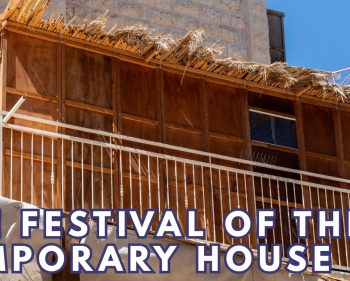
THE FESTIVAL OF THE TEMPORARY HOUSE
(For the SoundCloud audio, scroll down) Sukkot begins with a flimsy hut and ends with dancing around a Torah scroll. In between come the four species, Kohelet, Hoshana Rabba, Shemini... Read More