

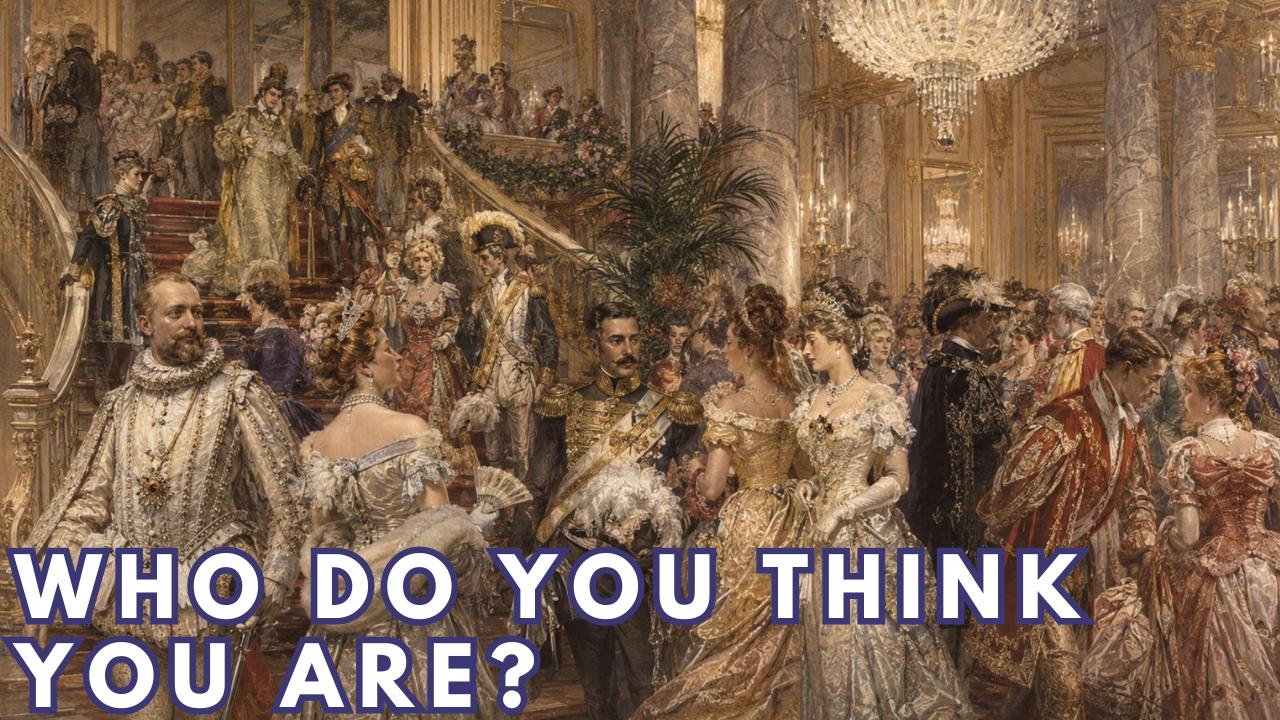
In early 1897, 800 of New York’s wealthiest citizens received the summons of the season: Bradley and Cornelia Martin were throwing a costume ball at the Waldorf Hotel, and guests were asked to come dressed as European royalty and aristocracy of centuries past.
The guests took their assignment with a seriousness bordering on the devotional. Antique dealers across Manhattan were stripped bare of old lace and jewels as America’s newest money scrambled to look like Europe’s oldest.
Cornelia herself appeared as Mary, Queen of Scots, draped in pearls worth more than $60,000 in 1897 money. Her husband came as Louis XV. One man wore a full suit of gold armor. There were at least three Catherine the Greats, eight Madame de Manintenons, and ten Madame de Pompadours.
The evening cost almost $400,000, more than $13 million in today’s money, even as the country limped through a brutal recession.
The Reverend William Rainsford, rector of St. George's Church in New York’s fashionable Gramercy Park neighborhood, publicly scolded his wealthy parishioners for spending fortunes on fancy dress while their fellow citizens went hungry.
But what fascinates me most about the Bradley-Martin Ball is not the money spent on costumes, nor the ostentatiousness of the party – it is the costumes themselves. Here were the most successful people in a republic founded on the rejection of hereditary aristocracy — and on the one evening in which they could be anyone at all, they chose to be somebody else’s ancestors.
Bankers became kings. Railroad men became dukes. Industrialists became earls. Not one of them came dressed as his own grandfather.
And that is the whole story. The grandfathers were the problem — peddlers and shopkeepers, men who crossed oceans in steerage, spoke with accents, and smelled of physical labor. The one thing new money cannot buy is old money, so they rented someone else’s past for the evening. It was ancestry as wishful thinking.
Which brings me to the opening of Parshat Ki Tavo — where the Torah stages its own celebration of success, and hands its successful man a script running in precisely the opposite direction.
Picture a Jewish farmer who has finally made it. He owns land in Eretz Yisrael. He spots the first fig ripening, the first cluster of grapes, and ties a ribbon around it: bikkurim. In due course he carries those first fruits up to Jerusalem.
And it was no modest errand. The Mishnah describes a royal progress: entire communities travelling together, an ox with gold-sheathed horns and an olive wreath leading the way, musicians playing, the dignitaries of Jerusalem coming out in greeting, the wealthy bearing fruits in baskets of silver and gold.
It was every bit as theatrical as anything the Waldorf ever staged. Judaism, as it turns out, has no objection to a spectacular party.
But there was a major difference. Because at the precise moment the farmer stood in the Temple courtyard, basket in hand, the Torah tells him exactly what to say. He begins as any man of substance would (Deut 26:3): הִגַּדְתִּי הַיּוֹם לַה׳ אֱלֹקֶיךָ כִּי בָאתִי אֶל הָאָרֶץ – “I declare today before God that I have come to the land.” I have arrived. So far, so Bradley-Martin.
But he is not permitted to stop there. The very next words must be: “My father was a wandering Aramean.” And then he must recite the whole unvarnished saga: we went down to Egypt with nothing, we became slaves, we cried out, God rescued us and brought us here. Only then may he conclude: “And now, behold, I have brought the first fruit of the land that You, God, have given me.”
The Torah waits until a man becomes successful — and then makes him recite his full family history. Not the flattering version, with dukes and imaginary coats of arms. The embarrassing version. My ancestors were wanderers, migrants, and slaves. Everything in this magnificent basket exists only because somebody before me endured a life I can scarcely imagine.
At the Waldorf, the successful dressed up as aristocrats. But in Jerusalem, the successful were required — by law, in a fixed formula, with no room for creative editing — to dress up as their grandfathers. And here is what the Bradley-Martins and their guests never understood: the Torah’s version is far more beautiful.
There is nothing lovely about borrowed grandeur; Cornelia’s pearls were genuine, but everything they were trying to say was false. All that money, and not one of them could afford to be themselves. Meanwhile, the farmer’s declaration turns a basket of figs into the final chapter of an epic — wandering, slavery, exodus, desert, land, all leading to this fruit, in these hands.
His grandeur is not rented; it is inherited, and inherited from people who had nothing — the only inheritance that appreciates in value. The distance between the wanderer and the landowner is not the skeleton in the family closet. It is the family treasure.
Success has a peculiar way of editing memory. Comfort begins to feel normal. The years of help from others, luck, sacrifice, and providence quietly vanish from the autobiography. Given long enough, every plutocrat “discovers” they are royalty.
But the Torah will not allow it. Pride says look what I have achieved; gratitude says look how far I have come. The first requires a costume. The second requires only the truth — and the truth, told properly, is the better story.
Which is why the passage ends unexpectedly: וְשָׂמַחְתָּ בְכָל הַטּוֹב... אַתָּה וְהַלֵּוִי וְהַגֵּר אֲשֶׁר בְּקִרְבֶּךָ – “You shall rejoice in all the good — you, the Levite, and the stranger among you.” Why the stranger? Because someone who has just declared that his own father was a homeless wanderer cannot look at the immigrant beside his field and see an inconvenience. He must see his grandfather.
The man dressed as Louis XV owes the stranger nothing — kings never do. The man dressed as the truth owes him everything.
This message endures today more than ever. Jews today enjoy prosperity our ancestors could scarcely have dreamed of. Grandchildren of immigrants with cardboard suitcases who own homes their grandparents would have assumed belonged to the local duke. Children of refugees from Morocco, Germany, Iraq, Poland, Iran, and Russia who run companies, command battalions, and influence markets.
It’s magnificent — and nobody should apologize for it. But prosperity carries the Waldorf temptation: to let our children believe Jewish life arrived fully furnished.
That’s a mistake. Tell your children the real stories — the shop that stayed shut on Shabbat, the young lad who crossed an ocean alone, the grandfather who learned English at night, the relatives who did not make it out. Do not launder the accents out of the family history; the accents are the history.
The Bradley-Martin ball ended before dawn, and Louis XV went back to being plain Bradley Martin — who shortly thereafter decamped to Britain, where the aristocracy, at least, was genuine. Having failed to become nobility for an evening, he settled for living near it.
The farmer in ancient Israel went home too — carrying what the Bradley-Martins spent so much money failing to acquire: a past he did not have to invent, and was not ashamed to recite out loud. Because the question is never who can I pretend to be? — but: do you still remember where you came from?
And if you can stand tall, amid all your success, and say, without flinching, my father was a wandering Aramean, you will discover you never needed any kind of fancy costume. The wanderer was the aristocrat all along.